Ferrero Built a Candy Empire by Turning Products Into Rituals


Shaan Puri argues that Ferrero built a major consumer business not by making radically better chocolate, but by turning ordinary products into rituals: Nutella became a breakfast habit, Tic Tac an invitation to share, and Ferrero Rocher a small gift. He presents its continuity across generations as a series of different tasks—finding a viable spread, creating consumer rituals, then expanding through acquisitions—while the family’s privacy and early exposure to the business helped protect the craft behind its brands.
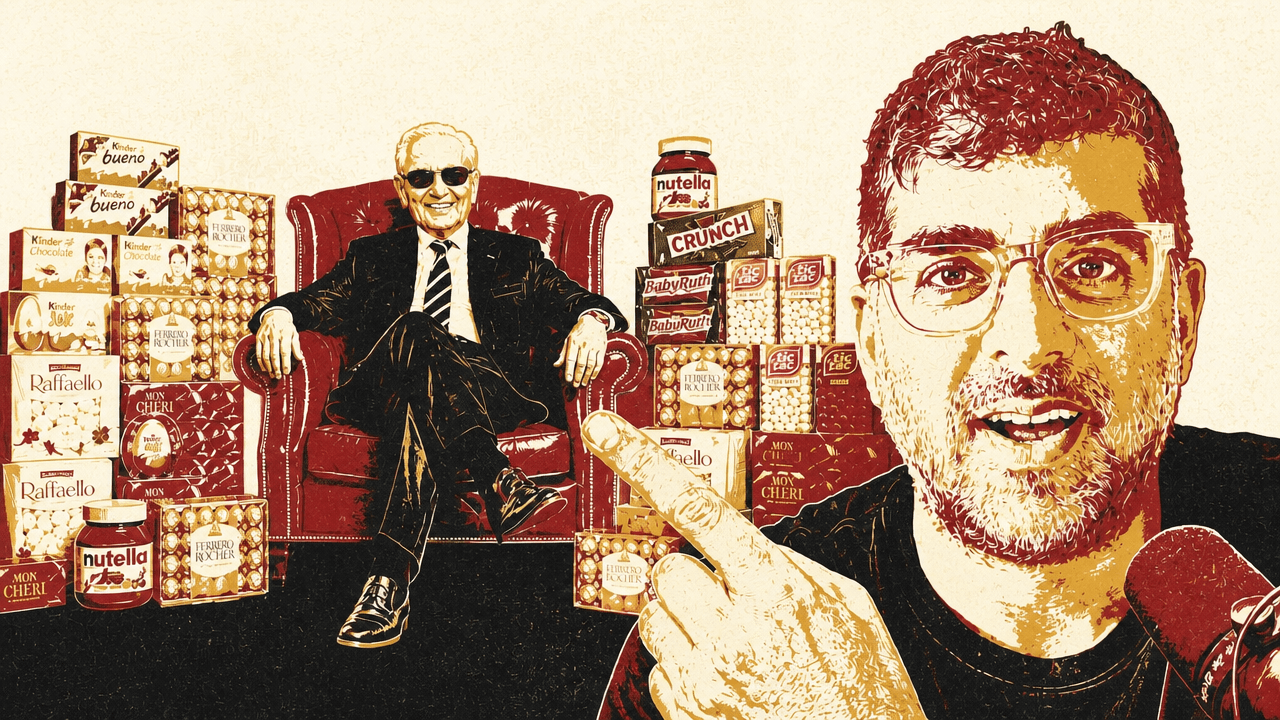
Ferrero’s advantage was to turn ordinary products into rituals
Shaan Puri describes Ferrero as a family company that built extraordinary scale by changing what familiar products meant to consumers. The company’s brands—Nutella, Tic Tac, Kinder products, Ferrero Rocher, and later acquired candy brands—are not presented as technical breakthroughs in food. Their edge, in Puri’s account, is a repeated ability to make inexpensive, everyday consumption feel distinctive: more giftable, more polished, more social, or more special.


Puri puts Ferrero’s annual revenue at roughly $20 billion and says the family’s current heir runs the company and is Italy’s richest man, with wealth of about $32 billion. But the business began in postwar Italy, when chocolate was expensive enough to be treated as a luxury. The founding generation tried to make it accessible as something people could put on toast.
Its first format was wrong. The company made a hard, butter-like chocolate bar intended for spreading, but customers complained that it was too difficult to use. The response was not to abandon the basic use case. It was to change the form: a creamy chocolate spread in a jar, called Supercrema, which Puri describes as Nutella’s predecessor.
The next generation improved the recipe, renamed it Nutella after the use of “crema” was barred in the product name, and extended the same logic into new categories. The products were not simply designed to work; they were designed to change the experience around them.
Ferrero Rocher is the clearest example. The chocolate is individually wrapped in gold foil and presented as a discrete object rather than as part of an undifferentiated candy bag. One image carries the line “Give FERRERO ROCHER (grudgingly).” The joke depends on the packaging creating a minor social obligation. The product looks like something meant to be offered, not casually consumed.
Puri’s broader point is that a company can compete without improving the core technical specification that a category normally emphasizes. A chocolate does not need to be radically different chocolate. A hand sanitizer does not need to kill germs faster. It can instead make the buyer feel that the product is cleaner, more luxurious, less embarrassing, or better suited to a social setting.
He compares Ferrero’s approach to Touchland, the hand-sanitizer company whose brightly colored bottles and scents repositioned a utilitarian product as an accessory. Touchland did not win by centering a claim about germ-killing speed, Puri says. It offered an alternative to the generic, medicinal experience of conventional sanitizer, including the lingering smell of ethanol.
Ferrero’s major products similarly make a category feel unlike its default version. Nutella turns a chocolate spread into a breakfast habit. Ferrero Rocher turns a confection into a small gift. Tic Tac turns a breath mint into a social gesture.
Tic Tac was small talk for the mouth.
The Tic Tac format solved mundane practical problems. Puri describes earlier breath mints as large tins that were inconvenient to carry, difficult to open, and awkward to share. Tic Tac came in a small box that was easy to transport and dispense from. Yet the functional improvement was only part of the design.
Its advertising made the intended behavior explicit: a person dispenses a Tic Tac into another person’s open hand; office workers and a couple on a couch react to the pack. The exchange matters more than the mint’s flavor or ingredients. Puri notes that campaigns often used a question mark—“Tic Tac?”—as if the product itself were an invitation. A mint could open a conversation, offer a moment of flirtation, or give someone a reason to approach another person.
The old ads are like pretty awesome. A lot of the ads would have a question mark which you would not normally do. You wouldn’t say Tic Tac question mark but the whole thing is basically it’s an offer to somebody else.
Sam Parr connects this kind of design to San Pellegrino’s foil seal, which Rory Sutherland had previously discussed with them. The seal is a small detail, but Parr’s retelling of Sutherland’s point is that it suggests cleanliness, protection, and special handling. The foil need not carry much intrinsic utility to shape the buyer’s inference that the can is somehow more premium than another drink.


Ferrero’s model, as Puri frames it, challenges businesses that try to outperform competitors only on the category’s obvious dimension. A product may not need to be more efficient, stronger, or cheaper. It may need a better ritual around use.
Each generation inherited a different problem to solve
Ferrero’s products are only one part of the story Puri finds compelling. The company is also an example of what happens when a family business survives long enough to face different strategic problems in different generations.
Shaan Puri describes the founding generation as the pioneer stage: it found the initial product opportunity but had not yet built the finished enterprise. The second generation made the defining product innovations—improving the chocolate spread into Nutella, developing Tic Tac, and building other brands including Kinder chocolate and Kinder eggs. The third generation adopted a different strategy. Rather than relying solely on the low-probability process of inventing another major consumer hit, it began acquiring established brands.
Puri characterizes that shift as Warren Buffett-like. Creating a major new product is difficult, costly, and uncertain; buying a known brand with recognizable consumer appeal can be a more dependable route to expansion if the owner can revive and maintain it.
Puri says Ferrero acquired brands including Butterfinger, Baby Ruth, and Crunch. He calls the resulting strategy “beautiful private equity”: a family owner using acquisitions to extend a consumer portfolio built over decades.
| Generation in Puri’s account | Primary task | Examples cited |
|---|---|---|
| Founding generation | Find a viable chocolate-spread format | Hard spreadable bar; Supercrema |
| Second generation | Improve products and create new consumer rituals | Nutella; Tic Tac; Kinder products |
| Third generation | Expand through acquisitions | Butterfinger; Baby Ruth; Crunch |
The strategy sits alongside a second element of Ferrero’s identity: secrecy. Puri describes the company as one of the world’s most secretive family-owned businesses. Until relatively recently, he says, it had not given interviews or allowed outsiders into its factories.
Photographs of Michele Ferrero repeatedly show him in dark sunglasses: alone in a suit, smoking between other suited men, and standing with family or associates in formal dress. Puri says the older generation did not want to be seen or known. The sunglasses were part of a broader insistence on privacy.
Puri treats secrecy as protection for recipes and production know-how. Ferrero built its own production equipment, in his telling, and did not want outsiders to understand either the machinery or the formulas behind products such as Nutella. One journalist who entered the factory reportedly compared it not to Willy Wonka but to Area 51, with armed guards and tightly controlled access.
The contrast is sharp. The products are highly expressive: gold foil, playful names, child-oriented packaging, invitations to share. The family behind them remained deliberately private. Ferrero’s consumer promise is theatrical, while its owners are not.
The harder challenge for a dynasty is not merely building a valuable company. It is passing one on without destroying the conditions that made it valuable. Puri says a business that survives generations has to perform “several miracles,” among them finding successors who do not simply inherit assets but can extend the work.
He recalls an anecdote about a Ferrero heir who reportedly did not realize the family was wealthy until around age 15. Puri jokes that the household staff might have made that difficult to miss, but he finds the stated ethos meaningful: time in the factory and attention to the product were supposedly more central to the upbringing than displays of the family fortune.
Sam Parr is drawn to the family dynamics behind that outcome. Public stories about wealthy families tend toward conflict because betrayal, competition, and incompetence make more entertaining drama. Parr suspects that a family can also be harmonious, loving, and capable in business, even if that produces fewer compelling television plots.
He offers the Rothschild family as an example from his own reading: a father in German banking who sent five sons to different countries to practice the trade he had taught them. Parr’s impression is not of a succession mechanism based solely on legal structure or inheritance. It is of children being taught a craft and given responsibility inside it.
The inheritance of a craft begins with exposure
The succession question leads Puri and Parr to a broader question: how does someone become capable enough to inherit, extend, or build a demanding body of work?
Shaan Puri calls the relevant period a “golden window,” borrowing an idea he attributes to investor Mohnish Pabrai. Pabrai told Puri that a person’s core nature may be substantially formed by age six or seven, and that the years from roughly six to 16 can allow unusual specialization if a child finds something they can obsess over and is free to pursue it.
Pabrai applies the idea aggressively to investing. Puri recounts that Pabrai looks for childhood signs of entrepreneurship in founders, such as running a lemonade stand. Puri does not fully endorse the claim. Sam Parr adds that people do not need early immersion to become very successful. Their narrower shared view is that early, sustained contact with an interest may help explain some cases of world-class performance.
Puri cites Warren Buffett’s early attention to businesses and stocks, MrBeast’s childhood commitment to becoming a YouTuber, and Bill Gates and Paul Allen’s unusual access to computers at school. He also mentions his former co-founder Furqan, whose father worked at a computer company and whose early memories included building a printer from scratch.
Someone who encounters an activity early, returns to it repeatedly, and has the freedom to get better at it accumulates time before adult obligations take over. Puri imagines responding strongly when his own children show a genuine interest, perhaps even taking a sabbatical year during late elementary school to give them different experiences while, as he puts it, “the dough is raw.”
But he later clarifies that he is not proposing that parents select an ambition and force children through a punishing regimen. The problem, in his view, is often earlier: children do not get a chance to encounter enough possible interests to know what has real pull.
I think most people don’t do is they don’t really get to walk around Costco and sample the things.
The metaphor is Puri’s critique of the default educational track. School gives children a standardized schedule of subjects, then directs them toward college and employment. By the time someone has enough independence to explore what they might like, earning a living may have made exploration harder. A person may never find out whether they have a deep affinity for podcasting, baking, manufacturing, design, or something else not readily available on the prescribed path.
Parr and Puri see a practical version of this in their friend Ramone Van Meer’s relationship with his son Victor. Van Meer became a single father when Victor was very young. Parr says he began bringing Victor to significant business meetings at around age seven. When Van Meer sold a company for close to $10 million, Victor sat quietly in meetings connected to the transaction. Afterwards, his father asked what Victor thought the company should do.
Van Meer also brought his son to China to visit manufacturers for his current business. The child was not presented as a precocious executive. He observed, then was asked questions afterward: Did a supplier seem legitimate? What choice would he make?
Puri’s point is that a child does not need to produce a sophisticated lesson on demand for the experience to matter. The learning may be invisible in the moment. It is “soaking somewhere”: exposure to negotiation, judgment, risk, trust, and adult responsibility builds a body of reference that classroom instruction may not supply.
That is distinct from the harsh-parent examples Parr raises, including Andre Agassi, Serena Williams, Rafael Nadal, and runner Sebastian Coe. Parr sees a recurring pattern in parents who pushed children intensely toward excellence. Puri emphasizes a parent’s responsibility to broaden the menu before a child chooses. Both accounts treat early experience as consequential; they differ over whether the parent’s central job is training, pressure, or exposure.
Curiosity is a way of taking people and problems seriously
Sam Parr describes meeting an unnamed founder of what he calls one of the world’s leading financial-services businesses. The person was an extremely wealthy, technically sophisticated figure who remained low-key at a dinner where Parr expected more obvious displays of status.
The founder asked Parr about his own small AI project, a Chrome plug-in intended to help shoppers select jeans by fit. Parr then asked how the founder’s company used AI. The explanation was necessarily vague, but Parr says the firm had been working with data centers and related systems before the current technology boom, using them to support trading and financial decisions at timescales Parr did not fully understand.
What stayed with him was not the technical explanation. Asked why the company was good, the founder gave an understated answer: it had a good culture, paid well, and had a nice office. Parr later found that the company’s compensation was among the highest in the world. He came away struck that someone operating at such an exceptional level had spent real attention on his comparatively trivial project.
Shaan Puri calls the quality genuine curiosity. “Make people feel important” can sound manipulative if the goal is influence, he argues. Curiosity means actually taking an interest in someone else. That makes the other person feel interesting because, in the moment, they are being treated as interesting.
Puri extends the idea beyond sociability. When he feels bad about something, he says, his coach does not tell him simply to feel better. He asks questions instead: What is the feeling? Why is it happening? Has it happened before? The inquiry can move the mind out of guilt, shame, or self-loathing and into a more exploratory state.
Parr offers a practical version of the same approach. He describes himself as an awkward teenager who had to learn how to make small talk, including by reading books and studying questions people use to open conversations. The questions he finds most useful are not polished: “What are your hobbies?” and questions about people’s parents and what they think of the person’s life. Their directness gives people room to discuss what they care about.
The connection to the earlier discussion is less a business tactic than a standard of attention. Ferrero’s story interested Puri because it asks what lies behind a familiar object and why its details work. Parr’s dinner guest impressed him because he gave a similarly serious level of attention to another person.
Being great is different from achieving greatness
Ben Wilson, a former producer of the show and host of How to Take Over the World, learned six weeks earlier that he had stage-four lung cancer, Sam Parr says. Parr says it began as lung cancer and had spread to Wilson’s spine and brain. Wilson has four children under five.
Wilson gave Parr permission to discuss the diagnosis. In the weeks after learning of it, Parr says, Wilson moved his household and sold his home to live nearer to medical care, organized a roughly $400,000 fundraiser, handled his will and estate arrangements, and attended a succession of medical appointments. He was working with leading doctors and pursuing both traditional and experimental options.
Parr’s first reaction was anger as much as grief. Wilson is Mormon, Parr says, and had never smoked or drank. Parr felt that Wilson had lived responsibly and that an implied bargain with the universe—put good in, get good out—had been violated.
What changed the emotional meaning of the situation for Parr was Wilson’s response. Wilson carried a journal titled “zero to 365.” He intended to document every day for a year and hoped to fill it. He knew he might not. He hoped there might be a sequel his children could someday read; if not, he said he was prepared to meet his maker earlier than he wanted.
I’m seeing like a great man be great in real time and respond to like the worst thing on Earth in the most dignified wise and like the best way I’ve ever seen.
Parr’s conclusion is about ordinary conduct. Most people will not face a crisis of that scale, he says, but daily life still offers smaller occasions to react badly: distractions, irritations, disappointments, and problems that consume more attention than they deserve. He now sees those moments as practice for responding with greater steadiness, whether or not a larger test ever arrives.
Shaan Puri says Wilson’s reaction also made the value of faith visible to him in a new way. Puri does not describe himself as religious and says he has often found it difficult to believe without evidence. But Wilson’s ability to say he was excited to meet his maker, and to understand a devastating prognosis through faith, showed Puri a source of support he had not needed in his own comparatively fortunate circumstances.
The distinction Puri draws is between achieving greatness and being great. Wilson’s work has examined conquerors and world-shapers such as Napoleon and Caesar—people associated with power, scale, influence, and historical consequence. Wilson’s conduct represents something else: greatness as character, visible not in a résumé line but in how a person responds when the stakes are real.
Parr says Wilson was feeling better when they met and had gained access to doctors and connections through people including Bryan Johnson and Andrew Huberman. Both hosts say they are rooting for him. Parr’s broader clarification is that a rich life is not confined to money: the “million” in My First Million, he says, can mean a first unit of richness in whatever form makes life worth living.