Jeff Bezos’s Fast Judgment Made Amazon Strong—and Made Dissent Harder



Ethan Evans spent 15 years at Amazon, including time as a vice president. He says Jeff Bezos combined patience about long-term bets with urgency about daily progress, and that his sharp judgment made him formidable but not infallible. Evans describes Bezos pressing teams over failures and using customer complaints to demand answers, while relying on dependable operators to take difficult work to a solid result.
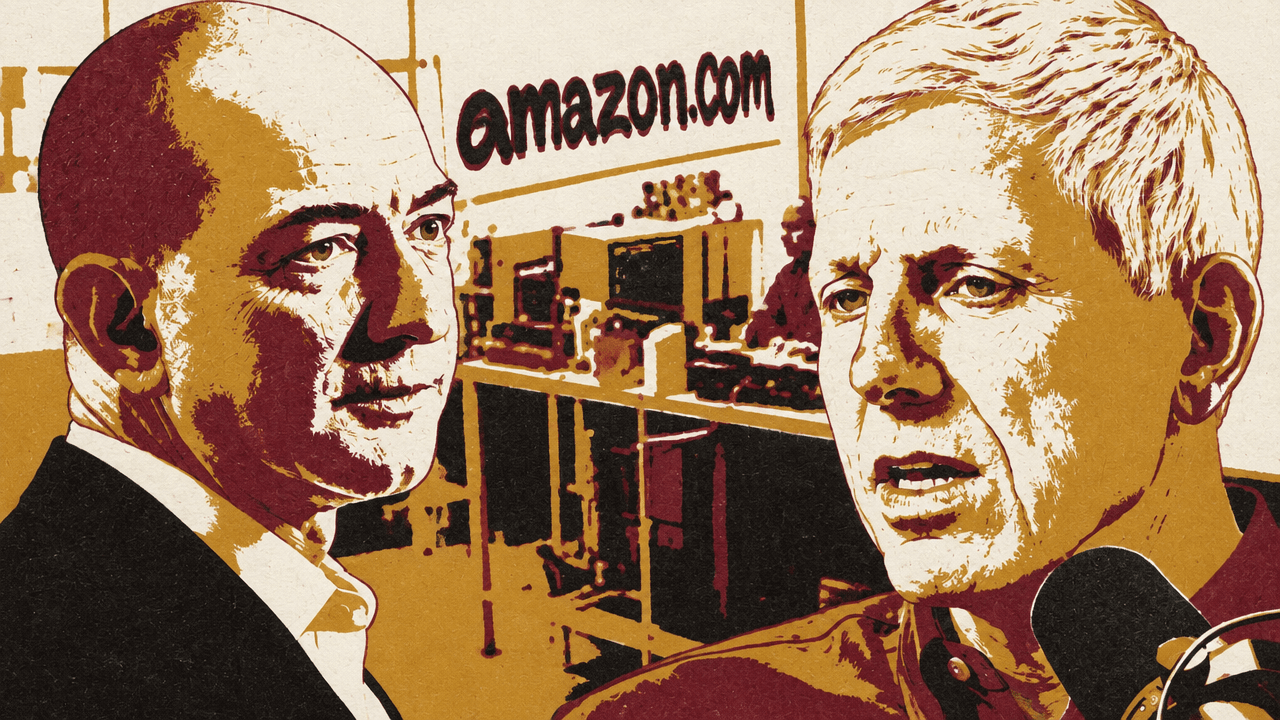
Bezos’s judgment made him formidable—and sometimes wrong
Ethan Evans spent 15 years at Amazon, including time as a vice president. When Amazon acquired Twitch, Shaan Puri says, Evans joined its executive team as the “adult in the room”—an Amazon representative assigned to the company. Some Twitch employees suspected he was a spy or a replacement waiting to take over from CEO Emmett Shear. That was never the plan, Evans says, but denying a conspiracy did little to dispel it.




The acquisition price was $970 million, just short of a billion. Evans says Amazon’s stock rose fivefold during the earn-out period, making the payouts unusually large for some Twitch employees. He remembers engineers whose market salaries elsewhere might have been $200,000 to $250,000 receiving stock that vested at a value of roughly $2 million a year. When that period ended, Amazon could not keep paying at that level. Many employees left—not necessarily because they disliked Twitch, but because they could not easily accept such a steep drop in compensation.
The acquisition also put Evans in a position to observe how Amazon’s leadership operated inside Twitch. His account of Jeff Bezos combines confidence in Bezos’s judgment with a warning about what repeated success can do to it.
Evans says Bezos often gave corrective feedback without praise. He might hear a proposal, identify what needed fixing and send the team back to work without acknowledging what it had done well. Evans recalls a meeting in which Bezos spent about an hour explaining what a team had missed. As he stood to leave, he turned back and added, “Oh yeah, but good job. You’re doing great.” Evans says it looked as though Bezos had remembered a coach’s instruction to praise people. He also says Bezos improved at giving recognition over time.
The criticism could be sharper. Evans recounts Bezos asking a team, “Is the A team for this project available? Because this is clearly the B team.” He describes “attack mode” as relentless pressure when something went wrong. Bezos was angry with the team, Evans says, but also with himself for having let the problem develop. The people in the room were caught up in that self-reproach.
One example involved an app that let customers photograph a price in a store and send it to Amazon. The company intended to learn about lower prices elsewhere. The Los Angeles Times article shown during Evans’s account described backlash against Amazon’s price-comparison app. Evans says the coverage portrayed the app as a way for Amazon to use customers to spy on small-town America and undercut local businesses. A public-relations employee sitting across from Bezos initially felt that his questions—how could the company have been so stupid?—were directed at her. She later realized, Evans says, that he was also directing the anger at himself.
That capacity to see a weakness quickly was part of what made Bezos effective. Sam Parr describes watching senior leaders review work prepared over weeks and put a finger on its key flaw or point of leverage within minutes. Evans says Bezos was one of the few people he had sat with and thought was plainly smarter than he was. But he attributes much of Bezos’s speed to pattern recognition built through repetition. Bezos reviewed three, four or five businesses a day, often reading about an area he did not know well and then turning the material into an insight. Evans estimates that Bezos spent 10,000 hours reviewing documents and giving feedback.


It was 10,000 hours of taking a business you don’t really know, reading about it for 20 minutes, and then having the ability to turn it into an insight.
Evans says Bezos generally had good taste, though he made mistakes. He points to the Fire Phone, which led to a $170 million charge for unsold hardware. Bezos had also fought for bets Evans considers right, including Kindle and Prime. The danger, Evans says, was that repeated success could persuade a leader that his vision was perfect. People around Bezos tried to tell him the Fire Phone was not a good product, but it was difficult to persuade someone whose earlier unpopular calls had worked.
Evans compares the problem to trying to tell a new father that his baby is ugly. Bezos had backed products others doubted, and some of those products succeeded. When people around him again said a product would not work, it was hard to know whether they were seeing a failure he could not—or repeating doubts that had been wrong before. With the Fire Phone, Evans says, the critics were right.
Bezos’s impatience with spending could be just as direct. Evans remembers being in a meeting about investment in a program he thinks was Kindle. CFO Tom Szkutak was trying to restrain the spending, saying Amazon had only so much money in the bank. Bezos asked, “Tom, well how much is that, Tom? I might want to spend it.” Evans reads the exchange as a public rebuke: the CFO’s job was to report how much money the company had, while Bezos would decide what to do with it. The confrontation illustrates both the authority Bezos held and the limits placed on advice that challenged his appetite to invest.
Customer complaints made the operating system personal
Evans describes Bezos using anecdotes to keep decisions connected to customers’ experience. Bezos said that, between data and anecdotes, leaders should trust the anecdotes. Even a 99% success rate could leave millions of packages undelivered or delivered incorrectly at Amazon’s scale. A customer complaint was not just a negligible exception to a good aggregate number; it was evidence of what had happened to someone.
Bezos’s email was open to customers, Evans says, and Bezos read their messages. Eventually, a team helped select which ones he saw. When a complaint concerned a particular business area, Bezos might forward it to the responsible team with a single question mark. Employees called these “question mark emails.” The recipient had 24 hours to investigate and explain what had happened.
The on-screen recreation accompanying Evans’s account shows a customer asking where a movie download is after it failed and support could not explain why. Bezos’s message to the video team consists of one question mark. The answer needed to establish whether the incident was unusual or part of a broader problem. If it was a real problem, the team had to say whether a fix was in place or when one would be. Evans says the worst answer was that the problem was serious and would take a long time to solve.
Evans remembers a more pointed exchange from when he ran the Appstore. Bezos wrote, “Please tell me we’re not doing this.” The team had to reply that, in fact, it was. Bezos answered, “Just euthanize me.” The wording stuck with Evans, but the larger point was the routine: a customer complaint reached Bezos, the responsible team had to account for it, and the reply had to describe what would change. Evans says Bezos treated every customer as his customer, even when the issue came from a business he did not run directly.
That routine was one part of an operating system built around measurable results, speed and a high bar for execution. Shaan Puri connects another part of it—reliability—to a trust exercise at Twitch. Participants were asked to choose the most important element in a “trust equation”: intimacy, credibility or integrity. Most chose integrity. One executive chose credibility, explaining that when someone said “I got this,” he needed to know the work would actually be handled.
Evans says that is the kind of trust Bezos placed in dependable operators. He expected a good, if not exceptional, result and knew the person would take responsibility for the problem. In a large company, Evans says, one product might carry the revenue while a supporting product only needed to work well enough. A reliable leader who could take an effort from a D or an F to a B might be more useful than a high-variance leader trying to make it an A, especially if that leader might not succeed.
“Sometimes all you need is a B,” Evans says. Bezos trusted people who would take on a mess and keep working until it was under control. They might not become the company’s top leaders, Evans says, but they were moved to new problems and rewarded. Bezos could hand them a fire and trust them to stay with it until most of it was out.
The distinction matters because senior leaders cannot personally keep track of everything. Evans says that after leading hundreds of people, he understood the relief of handing off a problem and no longer carrying it in his head. A company may need bold bets, but it also needs people who can take on work that will never become a bold bet and bring it to a solid, dependable state.
That practical need sat alongside Amazon’s demanding expectations. Evans describes the company’s standard as working “long, hard, and smart”—two out of three did not count. Amazon’s 1997 shareholder letter put the expectation this way:
You can work long, hard, or smart, but at Amazon.com you can’t choose two out of three.
Evans says the language of “work-life harmony” could make long hours sound compatible with a good life: if people enjoyed their work, working a lot did not necessarily mean their lives were out of balance. But the expectation was still to keep producing. A good idea did not automatically mean the day was over; a team might be expected to find another one before going home.
Amazon could be a place, Evans says, where high performers went to feel bad about themselves because the bar rose after they met it. That intensity suited some people in some seasons of life. For others, especially those unwilling to give up time with their families, Amazon might not be the right place. Evans describes employees being told that some seasons might not suit the work, while also describing ways people could go home, put their children to bed and return to work later.
Long-term bets required daily urgency—and the discipline not to take every bet
Bezos’s approach to time, as Evans describes it, combined patience about the destination with impatience about daily progress. Important projects take years. Prime began with two-day delivery and developed through further improvements; large technical or infrastructure efforts can take longer still. A long horizon was necessary, but it was not permission to move slowly.
Evans says Bezos pushed teams to ask what more they could accomplish this quarter on a project that might take five years. Five years contains 20 quarters; if teams lose progress in any of them, reaching the goal becomes harder. Puri summarized the approach as having a ten-year view with a 24-hour clock. Evans agreed: a ten-year plan without daily urgency would not get you there.
Prime grew from earlier experiments in shipping, though Evans joined Amazon after it launched and says he has heard competing accounts of who first proposed the program. Principal engineer Charlie Ward has said he invented the idea; Bezos has also claimed it. Evans does not know whether they arrived at it independently.
The initial concept, Evans says, was a fast-shipping program, not a membership with perks. It was called Project 100 because Amazon had to work out how to announce and start it within 100 days. Bezos was anticipating a difficult quarter and wanted good news to share with investors. At the time, Evans says, Bezos was still associated with the dot-com bust rather than regarded as an inevitable business titan.
The wording mattered. The program promised two-day delivery, not two-day shipping. Evans says it initially relied heavily on FedEx for two-day shipping, while Bezos expected Amazon to improve how it fulfilled the delivery promise over time, including by using the postal service and its own trucks. The promise described what the customer would receive without specifying the shipping method.
Amazon had already been experimenting with free shipping. Evans recalls Bezos arguing with Jeff Wilke, who pointed out that shipping had a real cost. Bezos’s answer, Evans says, was that customers hated paying for it and Amazon had to find a way. The free-shipping threshold began at $100, then fell to $75, $50 and eventually $25. At the time, customers were buying books, music and DVDs. The lower threshold often prompted them to put two items in a box, making free shipping more workable than when a single item’s margin could not cover delivery. Prime built on that learning.
The willingness to make a long bet did not mean Bezos accepted every proposed expansion. Evans says Bezos was repeatedly pitched on entering finance, healthcare and travel. He declined some proposals because the markets were mature or heavily regulated, conditions Evans says Bezos generally disliked because regulation could slow Amazon down. Evans does not claim to know the full decision rule. He does say those considerations mattered.
That selectivity is distinct from simply having the resources to act when a good opportunity appears. Evans thinks Bezos would likely have been successful in other circumstances, but not necessarily as successful as he became. Bezos worked at D.E. Shaw, where he discussed the idea of an “everything store,” then left to pursue the opportunity presented by the growing internet. Ten years earlier, Evans suggests, Bezos might have been too settled to leave; ten years later, the opportunity might already have passed.
Evans encountered a smaller version of that contingency when he arrived at Amazon. His manager offered him a choice between leading a video product team and building a shared platform to ingest books, music and video. Evans chose video. Another person arrived the following week, apparently expecting that role, and was assigned the ingestion platform instead. Evans says their careers diverged, and he cannot know how much of the difference came from ability and how much from arriving first and taking the chair.
Puri extends the point to Bezos’s later decisions: he sees significance not only in the opportunities Bezos pursued but also in the ones he passed up. The speakers discuss Bezos’s return to ambitious work as a new opportunity opens in AI. Puri describes Bezos as pursuing a kind of “artificial general engineer”: an AI intended to help build things in the real world, rather than only perform knowledge work. He says he does not know whether that means robotics or planning tools. Evans says Bezos can now choose when to swing in a way most people cannot.
Puri’s point is that not swinging at lesser opportunities can preserve the capacity to act when a more consequential one appears. He invokes the idea that there are no called strikes in investing: the choice not to invest carries no penalty, but a good opportunity has to be recognized when it comes. Evans adds that he remembers many pitches to enter industries Bezos declined, including finance and travel, but does not know a complete formula for how Bezos decided.
Amazon optimized the purchase; customer choice did not settle the moral question
Amazon’s website followed the same practical logic as its shipping programs: measure what works for customers and the business, rather than assume good design means fashionable appearance. Evans says a system called Weblab allowed Amazon to run many A/B tests at once and assess their effects. Teams cared about whether a change improved sales, not whether the page looked current to a design trend. Amazon did make attempts to improve the site’s appearance, and some design leaders pushed for that, but appearance did not win by itself.
The more fundamental constraint was speed. When Amazon was growing, internet connections were slower, and the company believed that waiting for a page to load drove customers away. Teams were expected to add features without increasing load time. Evans describes the principle as “speed equals sales.” Amazon also tried to keep the buy box consistent, make the purchase button easy to find and present a clear offer through price, discounts and delivery timing.
Low prices mattered as much as the interface. Evans says Amazon’s focus on price helped during the 2007–08 recession: when customers became more concerned about money, more of them turned to online shopping. In his account, a page could succeed without fashionable design if it loaded quickly, made the purchase clear and offered a low price.
But making a purchase easy also raises the question of what the company is helping people buy. Parr describes ordering cheap plastic items that seem likely to be thrown away and asks whether Amazon ever considered whether that was a net positive. Evans says Bezos had environmental concerns, including through the climate initiative, but also believed in customer choice and free markets. As Evans understands it, Bezos’s answer would be that customers should be allowed to choose what they buy—and that if Amazon did not sell a product, Walmart or another competitor might.
Evans does not treat that answer as a resolution. He says he shares some of the concern about whether Amazon is always a positive force. He imagines Bezos arguing that people have always bought things others might consider foolish, and that Amazon simply offers a wider range. Evans jokes that the company could add a principle: “Amazon should sell the dumb shit fastest and cheapest.” The line captures the tension rather than settling it: a customer-choice philosophy can be consistent with making products more accessible, while leaving unanswered what responsibilities come with making the purchase easier.
Scale brought influence, but also distance from ordinary life
Evans describes Amazon’s security arrangements changing as Bezos became more prominent. Early in his tenure, a security guard sat at a desk, and reporters once slipped past him and walked into Bezos’s office. The company brought in a new security firm the next day and tightened access. Later, in a new building, Evans noticed a person working in what looked like a terrible cube beside an elevator, exposed to the traffic. He realized the person was a security guard with a panic button and a response team nearby.
The executive suite Evans last visited was still accessible by elevator. The newer arrangement around CEO Andy Jassy, he says, was far more restricted: there was an elevator that required permission and could be stopped, leaving a visitor unable to proceed without access. Evans describes that progression as a growing security wall around the company’s leaders.
There was a social version of the same separation. Bezos used to attend an Amazon picnic at a farm outside Seattle and play broomball, a rough game involving brooms and an exercise ball. People got hurt, Evans says, including a manager whose hand was broken. As Amazon grew, the picnic became an event for thousands in the company’s stadium, with food trucks. Evans doubts Bezos attended for much of the later period. His presence would likely have been unpleasant, he says, and only a small fraction of the crowd would have been able to talk with him. In Evans’s view, Bezos gradually gave up being a man of the people.
Evans also says executives can lose touch with ordinary customers as their circumstances change. Bezos’s practice of reading complaints directly offered one counterweight, though eventually he relied on a team to select messages. Evans says he has tried to notice his own changing circumstances too. Having gardeners, for example, means he no longer experiences mowing the lawn as many customers do. He remembers a colleague proposing that Amazon prioritize automating whole-home Sonos systems, an idea that struck him as evidence that the colleague’s picture of ordinary life had shifted.
The platform that came with Amazon was another consequence of scale. Evans says that as a senior executive, he could generally get a meeting with almost anyone because the Amazon name carried weight. That influence was real, and it is something he misses after leaving. But he prefers working for himself.
At Amazon, Evans’s target compensation in his final year was $900,000, and he says he generally earned a little over $1 million as the stock performed well. He expects to earn roughly $700,000 to $800,000 in the year he discusses, while working about 20 hours a week with substantial vacation, rather than 50 or 60 hours plus travel. He says his happiness increased, though he also found that his scale for happiness went beyond what he had imagined.
The tradeoff includes identity. Being introduced as a former Amazon vice president gives Evans an institutional standing he no longer has. He says that platform was valuable, even if he is happier without the job. His work now includes executive coaching and helping people think about what financial security is for, alongside charity work in Poland helping people displaced by the war in Ukraine.
Build the next career through practice, not just plans
Evans’s practical advice is to use something available in a current job as a place to practice for work a person might want to do later. While still at Amazon, he began streaming career advice on Twitch. He was not presenting himself as a gaming personality; he used the platform to answer questions, test his ideas and get more comfortable speaking on camera.
Amazon executives were not supposed to speak publicly without public-relations approval. Evans says he asked his leaders for permission and framed streaming as a way to learn the company’s product. He also said he did not want special privileges or a partner designation. When an Amazon HR executive later questioned the broadcasts, Evans explained that he had approval and was discussing career advice rather than Amazon’s business. The HR executive, Evans says, recognized that Evans had thought through the issue and understood he might eventually leave to coach full-time.
At first, the streams drew only a few dozen viewers. Some people mocked him for showing up as a former vice president to give advice. Evans says the repetitions taught him how to handle live questions. He now attributes his composure to having answered thousands of questions on camera. The value was not that the audience was large; it was that he got practice.
Puri illustrates the same idea with his account of Tony Robbins starting out by calling radio stations and offering demonstrations at a mall. Those early efforts were small and awkward, but they supplied practice and feedback. Evans says Twitch served that function for him. His advice is to look for an asset in the work one is already doing that can help build toward a future ambition. He does not suggest that everyone’s opportunity will look like streaming; finding the connection takes creativity.
That advice sits alongside Evans’s longer-term goal: helping people reach a point where they have both the money and confidence to do work they find meaningful. Many people postpone that ambition until they have saved enough or met other obligations, he says, without deciding when “someday” will arrive. A ten-year plan can make the goal more concrete. It need not be elaborate; Evans says it should be simple enough to fit on a sticky note and clear enough to guide what a person builds toward each year.
Evans credits Puri’s earlier discussion of ten-year plans with making him take his own plan more seriously. His version is to help people become financially secure and then use that security to do good in the world. The point, he says, is not only what one person can accomplish, but the people they leave better equipped to do more.
The same attention to the person matters in the way feedback is delivered. When Puri asked how he could be candid without leaving people feeling bad, Evans pointed to Leadership and Self-Deception, by the Arbinger Institute. A person giving feedback has to see the other person as a human being, not as a machine to fix. Care does not change the message, Evans says; it changes the tone and body language, making the intent to help more apparent.
For a coach, Evans adds, there is also a useful way to set expectations: tell a client directly that difficult news is part of what they are paying for. That does not replace care for the person, he says. It makes the purpose of blunt feedback clear before delivering it.
Evans’s own transition depended on both ideas: a long-range aim and repeated practice in the work he hoped to do. The Twitch streams did not immediately make him a coach, and the ten-year plan did not specify every step. Together, they let him start building the next career while he still had the platform and tools of the previous one.