Bounded Challenges and Novel Formats Turn Vague Desires Into Products


My First Million’s Shaan Puri, Sam Parr and producer Arie Desormeaux argue that businesses can create demand by turning a vague desire into a defined test, or by making a familiar product into a public spectacle. Puri’s proposed work “lock-in” camp would sell a short, deliberately demanding period of focus, while a building-sized claw machine and a roll-on butter dispenser seek attention by changing the ritual around ordinary goods.
A lock-in camp would make work feel like an event
Shaan Puri sees a missing category between ordinary work and vacation: a temporary, deliberately harsh setting for concentrated effort. His “reverse vacation” would ask people to step out of their routine for 48 hours, 72 hours, or a week—not to relax, but to commit to a goal.


The comic exaggeration is part of the appeal. The Lock-In Camp image shown on screen resembles a penitentiary crossed with an extreme fitness retreat: orange jumpsuits, cold plunges, metal trays of “slop rations,” pull-up bars, and messages including “Comfort Is the Enemy,” “No Relaxing. No Excuses,” and “Lock In or Leave.” Puri imagines a slightly less prison-like uniform—perhaps an Adidas tracksuit—but wants participants to feel that they have temporarily adopted a different identity. They are there on a mission, not living their normal life with a little extra discipline.
The source does not establish that uncomfortable conditions produce better work. Puri’s proposition is instead that people may want a visible, finite way to opt into seriousness. Fitness supplies plenty of formats for this: marathons, Ironman events, Hyrox, and other tests that turn a general intention to get fit into a date, a standard, and a story people tell others. Puri asks why work has no equivalent for someone who wants to “lock in” for a short, intense stretch.
But what about in work? Like, why is there only normal work with deadlines and whatnot, but there’s not like a place? There’s not like a way you can opt in and go be hardcore for 48 hours or 72 hours.
In Puri’s telling, the difficulty is partly what makes the experience marketable. He compares it to registering for an Ironman: people often tell friends they have signed up before they have done the training. A lock-in camp would create the same kind of status-bearing commitment. Participants could say they are going, endure a deliberately uncomfortable program, and leave with a “certificate of survival.” The product is not merely productive time; it is an ordeal with a beginning and an end.
Sam Parr accepts that there may be demand for such a structure. He points to a video about a man who spent 11 days walking in the mountains to break an iPhone addiction. He also describes APEX, an athletic competition that rolls seven events into a 1,000-point score across speed, power, strength, and endurance. Parr says he signed up for an APEX event and hired a trainer through the organization.

| Category | APEX event | Format |
|---|---|---|
| Speed | Fast Forty | Laser-timed 40-yard sprint |
| Power | The Toss | Overhead medicine-ball throw |
| Power | The Broad | Standing broad jump |
| Power | The Vert | Full-approach vertical jump |
| Strength | The Pull | Trap-bar deadlift, one-minute AMRAP |
| Strength | The Push | Bench press, AMRAP |
| Endurance | The Mile | Timed one-mile run |
Puri likes the idea of giving adults a comprehensive, social test of athleticism and says he would like to discuss a youth version with APEX’s founder. What matters to him is that the format converts an amorphous aspiration into a specific challenge that people can train for and compare themselves against.
Parr finds a more theatrical version of the same dynamic in a street-calisthenics competition. He describes a community of performers and athletes who stage events in a crowded circle around pull-up bars and workout space. Competitors make UFC-style walkouts, use nicknames, talk trash, draw crowds, accept bets, and compete through physical tasks rather than fighting.
The displayed “battle set” makes the contest concrete: 100 burpees, 50 muscle-ups, 75 dips, and 75 squats with a 65-pound dumbbell.
Parr describes the atmosphere as “a rap battle meets a UFC fight.” Puri compares it to Kimbo Slice’s backyard-fight videos, but with exertion rather than violence at the center. The names—Extra Money, Calisthenics the Prince, Spec Nasty—matter because they turn exercise into characters, stakes, and watchable competition.
The commercial question for a lock-in camp is whether the performance of intensity can become a repeatable reason to pay. Puri supplies the aesthetic and the motivational logic, but not a detailed operating model. APEX and the calisthenics battles suggest what the camp would need to provide: a defined challenge, an audience or peer group, measurable completion, and enough distinction from ordinary work to make attendance feel consequential.
A giant claw machine turns the prize into a public spectacle
Arie Desormeaux begins with what she calls a casino for children: a gacha-style claw-machine arcade. The venue she visited had roughly 150 machines in a compact, intensely colorful space, stocked with toys that children recognize and want. The games were not only standard claws; some asked players to cut a thread or knock a prize from an edge.
The important distinction, she says, is from a conventional arcade. At Chuck E. Cheese, children play games, earn tickets, and eventually trade tickets for prizes. In a claw arcade, the effort to win the prize is the game. Desormeaux noticed that customers were given shopping carts, which made the venue feel designed for accumulation rather than a single attempt.
She estimated that a play could average around $2, while many of the prizes that machines dispense frequently might cost very little. Her own children got a $10 budget each. It lasted about four and a half minutes.
Sam Parr describes a remote version of the same premise. His partner Joe helped fund Winner Winner, a business that installed real claw machines in a warehouse, placed cameras on them, and let users operate the machines through an app. Winners received physical prizes by mail. Parr says Winner Winner did not work out, but points to Clawee as a larger business in the category; he says the Financial Times reported roughly $30 million to $40 million in revenue and that the app had around 400,000 App Store reviews.
Puri wants to take the concept in the other direction. Rather than remove the need to visit a venue, he would make the venue itself difficult to ignore: a giant claw machine occupying a storefront that otherwise might sit empty. The concept image shown on screen places a building-sized claw above large prizes including a golf cart and baby grand piano, with signs that read “$10 a go,” “Real prizes, real size,” and “Same rigged odds, bigger stakes.”
Shaan Puri is explicit that this would not be an efficient retail format. The scale is meant to create an event. Someone attempting to lift a golf cart with an enormous claw is something passersby can watch, record, and bring friends to see. The machine would sell tries, not just merchandise.
That depends on a broader instinct Puri repeatedly returns to: conspicuous demand attracts more demand. He says that when he sees a line, he tends to assume the place is worth trying. He recounts a New York business owner who told him he had paid people to stand outside for the first two months; according to Puri, the business then developed a real line that continued for two years.
The giant claw’s commercial challenge is more demanding than the basic arcade’s. Desormeaux’s account implies one model: many inexpensive prizes, frequent repeat plays, and a relatively low price per attempt. Puri’s proposal shifts toward fewer, conspicuous prizes and a $10 attempt. The source does not work through the economics of stocking, maintaining, or operating a storefront-sized machine, nor does it address the rules governing such games. Its claim is narrower: if the machine is strange and large enough, the spectacle itself could create the foot traffic that a normal retail tenant lacks.
Puri’s restaurant idea, Mexican Benihana, follows the same logic. He treats Mexican food as the superior cuisine and hibachi as a proven social format: chefs prepare food in front of a group, the table becomes part of the kitchen, and the meal includes performance. His deliberately absurd additions include tableside fajitas, a guacamole cannon, a tequila squirter, mariachi entertainment, and a salsa “lazy river” circulating around the table.
The details are jokes, but the underlying move is serious enough: make the food service visibly happen in front of diners, then add elements that are easy to describe afterward. Benihana, Puri notes, already does an estimated $300 million to $500 million in annual revenue. He and Parr then discuss its founder, Rocky Aoki, as a model of someone whose appetite for stunts and side ventures matched the theatricality of the restaurant concept.
The giant claw and Mexican Benihana are not arguments that every product needs a gimmick. They are examples of a more limited proposition: when the product is inherently public, an exaggerated physical form can create attention before a customer has decided whether the underlying offering is good.
A changed form can reveal demand that a category has ignored
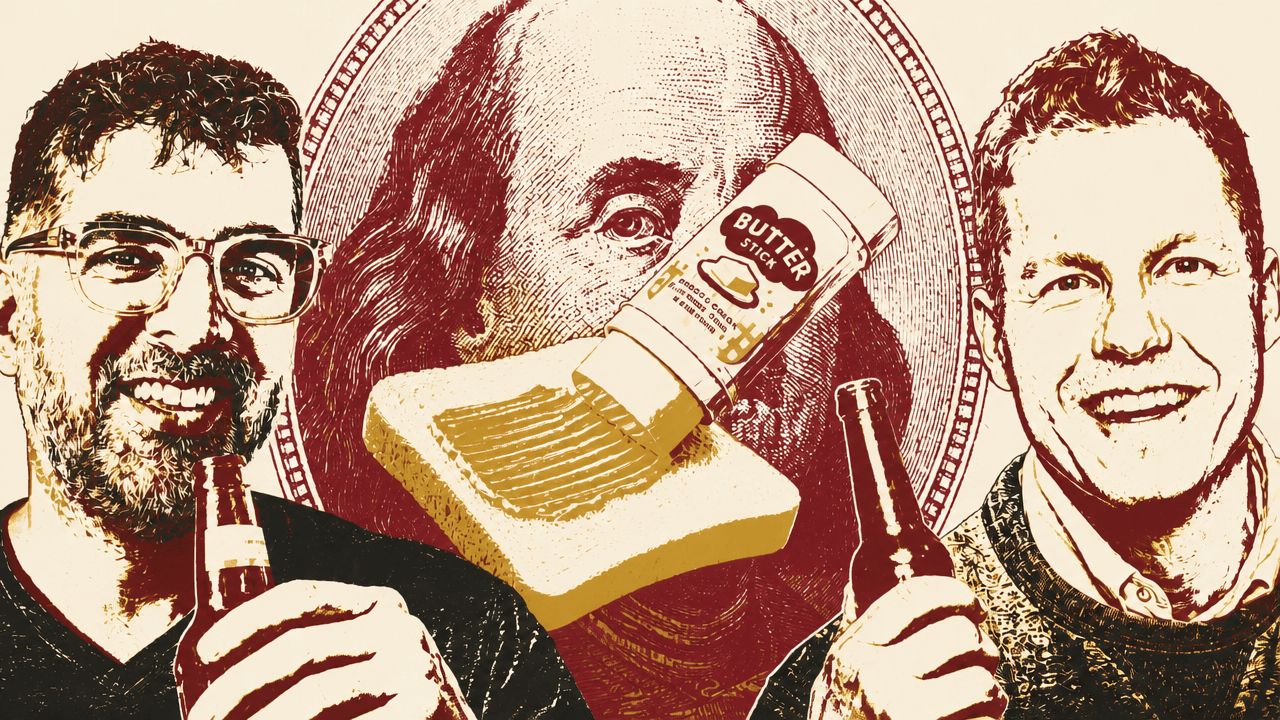
The roll-on butter idea is smaller than a giant claw machine but built on a related observation: a familiar product can become newly interesting when its physical form changes.
Shaan Puri shows a TikTok in which someone cleans an empty deodorant container, melts a stick of butter, pours it into the tube, and uses the resulting roll-on stick on a pan and toast. Puri argues that it solves practical annoyances in an exaggeratedly mundane task: slicing butter, deciding how much to use, adding too little, adding too much, and making a mess while it melts.
The video shown on screen had 2.8 million likes and 27,000 comments. Puri is not persuaded merely because it attracted positive sentiment. The reaction itself is evidence that the object gets attention. More importantly, he says some commenters reported already using a similar method.
He calls that a “happy path,” borrowing the image of pedestrians creating a dirt trail across grass rather than following the sidewalk a planner built. A repeated workaround can be evidence that people want something the standard product does not offer.
Form factor changes, underrated.
The mock product, BUTTR, makes the pitch plain: “Twist to dispense,” “Never over-pour again,” and “No mess. No guess. Just roll.” Puri sees a butter aisle that has not changed much beyond salted and unsalted varieties. A roll-on dispenser could offer a different way to control quantity and apply butter while also being novel enough to travel on social media.
He points to Vacation’s Classic Whip sunscreen as a real example of the same strategy. The product comes in a can designed to resemble whipped cream, dispensing sunscreen as foam. Puri says it repeatedly goes viral because putting on sunscreen becomes more playful. He also notes that children at his kids’ swim team were using powder sunscreen applied with a makeup-style brush, a form that avoids rubbing cream onto a child’s face or spraying product everywhere.
Sam Parr gives a rough taxonomy for food concepts that become locally viral: make a side food the main event, change a normal food’s color, or make it unusually large or unusually small. Cookie dough without ice cream, rainbow croissants, miniature cupcakes, and an oversized burger all reframe something familiar through presentation.
Parr also recalls discussing Groons, a company that put a nutritional product into gummy form. He and Puri characterize the move as changing the form in which a consumer encounters an existing category. Puri adds liquid vitamins as another case: he says brands such as MaryRuth’s have built large businesses around vitamins that are refrigerated and consumed as liquids rather than gummies or pills.
The commercial constraint is that a form-factor change has to be more than a demonstration. The source offers evidence of attention—the TikTok’s likes and comments, the novelty of Vacation’s packaging, children responding differently to powder sunscreen—but it does not establish demand for a commercial butter dispenser. Puri’s stronger claim is that the category should not dismiss a changed form as trivial. It can supply a practical preference, a new reason to buy, and a reason for people to notice a product that otherwise blends into an old aisle.
Personalized mail works by proving the sender paid attention
Sam Parr offers a less theatrical approach to attention: send an unusually specific physical package to a prospect.
Hampton needed to assemble founder peer groups in particular cities. Parr says that if the company had six people in Austin who needed a group, it needed to find several more people who would fit. The team could not find a service that did the work as they wanted, so they hired someone and paid roughly $100 per person to research around 200 potential fits and send tailored gifts.
The gifts were related to the recipient’s business or public interests. A bookkeeping company with “Honey” in its name received artisanal honey. A person who had posted about a favorite band might receive a vintage shirt connected to that band. Each package came with a handwritten letter.
Parr says the campaign took six or seven months to generate enough data to evaluate but became one of Hampton’s best marketing channels. The gifts did not need to be expensive. Their value was that they made the outreach feel too particular to be generic.
The Jumbo Mail concept displayed on screen captures the distinction: “Nobody Opens Their Mail. Everybody Opens a Package.” The package gets opened because it is a package; the contents matter because they show that the sender has looked closely enough to identify something relevant.
Shaan Puri says the per-recipient cost would likely rise in a scaled version once the service accounts for research, gift selection, fulfillment, and the item itself. But he sees a product opportunity in making that process usable: upload a lead list and receive gifts tailored to people’s social profiles or websites.
Parr says World 50, a community for senior executives, gets a meaningful share of customers through physical letters sent to executives. He and Puri also argue that direct mail remains underused in ecommerce. Puri says his ecommerce business used PostPilot for re-engagement campaigns aimed at customers who had previously purchased but had not returned. He recalls returns of roughly five to eight times the money spent.
The source’s argument is not that mail works because recipients are inherently receptive to it. It is that physical delivery creates a different kind of interruption from digital outreach, and customization gives that interruption a reason to be welcomed rather than discarded. The operational challenge is exactly what Parr encountered: researching people well enough and fulfilling gifts cheaply enough that the response rate justifies the labor.
A child device has to preserve independence without recreating a phone
Arie Desormeaux points to Tin Can, a Wi-Fi-connected landline for children, as evidence that parents may want deliberately limited devices. The phone has an old-fashioned physical handset, buttons, and curly cord, while its controls are contemporary: approved contacts, parent-managed access, quiet hours, and Do Not Disturb. The product’s language is direct: “All Talk, No Smarts.”
Desormeaux says Tin Can addresses communication at home, but not when children are out. Her proposed answer is a beeper for kids: a small pager that clips to a fanny pack or another object a child already carries. The Beep Beep Kids mock-up promises “Independence They Can Wear,” “Tiny Pager. Big Freedom,” voice-to-text buzzes, parent approval, and a $10 monthly plan.
Puri initially questions what his young children would do with such a device, since they are rarely out of an adult’s reach. But he thinks the object itself fits children’s behavior. His children enjoy carrying their own belongings, including backpacks and fanny packs, even when those possessions are unnecessary for the outing. A pager could feel like their own equipment, not simply a parent’s monitoring device.
Sam Parr explains the old pager model: a small screen displayed a number or code that told the recipient to call back. As a child, he could send his father “911” to indicate that he should call home. Puri imagines modernizing that interaction with voice-to-text, emojis, and tightly constrained messages. If friends had matching devices, he thinks they would message each other constantly.
Free-range, more more independence, unreachable, but still reachable.
That phrase captures Desormeaux’s larger thesis. She cites a statistic she encountered on TikTok that 60% of parents would not let their child walk to the next aisle in a grocery store. She identifies herself with the other 40% and expects a countertrend toward more independence, though not toward total parental disconnection.
Puri agrees with the aspiration while describing his own uncertainty. He says he would not yet let his children walk to school and imagines following at a distance or tracking their route with an AirTag. Parr describes parents who had a camera pointed at their 12-year-old’s bed, which he sees as excessive. Puri says over-parenting can exhaust both parent and child and can produce more fragile children.
The commercial problem is not simply making a cute pager. The device needs enough parent-approved safety to justify purchase, enough freedom to feel meaningful to children, and enough peers using compatible devices to make messaging compelling. Tin Can’s model points to one version of that network effect: calls between Tin Can devices are free, while calling ordinary phones costs $10 a month. Puri and Parr both choose the beeper as their favorite proposal, and Puri says he thinks the company should genuinely be built.
The anti-slop defense would make automated outreach expensive to pursue
Shaan Puri expects AI to make mass outreach more intrusive. Sales-development systems can scrape contact information, write apparently personalized emails, send texts, make calls, and present themselves as human. In that setting, he says, businesses will be bombarded from multiple directions.
His “Slop Stopper” is an adversarial response. Puri says he borrowed the initial idea from someone on X: when an unsolicited sender reaches out, an AI replies with questions, requiring the sender to research and respond. It then signals interest in a meeting and books a call. The recipient’s system does not merely block the pitch; it consumes the sender’s attention.
Puri proposes taking the idea further. An AI could appear on the call, ask for more information, request case studies and follow-up material, ask for a contract, return extreme redlines, and then disappear at the point of closing. The visual shown on screen labels the sequence: “Books Fake Call,” “Demands Case Studies,” “Sends Insane Redlines,” and “Ghosts Them at the Finish Line.”
The idea is retaliatory rather than simply defensive. The goal is to make indiscriminate automated outreach costly enough that the sender has an incentive to reduce it.
Parr connects the proposal to an earlier anti-spam model. At the Hustle, he says, mass campaigns generated tens of thousands of vacation replies and other incoming messages. He remembers a service that asked unfamiliar senders to pay $1 before their message would be read. Parr says he sometimes paid the dollar himself to test it.
Puri names Balaji’s Earn as a version of the “reverse inbox”: recipients publicly set a price for reading or responding to messages. A normal sender could pay a trivial amount, while a spammer sending messages at enormous volume would face meaningful aggregate costs. Puri says this did not become part of email because early internet systems lacked micropayments. Crypto could support them now, he says, but existing habits and infrastructure make adoption difficult.
Slop Stopper avoids requiring a new email payment system. Its unanswered question is whether a system designed to frustrate senders can distinguish low-quality automated outreach from a worthwhile new contact. Puri’s focus is on the asymmetry: if AI makes it cheap to ask thousands of people for attention, recipients may want an AI that makes attention expensive to waste.
People cannot choose careers from options they have never seen
Shaan Puri frames “Take Your Roommate to Work Day” as a way to give people exposure to jobs they might otherwise never encounter.
He says he knows intelligent, hard-working, consistent people who never found the setting in which those traits compounded. Looking at friends from high school and college, he sees people who had many of the qualities needed to succeed but did not find their “thing.” Puri does not attribute his own path to exceptional intelligence or discipline. He says he arrived at his work through luck, the right people, conversations, and exposure appearing in the right sequence.
The conventional advice to find one’s passion fails, in his view, because people cannot prefer what they have not experienced. He compares the problem to asking a four-year-old for a favorite food when the child has only had cheese pizza and macaroni and cheese. His son, Puri says, turned out to love salmon once he tried it.
The roommate idea broadens the menu. A person could spend a day at a roommate’s workplace, see another industry or role, observe a different working environment, or simply realize that the standards at their own job are lower than they had accepted. The experience might lead to a career choice, a business idea, or a reassessment of what is possible.
Sam Parr describes the concept as “Airbnb Experiences for different jobs.” He connects it to Dirty Jobs, in which Mike Rowe spent time with workers doing unfamiliar jobs, including sewer cleaning, portable-toilet work, farming, and other blue-collar roles. Parr says he always wanted the ability to try work like that directly.
The idea also has an entrepreneurial use. Parr describes a friend, Austin, building a company connected to a blue-collar industry. Austin cold-emails workers, asks to shadow them for a day, and looks for operational problems he might solve. That approach can produce firsthand knowledge, but it depends on identifying people in the field and persuading them to grant access.
The business model remains open in the discussion. Consent, access control, and the willingness of employers or workers to host strangers would determine whether it could become more than an informal practice among friends. But Puri’s underlying claim is clear: career discovery is constrained by exposure. People may need more chances to see work up close before they can know what they are suited to pursue.