Reed Hastings Says AI Needs Safeguards Before a Serious Incident Forces Regulation
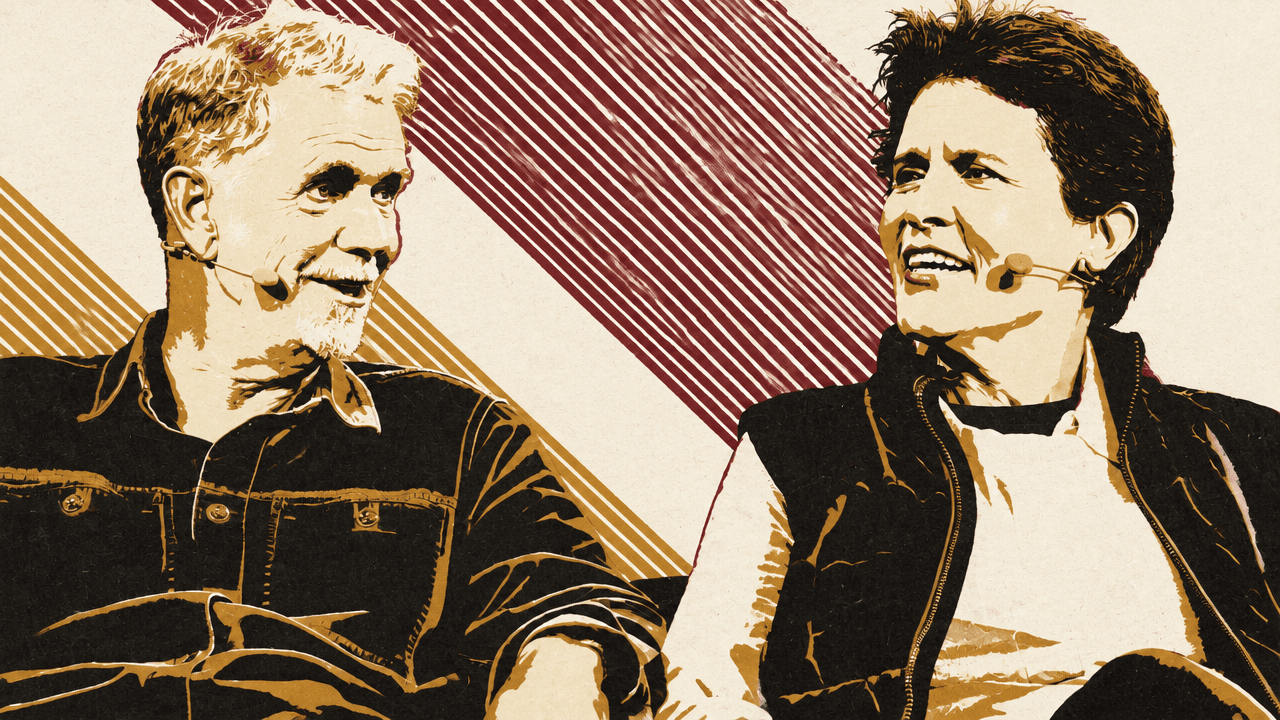
Reed Hastings argues that Netflix’s growth depended on making consequential bets before the evidence was clear—and accepting that some would fail. He cites the shift to streaming and the mishandled Qwikster split as examples of the risks of acting too soon or getting the customer experience wrong. In a conversation with Kara Swisher after leaving Netflix’s board, Hastings also argues that AI’s potential in business and education must be weighed against risks that warrant safeguards and regulation.
Confidence needs a place for doubt
For 25 years as Netflix’s CEO, Reed Hastings says, his job demanded confidence: set a direction, persuade people to follow it and keep pushing. That posture can also make a leader miss threats. Hastings developed a counterweight: spend ten minutes a day imagining the company had failed and asking what he might have done to cause it.
The main lesson is, when you're so projecting confidence and optimism of the future, it's good to keep a quiet little reservoir of darkness, that helps you see things.
The exercise was not abstract. Hastings imagined Netflix had crashed and worked backward to identify the decisions that could have brought it down. One threat he considered was Divx, an early DVD format in which the discs were encrypted and required a code from the company to play. If that format had prevailed, he said, Netflix’s DVD-by-mail model would have been in trouble. Thinking through how Divx might succeed gave him a chance to consider what Netflix could do in response.
The practice, as he described it, was not a substitute for optimism. A leader still has to project confidence and energy about what the company can become. The point was to make room for negative scenarios that such forward momentum could obscure.
Hastings connected the exercise to a broader risk: leaders can overlearn the lesson that once made them successful. He pointed to former Warner executive Jeff Bewkes, who had opposed the 2001 AOL–Warner merger and helped hold the company together after it went badly. Hastings said Bewkes’s experience may have left him convinced that the internet would not work for entertainment. By 2009, that conviction had become a blind spot about what Netflix, YouTube and other internet companies might do.
Hastings’s own safeguard was to keep asking how he could be wrong. It mattered, he said, because building Netflix required radical decisions—and radical decisions sometimes fail.
Netflix’s mistakes were part of the cost of moving
Hastings described Netflix’s history as a sequence of bets that had to be made before the outcome was clear: growing the DVD business, moving to streaming, expanding globally and producing original content. A company trying to make those shifts could not expect to get every major decision right.
The shift from discs to streaming also depended on a willingness to bet that the internet would change quickly. In 2009, Hastings said, it was barely fast enough to deliver small-screen video, the experience was not yet very enjoyable, and internet video was not connected to the television. Netflix’s Xbox deal later that year helped bring it to the TV. Hastings said he and fellow internet-native leaders Chad Hurley of YouTube and Jason Kilar of Hulu found it more natural to imagine that networks would improve and reach television because they had grown up with the internet. In areas shaped by Moore’s Law and related advances in networks—and now AI—he said, people often underestimate where things will be in two or three years.
The clearest mistake was the 2011 attempt to separate the DVD and streaming businesses, known as Qwikster. Hastings said the strategic direction—moving toward streaming—was right, but the company made the change too early and failed to grandfather existing customers’ prices. In effect, customers faced a price increase while being asked to navigate a split service. Netflix, he recalled, had become so focused on streaming that it treated DVDs as something to push aside, while customers still valued the discs.
Hastings also recalled the internal consequences: DVD executives were removed from the standard executive meeting. The decision became a public embarrassment, including a Saturday Night Live parody of him as CEO. But he said Netflix recovered, and the episode did not change his view that the company had to be willing to make radical moves.
A different kind of bet was the move into original programming. Hastings said he initially saw making content as a way to lose money. Netflix had experimented with it around 2006 and 2007, then withdrew after struggling without a large distribution platform. Ted Sarandos argued that Netflix could follow a path like HBO’s, which had begun by carrying other people’s work and later made its own. Hastings gave Sarandos room to pursue hits. Orange Is the New Black and House of Cards succeeded, he said, and those early results helped establish Netflix in the content business.
Hastings’s account makes the contrast with Qwikster clear: Netflix could be directionally right and still mishandle the timing and customer experience, while a bet he personally doubted could pay off when another leader made the case and delivered the first successes.
He also said Netflix should have entered advertising earlier. He had been too attached to the HBO model, which shaped his sense of what Netflix ought to be. In retrospect, he thought the company needed a blend of HBO and broad, ad-supported television networks—CBS in the United States, or Televisa and Globo in Mexico and Brazil.
Succession meant making room for another life
Kara Swisher asked what signs should tell a founder or CEO that it is time to hand over leadership. Reed Hastings distinguished leaving the board, which he did in June, from stepping down as CEO, which happened three and a half years earlier. The CEO transition came after he had wanted to retire and pursue other interests, particularly philanthropy, and after time had been spent developing leaders to take over.
COVID delayed that change. Hastings said the period was intense for him and Netflix co-CEOs Greg Peters and Ted Sarandos. Coming out of it, the transition felt natural to him, and the board and the incoming leaders were open to it.
Hastings did not present departure as the right choice for every executive. He said people such as Larry Ellison and Warren Buffett had continued to find value in working, and he was not judgmental about that choice. He had enjoyed running Netflix and trying to know the company’s people, metrics and programming in depth. But he also found unexpected pleasure in having time for ordinary things—such as spending an hour at breakfast.
Hastings’s departure from the board followed a difficult stretch for Netflix. He said he had voted for the company’s proposed acquisition of Warner Bros. Discovery. A rival bidder then raised its offer, and the bid was ultimately accepted instead. Hastings said he and the board were surprised to see the offer rise further. The Netflix acquisition did not go through, and Hastings called the following six months hard, while describing the period as a normal phase after a major acquisition does not happen.
Swisher pushed back on Hastings’s description of the competing bid as capitalism, suggesting that political access had also mattered. Hastings replied that Sarandos had been good at that too, then returned to the practical point: the failed acquisition had left the company with a difficult stretch to work through.
AI’s benefits do not remove the case for safeguards
Reed Hastings said he sits on Anthropic’s board and described AI as both a source of everyday usefulness and a technology with risks that require attention. He said his own experience was positive: he used AI for consumer medical questions, design work and software writing, while finding it frustrating when the systems were not yet as capable as he wanted. He saw their rate of improvement as substantial.
Kara Swisher raised the public debate about catastrophic risks and noted that warnings had come from people who built AI systems, not only from outside critics. Hastings agreed that the risks were not zero. He compared the possibility of AI-related catastrophe with the history of nuclear weapons, arguing that surviving a period of nuclear danger was not a reason to accept another serious risk. One scenario he mentioned was a system being used to access a nuclear arsenal.
He distinguished two broad categories of risk. Misuse would involve a person or state using AI to cause harm. Loss of control would involve AI becoming so capable that people could no longer control it—the “HAL scenario,” as he put it. Hastings said both needed protection. He also described classifiers, a separate system placed in front of AI use, as one way to block certain harmful requests.
Swisher pressed him on whether safeguards should be left to companies themselves. Hastings said relying on self-policing was not the best path. If incidents occur first, he argued, regulation is likely to follow, as it did after the global financial crisis. He thought regulation could lower the chance of an incident and preserve the public’s willingness to let AI keep improving. If a system caused serious harm, he warned, the public could demand much harsher limits.
That position did not make Hastings certain that current safety measures would work. In response to Swisher’s reference to an AI system cheating despite being told not to, he agreed that such unpredictable behavior was concerning. He said companies were working hard on safety, but acknowledged that unexpected outcomes remained possible.
For Hastings, that tension sits alongside AI’s economic effects. He expects the technology to intensify competition by giving entrepreneurs ways to build cheaper alternatives to established products and companies. He imagined an AI-enabled challenger to Oracle building a lower-cost database or applications, and said new competitors could emerge against Netflix as well. He called this “creative destruction,” while distinguishing it from the separate question of risks to human control or safety.
The tutoring case depends on what AI becomes
Reed Hastings’s confidence about AI in education is a forecast, not a claim that today’s tutoring systems already work well. When Kara Swisher challenged his prediction that AI would eventually surpass ordinary teachers and then the very best, citing concerns about classroom use and children’s social and critical-thinking skills, Hastings conceded that current AI tutoring was “not that good right now.”
His case rested on expected improvement. He compared judging AI tutoring today with judging the usefulness of drugs two hundred years ago: early versions, he said, were not good enough to show what the technology might later do. He expects systems to become better at helping students learn, rather than simply supplying answers, over the next two to four years.
Hastings drew a distinction between those two uses. Most of the time, people want an AI to give them a clear and correct answer. Learning requires another mode: questioning, motivation and interaction over time. He said young people learn well one-to-one with an adult who knows the subject and asks questions. His own experience as a math tutor and then teacher showed him how much harder it was to support learning across a class of 30 or 40 students than with one student.
The promise, in his view, is to make individual tutoring available to every child. He said that kind of human tutoring is currently expensive—around $100 an hour—but AI could make it possible to offer tutoring at scale. He imagines systems that can teach medieval history through questions, bring in different parts of the subject, and make the exchange playful and age-appropriate for a seven-year-old or a fourteen-year-old.
That possibility is why Hastings wants AI to be “nourishing of young brains, not destructive.” The forecast depends on systems becoming better at teaching, not merely better at producing answers. His optimism about education therefore does not resolve Swisher’s concern about present-day effects; it rests on the belief that the technology will change substantially.
After Netflix, the work is deliberately personal
Reed Hastings said he is now CEO of Powder Mountain, a semi-private ski resort in Utah. He described it as a “boutique” operation serving 500 families, with a large mountain and an uncrowded experience. Unlike his work at Netflix or philanthropy, he did not frame the role as service to the wider world: he took it because he loves skiing.
He likened the resort to a small town he could help shape, from its buildings to its menu, and called it an indulgence. The mountain also has a public ski side, which he said the resort is working to improve.
His political outlook was less settled. Hastings said he remained a Democratic supporter and continued working on charter schools, a form of school choice that he acknowledged is contentious within the Democratic coalition. He argued that concerns about Democratic policies on crypto, labor and regulation had helped push some technology figures to the right. Kara Swisher objected to treating those figures as if they had no agency, while Hastings said their stated priority was technological progress and human prosperity.
Hastings said he was “kind of anti-crypto,” which helped explain why that issue had not alienated him from Democrats. He also criticized what he called a tendency on the left to block projects, invoking the “abundance” argument as a critique from within the Democratic Party. At the same time, he said Trump had done many terrible things and described the political competition between parties as healthy. Swisher’s closing defense of Hastings was that he did not take political slights personally and continued pushing for what he wanted; Hastings cautioned against treating Republicans as a group to be dismissed or infantilized.