Neural Technology’s Promise Outpaces Our Understanding of the Brain
Neuroscientist Andrew Huberman argues that major AI labs will become biotech companies because their ambitions extend beyond language models to reading and changing brain activity. In a discussion with Patrick O’Shaughnessy, he describes non-invasive neural control as a possible frontier, but says researchers still lack a clear account of how thought and memory work—an uncertainty that limits what such technology can safely and reliably do.
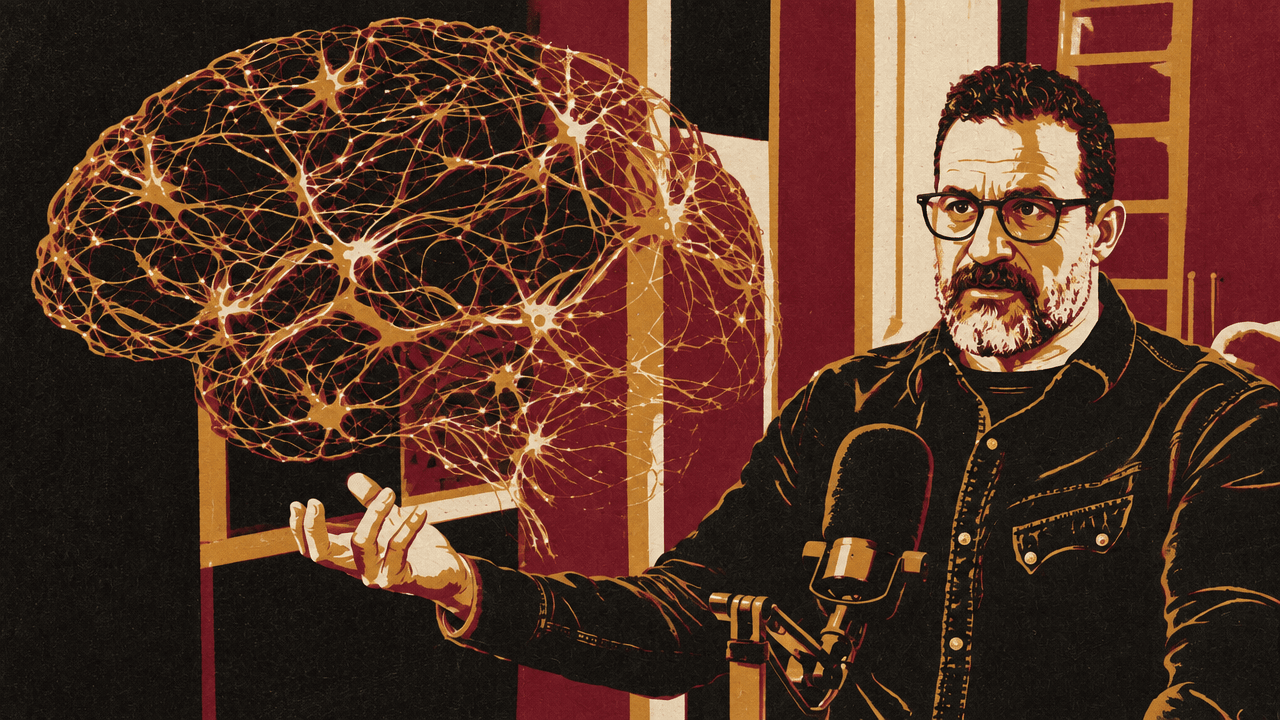
The promise of neural technology depends on what we still do not understand
Andrew Huberman makes a prediction that reframes the competition among AI companies: Meta, OpenAI, Anthropic, and other major technology firms will become biotech companies because they are interested in the brain. Their longer-term aim, he says, is to read from and write to the brain non-invasively. In this account, language models are not the endpoint. They are part of a race to measure and change human neural activity.
The ambition has two sides. Reading means detecting activity in the nervous system and interpreting what it signals. Writing means influencing that activity: stimulating or quieting selected areas, at a chosen time and to a chosen degree. Huberman argues that the important technical problem is not simply turning a brain region on or off. Neural signals are graded; activity can be gated, thresholds can change, and the same region may contribute to different functions. A useful technology would need spatial and temporal precision, and would need to adjust its effects to the person.
He imagines AI helping make that adjustment. A system might learn that a particular level of activation helps one person focus but leaves them unable to shift to other tasks later. It could then “titrate” stimulation to reach a useful state without overshooting. Huberman presents this as a future possibility, not a current capability. But it shows why he sees AI and neurotechnology converging: the system would need to measure neural activity, relate it to a person’s state, and use that information to change the activity.
Some existing methods offer quite different kinds of access. Huberman describes recordings made with electrodes close to neurons, or placed inside them, as ways to capture electrical signals in detail; these require breaching the skull. At a broader scale, researchers use tools such as EEG and fMRI. The brain heat maps familiar to the public do not give access to every structure, he says. EEG mainly measures signals at the surface of the cortex, not activity in deeper regions. For stimulation, he points to ultrasound and transcranial magnetic stimulation as promising approaches, while noting that the spatial control is not yet good enough for the precision he has in mind.
His account of neural signals also complicates the idea that recording an electrical event tells researchers what a person is thinking. Neurons communicate through action potentials, but Huberman says the simple textbook picture—a neuron either fires or does not, and each action potential has the same shape—is incomplete. Inputs can be graded; whether a neuron fires depends on whether activity crosses a threshold and on the other inputs present. Neural activity has to be interpreted in context, not just detected.
Some parts of that context are better understood than others. Huberman says neuroscience has a detailed account of how sensory organs such as the retina and cochlea transform signals. He describes some deep-brain circuits involved in hunger, anger, sexual appetite, and hormone release as relatively well characterized. He also points to the prefrontal cortex’s role in contextual learning, strategy, and impulse suppression. But he draws a boundary around that knowledge: there is no settled textbook account of how thoughts are made, and memory remains especially difficult to explain.
That gap matters for any technology that aims to write to the brain. A device may be able to activate neurons associated with an action without researchers knowing whether they have reproduced the process that normally produces it, or what else those neurons do. Huberman’s most striking example comes from experiments he attributes to Mark Mayford’s lab at Scripps and Susumu Tonegawa’s lab. In the studies as he recounts them, an animal learns a task—such as finding a reward, navigating a maze, or pressing a lever—and researchers identify neurons involved in learning or expressing the behavior. Reactivating those tagged neurons can produce the behavior.
The apparent implication is that the relevant neurons need to fire in a particular sequence. Huberman says a control experiment unsettled that interpretation: activating the same neurons in the reverse sequence, or activating them all at once, also produced the behavior. He compares the result to identifying the notes in a musical phrase and then striking all of them together rather than playing them in order. The sound changes, but in the experiments he describes, the behavior did not.
If sequence is not always necessary, some forms of neural writing could be simpler than expected: perhaps researchers need to activate a set of cells without reproducing its precise pattern over time. But the finding, as Huberman presents it, also complicates the model that would tell them which cells to target and what their activation will do. The neurons involved in one behavior can also participate in other perceptions and behaviors. The brain reuses cells across circuits; a group associated with a tennis serve, for example, would not necessarily be dedicated only to serving.
Huberman contrasts this with pathways where the direction of activity appears clearer. He says the route from the eyes through the thalamus toward the cortex is necessary for visual perception: interrupting it prevents perception. For memory, thought, and plasticity, he says, it remains unsettled whether the temporal order of neural firing matters in the way many accounts assume. That uncertainty limits how confidently researchers can move from a recorded pattern to a deliberately reproduced mental state.
The distinction is between reading a signal that supports a defined output and changing a complex capacity. Huberman describes the work of his childhood friend Eddie Chang, a neurosurgeon and bioengineer at UCSF, as an example of the first. During surgery, Chang maps brain regions related to speech and language in patients who are awake. For people who cannot send signals from the brain to the muscles needed for speech, Huberman says, Chang has characterized activity in speech-planning areas and translated those signals into computer output. The system does not need to record from the muscles that produce speech; it uses planning signals to provide another route to communication.
Huberman also points to work by Chang, Neuralink, and others on helping people with spinal injuries walk. These are clinical goals tied to a specific function that has been lost or interrupted. They differ from consumer technologies intended to shift a person’s everyday state—to make someone more focused, motivated, creative, or relaxed. Asked about increasing creativity, Huberman says researchers are “not even close.” He allows that one might imagine increasing memory capacity, but warns that a change could come at a cost.
The central tension is therefore not just whether neural activity can be measured or stimulated. It is whether researchers can interpret the activity well enough to intervene selectively—and predict what else the intervention may affect. Huberman sees the technology advancing, but the model of the brain that would make broad, reliable control possible remains incomplete.
Clinical translation and consumer state-shifting are different ambitions
The clinical case for neural technology is clearest when a signal can be connected to a specific task. Huberman describes Chang’s speech work as translating activity from speech-planning areas into a computer signal when the usual route to the pharynx and larynx is unavailable. He calls efforts to restore speech or movement heroic. In these cases, the goal is to provide a route around a damaged or interrupted connection.
Consumer state-shifting asks more of the technology. Huberman imagines devices that could move someone toward focus or learning during work, then toward a more relaxed state later in the day. He compares this with methods people already use to change how they feel: cold showers, caffeine, exercise, and breathing practices. In his formulation, breathing exercises tend to emphasize either inhalation, which can increase alertness, or exhalation, which can promote calm. Future devices, he predicts, might make such shifts more direct.
Pharmacology already changes neural activity, but Huberman describes it as a blunt instrument. Sedatives, alcohol, and related drugs can increase the threshold for neuronal activation, quieting activity in part by increasing inhibition. Stimulants such as caffeine, nicotine, Adderall, and modafinil can increase the likelihood that neurons will fire. They may raise energy or focus, but their effects are not confined to a narrowly selected group of cells. Huberman says stimulants can leave the brain and body primed to move and think, making it harder to switch off; sedating drugs can make quieting activity easier.
The case for greater precision is not that the existing tools do nothing. Huberman describes sleep, caffeine, and creatine as tools with different effects and margins of safety, and says a good night’s sleep plus caffeine can come close to some of the effects people seek from Adderall. His point is that these interventions work broadly. Receptors are distributed across the brain, so a drug intended to change one aspect of experience can also produce effects elsewhere. He sees more spatially and temporally specific intervention as the direction neuroscience is moving.
Vagal stimulation offers an example of why the effects of a neural pathway can be less intuitive than its popular label. The vagus nerve is often discussed as a way to calm down, but Huberman says many vagal pathways are excitatory. He describes an implanted stimulator used in some depression treatments. He also recounts an example from his colleague Karl Deisseroth: as Deisseroth increased stimulation in a patient who was suicidally depressed, she moved toward saying she felt able to apply for a job. Huberman uses the case to illustrate how changing neural activity can affect a person’s experience in real time.
The technology raises a practical question: how much intervention are people willing to accept? Huberman notes that stimulation can require a device under the skin. He describes a colleague, now head neurosurgeon at Neuralink, with a small receiver implanted in his hand between the thumb and index finger. The receiver can open a door and provide access to keys; the colleague’s wife has one too. Huberman presents the implants as an experiment in having a device under the skin that can interact with the world.
He expects more people to consider implantable devices, perhaps as readily as they now wear a ring or wristband to measure sleep, heart rate, or heart-rate variability. But he distinguishes that expectation from a claim that current consumer vagal stimulators are already compelling. Some commercially available devices have shown promise, he says, but have not impressed all of his neurosurgeon colleagues. His forecast is that people will begin thinking about devices as another possible form of intervention, not that the clinical case is settled.
The most speculative version would combine targeted genetic changes with stimulation from outside the skull. Huberman describes laboratory methods in which a genetic tool gives selected cells a channel that responds to a stimulus. A virus can act as a carrier for genetic material, and promoters can help target particular cell types. He says these methods are used in animals and that related methods have been used in people for other purposes, including localized work in the eyes.
From there, he imagines a person receiving a viral vector that makes selected neurons responsive to a stimulus delivered through a cap. The stimulus might be long-wavelength light or ultrasound, directed broadly toward a region but affecting only cells that carry the relevant genetic change. Varying the intensity or pattern of the stimulus could then change the activity of those cells. Huberman stresses that he is describing a future scenario, not a device currently available.
He imagines AI helping regulate the stimulation rather than leaving the user to turn a knob. A person seeking more motivation, for example, might increase activity in a relevant circuit. Huberman acknowledges that this could amount to “cranking the circuit,” and compares it with the fact that people already use caffeine and other stimulants to increase excitability. The difference, in his account, would be a more specific route to changing selected activity, with the possibility of tuning the effect to an individual.
The same scenario creates a question of control. Huberman says he would be willing to consider a device under his skin, but wants control over anything that could influence his brain. He argues that safeguards should be built into brain stimulators, as he says they are for vagal stimulators, so that a device cannot suddenly push someone into an unwanted state such as rage. One safeguard he imagines is an “AND gate”: the genetic change alone would not be enough; stimulation would also require a second condition, perhaps a pill. He also notes that people with vagal stimulators can unplug them. These are design possibilities Huberman raises, not a detailed account of a finished regulatory or safety system.
The difference between a device that measures and one that acts matters here. A wristband may report heart rate or HRV; a stimulator aims to change nervous-system activity. Huberman describes a cuff that his former postdoctoral researcher Melis Yilmaz is developing to measure autonomic nervous-system activity directly. He says the device gives a readout relating activities, speech, and breathing patterns to distress or positive arousal, and that Yilmaz has brought it to police departments and first responders.
In Huberman’s view, ordinary measurements can be misread. A higher heart rate or lower HRV is not automatically a sign that someone is doing badly. An activity that feels stressful but is also meaningful or enjoyable may, he says, set a person up for better sleep or focus. More direct measurements could help distinguish distress from a high-arousal state that a person is handling well, and show how long the effects of a stressful interaction last. He also imagines glasses using changes in pupil size to estimate focus.
Huberman expects people to become more comfortable with direct measurement, comparing it with the adoption of sleep trackers, blood tests, and genetic testing. The possibility of measurement becoming commonplace does not answer the separate question of how willing people will be to have their brains made accessible to non-invasive control. For him, the prospect depends not only on precision but on who operates a device, what safeguards govern it, and whether a person can stop it.
Genetic choices expose the unsettled boundary between selection and intervention
The prospect of changing neural function leads Huberman to a parallel question in genetics: which capabilities will people use, and who will decide what is acceptable? He discusses the scientist who announced that he had used CRISPR on twin babies, reportedly deleting a receptor associated with HIV. As Huberman recounts the account, the stated aim was to protect the children because their father was HIV-positive. Huberman also says researchers in neuroscience knew of a possible connection between that receptor and aspects of neural-circuit formation and memory. He does not know whether the experiment was intended to affect those traits.
He remembers uncertainty in the scientific community after the announcement. Some people who had exchanged messages with the researcher, he says, appeared to be waiting to see whether the work would be celebrated or condemned. The response eventually was that the experiment was ethically unacceptable. Huberman says the Chinese government stated that the researcher’s lab would be taken away and that he would be punished.
Huberman also repeats a claim that the researcher later had a laboratory in Austin, Texas, while explicitly saying he does not know whether it is true or where the researcher is now. His point is that the tools exist and that scientists or others may act before there is agreement about the limits. He says it is important to have ethics committees for this kind of technology, while also arguing that the episode made the field’s uncertainties and incentives visible.
He sees no clean line separating genetic intervention from other reproductive choices. Prenatal testing can identify conditions; embryos created through IVF can be screened; people choosing a partner or donor may consider height, education, or appearance. These practices are not equivalent to editing an embryo, but Huberman treats them as part of a continuum of decisions about genetic traits. The ethical boundaries between them, he says, have not been clearly defined.
He mentions companies screening embryos for disease and efforts to associate genetic patterns with autism, IQ, or height. He presents those efforts as signs of where screening could lead, not as settled ways to select those traits. He also points to follistatin, a gene manipulated in animals and discussed in gene-therapy efforts related to muscle growth, as an example of capabilities that might have sounded far-fetched fifteen years earlier but are now part of research and treatment discussions.
Huberman says he is more excited than concerned, provided people are talking about the science and thinking carefully about its consequences. He expects information about developments to circulate quickly, especially online. But visibility is not the same as agreement on what should be done. The underlying tension is between the ability to use a technology and the social and ethical rules that might constrain its use.
Sleep offers a modest test of changing brain state
Patrick O'Shaughnessy says it can take him four hours to quiet his mind after an exciting day. Huberman breaks sleep onset into three tasks: quieting thought, slowing the heart rate, and letting go of awareness of the limbs’ positions in space. The advice is a near-term, non-invasive contrast to the more ambitious technologies he describes elsewhere: here, the aim is to change state through attention and bodily cues rather than by directly stimulating the brain.
To quiet thought, Huberman suggests moving attention away from planning and prediction and toward sensation. He describes shifting awareness among the feet, legs, breathing, and sounds in the room, rather than fixing on a single object as in meditation. The point, he says, is to move from thinking about what comes next to noticing present sensations.
For the heart-rate component, he recommends long exhales followed by passive inhales. Huberman explains that breathing affects heart rate through respiratory sinus arrhythmia: heart rate tends to increase on inhalation and decrease on exhalation, with signals involving the vagus nerve. He suggests using long exhales to lower activation while awake or when trying to fall asleep.
For proprioception—the sense of where the limbs are in space—Huberman points to research on rocking. He says rocking babies at a certain rate can help them fall asleep, and that studies have found adults can also fall asleep more quickly on a bed that rocks at a particular frequency. He connects the effect to compensatory eye movements beneath closed eyelids and systems involved in balance and body position.
Without a rocking bed, he describes moving the eyes behind closed eyelids from side to side, then up and down, or in circles, alongside a long exhale. He says the movements may confuse the system involved in tracking body position. He also describes an eye mask developed by a group from MIT that approached him to try it. The mask is designed to measure REM sleep directly and to help people fall asleep faster. Huberman says mild stimulation behind the ears produces slow eye movements; he reports that it worked well for him and estimates the technology was seven to twelve months from release.
The sleep discussion also grounds his broader argument about individual differences. Huberman says seven hours of sleep leaves him feeling great, eight can make him groggy, and six is manageable. He cautions against assuming that someone else’s short sleep requirement applies to you. People should assess how much sleep they need to perform well and how much they can get by on when circumstances prevent them from getting that amount.
He recalls working 80- to 100-hour weeks in graduate school and exercising twice a week to maintain himself. For the first years of starting a company or attending medical school, he says, the priority may be to get as much done as possible without injury or chronic disease. Later, it can make sense to build rest into the day, week, or month. He does not present one schedule as universal; his emphasis is on knowing what kind of effort a person can sustain and whether they can switch off enough to recover.
Public trust and personal curiosity shape what comes next
Huberman calls public discourse around health and longevity “a disaster,” arguing that it has become increasingly theatrical. His complaint is not that people should never discuss personal experience. He praises Tim Ferriss for being candid about experiments he later decided were not good ideas. The problem, in Huberman’s view, is that attention can be won with a persona or a dramatic claim without the training or care needed to sustain respect.
He contrasts the standards of public health education with those of neuroscience, where even having a PhD is not nearly sufficient to establish that someone has contributed to understanding the brain. He sees a widening gap between the most serious public educators and others whose authority rests mainly on personal transformation or performance. It is easy to get attention, he says; keeping respect is harder.
Huberman expects interest in optimization to cool as people tire of adding more practices to every day. He predicts a downturn in public-facing health and longevity content, followed by an influx of people trained in science, medicine, pharmacology, or health who can explain their work clearly. He wants more serious peers and expects public education to improve when expertise and communication are joined rather than replaced by theatrics.
That concern becomes more consequential as health advice moves from habits toward technologies that can measure or alter neural activity. Huberman’s distinction is not between public communication and science, but between communication that takes the underlying work seriously and claims that rely chiefly on attention. His own interest, he says, has shifted from explaining familiar tools such as morning sunlight toward understanding waking brain states: what states people enter during ordinary life, which states support particular activities, and how they might be changed with precision.
His interest in curiosity is personal as well as scientific. During graduate school, Huberman first joined a laboratory doing prominent work on molecular genetic techniques for studying neurons. But he was more drawn to work he had encountered during an earlier rotation, and began going into that laboratory at night to do experiments. His graduate adviser, Barbara Chapman, told him she was not upset that he had joined another lab. She could see that he loved the work in hers. The question that would determine his success, she said, was how badly he wanted answers to the questions he was working on.
Huberman left the first lab and joined Chapman’s. He says they published eight first-author papers. He remembers her advice as an act of confidence: she recognized that he lacked the self-understanding and courage to choose the work he genuinely wanted to do. He says the lesson carried into his decision to move from running a lab and teaching at Stanford to public communication. He had no training in media, but felt compelled to share knowledge that he believed could benefit people.
The principle does not mean ignoring the field, he says. Experiments are hard; building a company or making a podcast well is hard. People need to understand the work and the context in which they are doing it. But choosing a path only because it appears likely to succeed can make effort difficult to sustain. Huberman compares telling a band to play music it does not love with telling a researcher or entrepreneur to abandon the questions that give their work meaning.
Success is determined by how precisely you match your genuine curiosity to the work that you do.
For Huberman, that advice links the personal and technical threads. The people developing neural technologies need to understand the brain, take the ethical questions seriously, and be motivated by problems they genuinely want to solve. Chapman’s counsel, as he remembers it, was to follow the questions that matter while doing the work carefully. Not doing so, he says, can become a “slow death.”