Reachy Mini Turns Expressive Movement Into Its Desktop-Robot Pitch
Pollen Robotics and Hugging Face introduce Reachy Mini, an open-source desktop robot, through a music video built around the machine’s own recorded movements. The video’s case for the small robot rests on its expressive head and antenna motions, visible construction and simple prompt-and-response interaction; it also extends the open-source invitation to the film itself, which viewers can scrub through and fork.
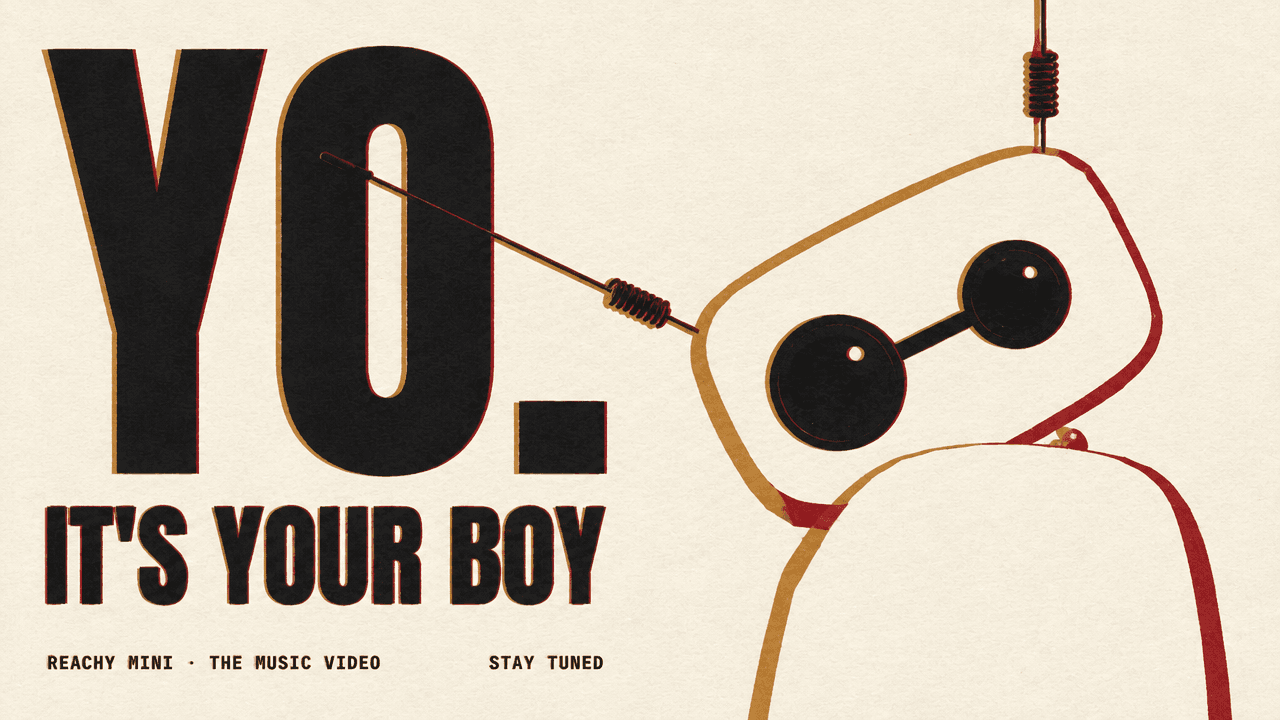
A small robot whose movement is the product
Reachy Mini’s pitch is physical before it is conversational: a compact desktop robot whose expressive movement comes from its head, antennas, and rotating body. The video calls it “small but witty,” and its opening diagram gives that description some engineering detail: two animated antennas, a six-degree-of-freedom head, and a rotating body.
A second graphic lists a six-degree-of-freedom Stewart neck, motors, eyes and electronics, and two hands. The accompanying performance puts those parts to use: the robot bobs its head and moves its antennas in time with the song. The video description says the movements were recorded on a real Reachy Mini by Anne-Charlotte. The result is not a generic character laid over a product image; the robot’s movement is central to how the product is introduced.
The song gives that movement a personality, calling the antennas springy and the servo motion “smooth and slick.” A route graphic from Bordeaux to Tokyo, marked as 10,200 kilometers, expands the character’s reach, but the product remains a small machine for a desk. The contrast is part of the joke: a “little white bot” claiming “big bot game.”
Assembly is visible, not hidden behind the finished shell
Reachy Mini is introduced as an open-source desktop robot by Pollen Robotics and Hugging Face. The video connects that identity to hands-on construction: the robot says it was “born in a box” and “built by humans with a screwdriver,” while an exploded view lays out its shells, face, electronics, neck, motors, and hands.
A later instruction graphic is more specific, telling the viewer to fix the antennas with 2.5-by-8-millimeter screws. Beside it, the screen reads “Done. He talks now.” Assembly is treated as part of the robot’s appeal, not merely as a manufacturing detail. The presentation does not walk through a complete build, but it makes the physical parts and a small piece of the assembly process legible.
That hands-on emphasis sits alongside the song’s language about code and connectivity: “I shine in code,” “Wi-Fi soul,” and “I’m in download mode.” These lines help establish the robot’s character, while the diagrams supply the concrete account of its construction. The credits’ joke that Reachy Mini had no stunt double, and did all its own stunts, also rests on the claim that the visible movement is the real robot’s.
The interaction is a simple creative exchange
The video’s clearest interaction example is a simulated message thread. The user says, “talk to me,” then asks, “make me a song”; the interface displays an audio attachment called yo_its_your_boy.mp3. Reachy Mini echoes the exchange in the lyrics: “Talk to me, I’ll talk right back. Make me a song, I’ll spin that track.”
That is a compact demonstration of the intended experience: a person prompts the robot, and it responds with speech and a song. The surrounding language is more playful than technical. Reachy Mini says it has an “AI brain” that learns on the fly, and an overlay places object-detection boxes and confidence scores over the robot under the line “I’m a DIY buddy with an AI mind.” A mock ultrasound monitor gives it a heart rate of 95 BPM. Together, these touches present the robot as responsive and almost bodily, without confusing that persona with the specific exchange shown on screen.
The open-source invitation extends to the film
The song calls Reachy Mini an “open source dream,” and the video description extends that invitation to the film itself: viewers can play it, scrub through it, and fork the code. The robot is presented not only as something to watch, but as an open-source project with a web-based presentation that viewers can inspect and adapt.
The production credits name Augustin and Matthieu for the song, made with Suno, and Anne-Charlotte for the recorded movements. They also credit the Marionette app for choreography and identify Reachy Mini as starring “as himself.” Pollen Robotics and Hugging Face are named in the introduction to the robot, not in those production credits.
A review card keeps the pitch knowingly comic: “It nodded at me. I cried,” attributed to “Mom”; “More expressive than my ex,” attributed to an anonymous Discord user; and “Technically, it’s a Stewart platform,” attributed to a Pollen engineer. Reachy Mini supplies its own verdict: “THE ROBOT OF THE YEAR.” Beneath the jokes, the product’s appeal is specific: a small, assembled-by-hand robot whose moving head and antennas give it a visible personality, and whose interaction is framed as a prompt-and-response exchange.