Google Says It Is at the AI Frontier, Except in Coding


Google chief executive Sundar Pichai told Hard Fork’s Kevin Roose and Casey Newton that Google is at the frontier in some areas of AI and behind in others, particularly long-horizon coding tasks. He argued that the race is moving fast enough for public judgments of leadership to change within months, while defending Google’s broader platform strategy in search, agents, cloud infrastructure and chips. Pichai also treated public anxiety about AI as rational, saying the technology is advancing toward AGI quickly enough that companies and governments need to prepare without either dismissing disruption or slowing progress excessively.
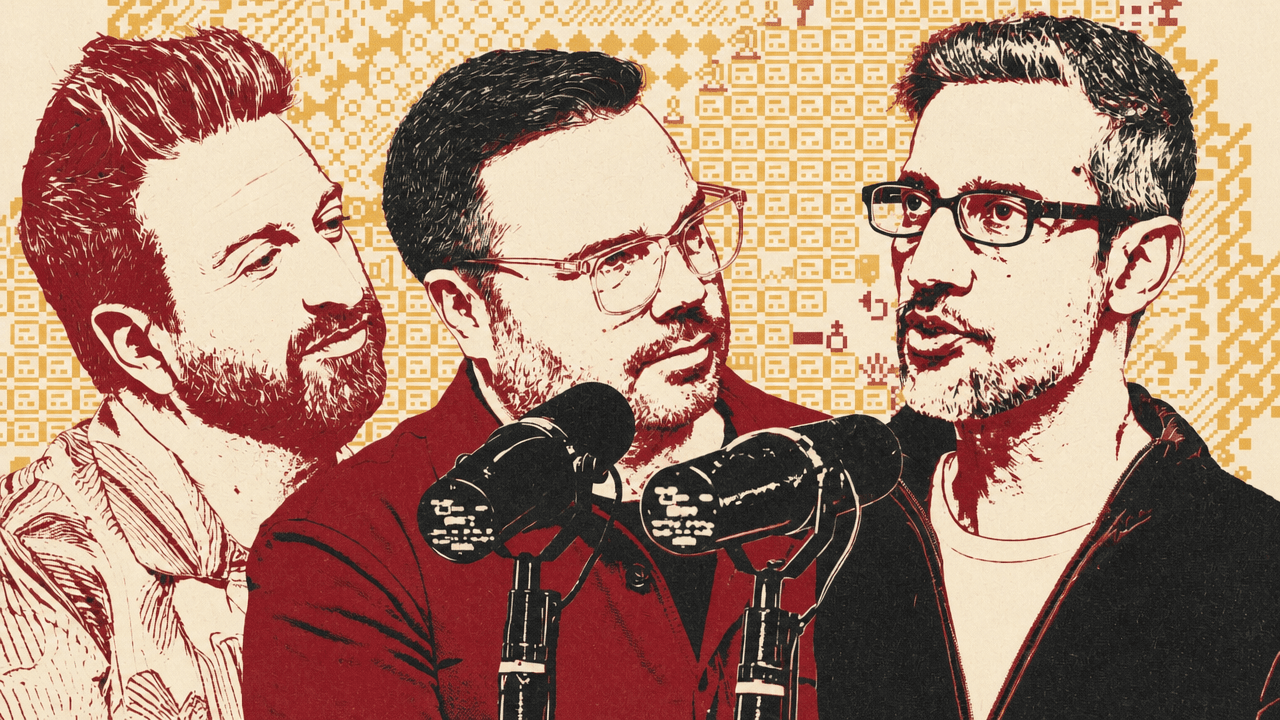
Google says it is at the frontier, but not across every frontier
Sundar Pichai described Google’s position in AI as strong but uneven: at the frontier in some areas, behind it in others, and operating in a market where a three-month shift can change the public story about who is leading.
Asked by Kevin Roose whether Google was still catching up in AI, Pichai said the three years since Bard’s debut “feel like a long time ago now.” He pointed to progress in the technology overall and inside Google, but did not claim across-the-board leadership. On “overall capabilities,” including text, multimodality, voice and audio, reasoning, and general intelligence, he said Google is “very capable.” The weaker area, narrower but strategically important, is “agentic coding with tool use and instruction following,” especially long-horizon tasks.

I think our models are at the frontier in some areas, you know, and there are areas where we are behind the frontier.
That caveat mattered because Pichai repeatedly treated coding as an arena where model quality, product design, developer trust, and data loops now compound. Casey Newton asked whether coding was the place where Google most clearly wanted to close a gap. Pichai agreed that coding is “very foundational” to what Google does. He argued that Google has been strong at “single-shot web frontends” and similar tasks, but acknowledged a gap in long-running work where serious developers operate on complicated code bases.
Pichai’s explanation for the gap was partly about model capability and partly about product surface. He said Google “maybe” did not quite have the surface that Claude Code offered, or what Anthropic may have had through Cursor, giving competitors useful access to coding data flows. Google is trying to build its own loop through Antigravity, which it has been using internally. At Google I/O, he said, he had shared internal token-usage data and had “never seen anything like it” inside Google: usage was doubling every week as employees put the models to work.
That internal deployment, for Pichai, is not just a productivity story. It is a way to improve the system. “Getting it out in the real world and iterating with that data coming back” is part of how Google expects to climb toward the frontier in coding.
The 3.5 Flash launch exposed the practical cost of moving fast
3.5 Flash was only a day old when Casey Newton noted early complaints about pricing and model quality. Sundar Pichai did not litigate the criticism in detail. He said he wanted to finish interviews so he could spend more time with the teams, then framed the reception as something that would take “a day or two to settle in.”
His response drew a distinction between deeper capability and launch artifacts. He said 3.5 Flash was a “new model in a new area” where Google had made progress, and acknowledged that “there could be some regressions.” He argued those could be addressed quickly through post-training. He also pointed to usage limits as a known source of frustration: after releasing many things at once, Google had tightened limits to avoid outages, but would make progress on those limits “very soon.”
Kevin Roose’s broader question was whether Google’s breadth is a weakness against focused AI labs. He contrasted Google with companies such as Anthropic and OpenAI, saying competitors appeared to have a “relentless focus on coding” after tightening their priorities. Pichai rejected the premise that Google’s multiple bets necessarily dilute its effort. Google, he said, is large enough to pursue several serious fronts at once, and coding became an obvious inflection point to which all major labs are responding.
We are in a moment in time in this field where 30 to 60 days look like five years.
That line captured Pichai’s defense of Google’s apparent unevenness. He did not deny that the company can be behind in a given domain. He argued that the cadence of pre-training cycles and product launches makes any fixed ranking unstable. In his view, being “slightly off” can create a public narrative that a lab is behind, only for the narrative to reverse a few months later.
AI mode is not being treated as a search cutover
Kevin Roose asked whether Google will eventually replace classic search with AI mode. He described Google’s changes to the search bar as the biggest in 25 years and asked whether the company would at some point “rip the band-aid off” and make AI mode the default, with the traditional search interface and “10 blue links” effectively gone.
Sundar Pichai’s answer was deliberately gradualist. He said Google needs to bring users along and make sure the product works for their expectations. People still want search to be fast, and through search they are looking “to connect with what’s out there on the web.” He said Google can see positive user response in long-term product metrics, but he did not describe an abrupt switch.
For Pichai, AI mode is part of a continuum. A year earlier, he said, Google did not have AI mode; now many people are experiencing it, and Google has made it easier to move into that experience. But he explicitly said that “sources and links will always be there as part of it.”
I don't see, sources and links will always be there as part of it.
Casey Newton pressed the business-model tension more directly. Roose, Newton said, had told him on the ride down that he had basically stopped doing traditional Google searches and was fully using AI searches. Newton asked whether that is the kind of user Google wants, or whether it sends “a little chill” because traditional search ads are such a strong business.
Pichai answered by widening the frame from today’s ad format to the economic value of the product. In AI mode and agentic mode, he said, Google will be able to do much more for users than it could 10 years ago. The economic value, in his view, follows the total value delivered to users. He said he was comfortable that a combination of subscriptions and ads would support the right models.
“Adam Smith’s rules don’t change in this new world,” Pichai said. Taken together, his remarks suggest Google is not presenting the old search page as something that must remain unchanged. He emphasized speed, links, user expectations, and economic value while describing a gradual shift into AI-mediated search rather than a sudden cutover.
Pichai treats the AI backlash as rational, not merely reputational
Casey Newton raised a public-opinion problem: a New York Times/Siena poll found that only about 16 percent of people said AI was mostly good, while about 35 percent said it was mostly bad. He asked what Sundar Pichai made of the backlash and how much leverage Google had to change it.
| Response in poll | Share cited |
|---|---|
| AI is mostly good | 16% |
| AI is mostly bad | 35% |
Pichai’s answer did not dismiss public anxiety as misunderstanding. He called AI “the most profound technology humanity will ever work on” and said it is progressing at an extraordinary pace. Humans, he said, are not evolved to process that much change. He described public concern as natural for a technology shift of this scale, especially because people are anxious about their economic future and hear claims that jobs will radically change or disappear.
I don't, you know, humans aren't evolved to process that much change.
Pichai said the industry has to do more to show the benefits of the technology. He also acknowledged that infrastructure buildout raises questions companies can address. But he treated the deeper anxiety as more fundamental than public relations or data-center logistics. In democracies, he said, people need to be engaged, aware, and able to make their preferences known. That public dialogue, in his view, is “healthy” as well as uncomfortable.
Kevin Roose connected that anxiety to campuses, asking about recent cases where commencement speakers had been booed by students worried about AI. Pichai is scheduled to give Stanford’s commencement speech, and Roose asked whether he had a “boo strategy.” Pichai said graduates will both drive technological progress and deal with its effects. His intended message, as he described it, is grounded in optimism about the next generation: older generations worry, but the next one rises to the challenge and builds a better world.
Newton then asked for the actual economic case that an entry-level graduate should still see a bright future. Pichai’s argument was not that AI will leave jobs untouched. It was that AI changes the starting point of work, as spreadsheets did for financial analysis. Many more people, he said, will be able to code. He suggested Roose and Newton themselves might be examples of that shift, and argued that society tends to underestimate the “serendipitous” new ways work changes when capability becomes more widely available.
He also used medicine to describe a more complex productivity effect. Doctors, he said, often spend less time with patients than their training and calling would suggest, because their work includes large amounts of other labor. AI could help them spend more time with patients. Radiology, in his telling, shows why simple job-displacement narratives can miss expanding demand: Pichai said he has had many more scans than his father did, and each scan contains far more information because imaging has moved from printed film to digital. He expects that amount of information to grow again, creating a need for AI to keep up.
He still cautioned against minimizing disruption. Every technology shift brings it, he said, and society needs to take it seriously. His disagreement was with “overly deterministic dire scenarios,” not with the idea that work will change.
The agent pitch is constrained by trust, control, and security
Casey Newton described Spark as a coming agent for regular users and asked what an agent was doing for Sundar Pichai personally. Pichai did not confirm the product name in his answer. He said he had used it more in a professional context because it was mainly available in his corporate account. One recurring use was meeting preparation. He said he had even used it as a test case for the Hard Fork interview, though he joked that he did not want to show the output because it included things about Kevin Roose and Newton.
In his personal account, Pichai said, he had asked the agent to look ahead at his meetings and color-code them into categories so he could understand how he was spending time. The system came back with two suggested color-coding schemes; he chose one, and it changed the colors in his calendar. He described the experience as “sci-fi,” while presenting it as a simple example: personal meetings, health-related meetings, work time, and similar categories.
The more important part of the answer was the caution around agents. Pichai compared adoption to getting someone to sit in the back seat of a self-driving car: it has to happen in steps. If an agent does something unexpected, people may back away. Google therefore needs to earn trust by giving people control and transparency.
Security was the harder boundary. Pichai said agentic systems “can be hacked,” and Google does not want to be “ahead of the frontier” in the wrong way. His remarks made agent deployment a practical trust problem, not only a capability race: the product has to become useful enough to act, transparent enough to supervise, and secure enough that expanded access does not create new risks faster than users and companies can absorb them.
Pichai wants coordination without excessive slowdown
Kevin Roose said he had heard Sundar Pichai was headed to the White House for an AI executive-order signing, then asked what the government should be doing to regulate AI. He also asked about pre-release review: whether government should see models before release and sign off, and whether that risks censorship or pressure on companies.
Pichai said he would need to see the full details of the executive order, but described the administration’s engagement with industry as robust. He characterized the approach as balancing innovation and oversight. His strongest example for government-industry coordination was cyber. If a model or system exposes an exploit that could affect a government agency, he said, the government needs to be prepared. That makes coordination valid.
At the same time, Pichai warned against slowing things down too much when the technology is strategically important and when countries want to remain at the frontier. He suggested the balance may shift as systems become more advanced, but described the current approach as prudent.
He also used SynthID as an example of a problem that cannot be solved by one company alone. He described Google as building SynthID, open-sourcing it, sharing it with others, and building a consortium around it. In Pichai’s view, such measures work only if the industry comes together.
Casey Newton then asked about recursive self-improvement: AI systems that can rapidly improve themselves. Pichai said current models are getting better at coding and agentic workflows, and pointed to Antigravity’s ability, over more than 12 hours, to build a simple operating system from scratch. He said that kind of work would ordinarily represent “multiple thousands of hours” for a person. He also described current products as already involving agents, sub-agents, and orchestration among them.
But he drew a boundary between that continuum and full recursive self-improvement. “In the way people describe RSI,” he said, “I don’t think we are there yet.” If such a point approached, he said, it would not be appropriate for a responsible lab to treat it as an internal conversation. It would need a broader discussion, and labs would need to avoid race conditions at advanced stages of AGI. Ordinary agent orchestration, in Pichai’s answer, is already arriving inside products; recursive self-improvement would be a different threshold, with different governance demands.
Selling TPUs to rivals is part of Google’s platform logic
Kevin Roose pressed Sundar Pichai on compute, asking why Google continues selling access to TPUs to rivals and other companies when every major lab is racing for chips and data-center capacity. Why not keep all of that capacity for Google’s own models?
Pichai’s answer was that the two uses are not necessarily constrained by each other. Google plans chips for Google DeepMind and first-party services, with their own business needs and cash flows. Separately, Google Cloud has revenue, cash flows, and long-term planning. If Google did not have Cloud and were not serving external customers, he said, it would not be planning those chips in the same way anyway.
He also argued that external use improves the platform. Researchers at Anthropic using TPUs, in addition to Google’s own use, helps Google make better next-generation hardware. Pichai added that Google uses Nvidia chips too, calling Nvidia’s next-generation chips “incredible.” His broader point was that platform businesses work differently from closed internal infrastructure. He compared the logic to Chrome, Android, Google Cloud, and open source: providing technology to others can make sense on its own merits and can keep Google at the frontier through scale, feedback, and platform economics.
Pichai is more explicit about AGI than his public phrasing suggests
Kevin Roose returned to a previous exchange about AGI. In 2023, Sundar Pichai had said that whether or not systems reached AGI, they would become very capable and Google’s strategy should be the same. Roose noted that Pichai did not say “AGI” in his I/O keynote, while Demis Hassabis did, and asked about Pichai’s current relationship to the term.
Pichai answered more directly than his public caution might imply. “There is inevitable progress towards AGI that’s happening,” he said. He said he had long understood that direction; otherwise, he would not have pivoted Google 10 years earlier to put AI at the center of the company. His earlier point, he said, was not that AGI does not matter. It was that even if AGI were 10 years away, the systems three years from now would be powerful enough that companies and societies should act and prepare.
When Roose asked whether he was “AGI-pilled,” Pichai said he was sure the technology is making foundational progress toward AGI, but less certain whether the timeline is three to five years or five to 10. The progress of the last one to two years, he said, made him feel it is “on the closer side than not.”
He also explained why his language differs from some others in the field. Running one of the world’s largest companies, with responsibility to society, affects the words he chooses. But he pointed back to Google’s own history: 10 years earlier at I/O, he had announced TPUs and AI-first data centers. “Yes,” he said, he clearly understood where the technology was headed.
Casey Newton closed by asking about one of Hassabis’s keynote phrases: that society is in the “foothills of the singularity.” Pichai said Hassabis was defining singularity as the advent of AGI, and that if one believes AGI could arrive “by 2030 or so,” the phrase makes sense. Pichai attributed that timing to how he recalled Hassabis articulating the idea, not to a formal Google timeline. He said he, Hassabis, and others at Google believe it is important to articulate what they believe because they are building at the frontier and society needs to internalize what may be coming.