India’s Language Diversity Makes Human-Like Voice AI a Product Challenge

ElevenLabs co-founder and CEO Mati Staniszewski argues that the central challenge for voice AI is not just intelligence but the ability to interact naturally with people. In his keynote at the ElevenLabs Summit in Bengaluru, he points to India’s many languages and dialects as a demanding test of that capability—and a place to develop it. He presents the company’s speech and agent tools as attempts to meet that challenge, while emphasizing that deploying them in industries such as healthcare and government requires work tailored to each setting.
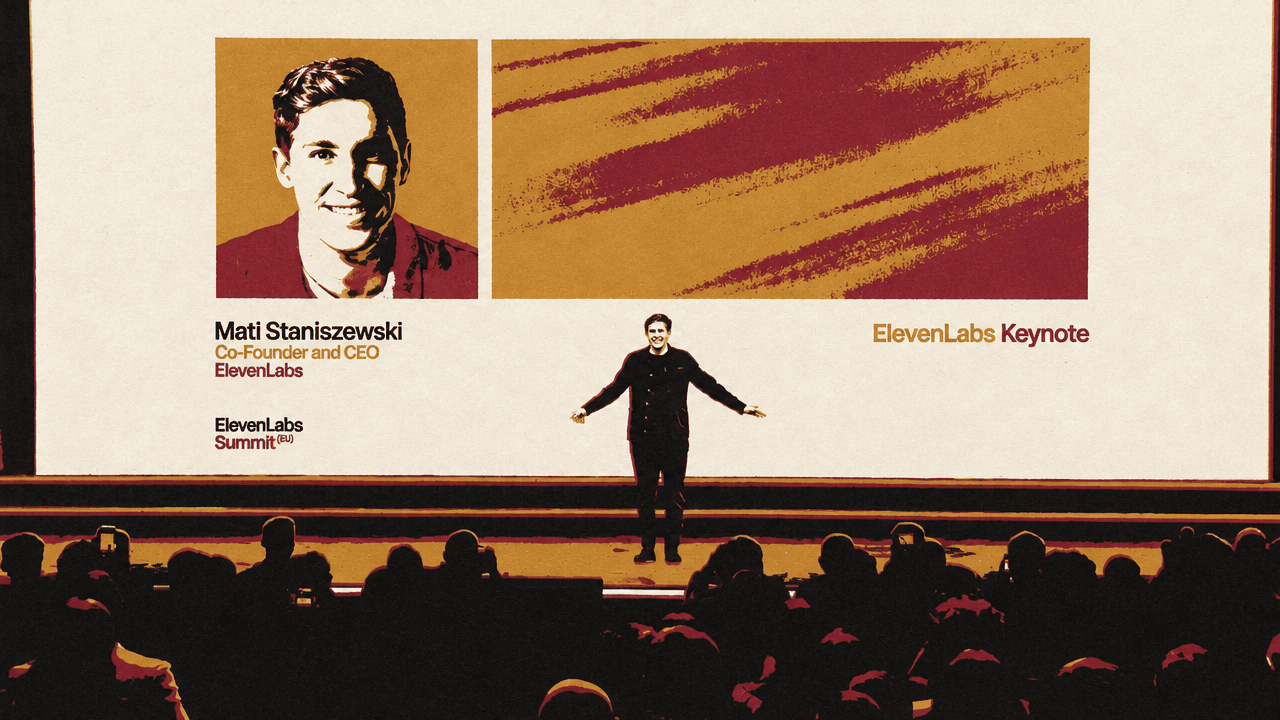
India’s language diversity makes interaction the product challenge
Mati Staniszewski describes India as both a major market for ElevenLabs and a demanding place to build voice AI. Some of the company’s first customers were Indian, its first model spoke Hindi, and India is now its largest market outside the United States. For Staniszewski, that history connects to a broader product question: as AI becomes more capable, what limits adoption may be less its ability to reason than its ability to interact well with people.


A system can be powerful and still fail in use if it sounds robotic, misunderstands someone, or behaves strangely. Staniszewski frames the challenge as needing both IQ and EQ: reasoning ability and the interpersonal skills that shape whether people trust an interaction. AI should let people converse naturally in their languages and dialects, while respecting the social norms of a particular place.
India makes that requirement concrete. Staniszewski cites 22 official languages, 122 major languages, and thousands of dialects and accents. Speech varies not only by region but by relationship: how someone speaks depends on whom they are addressing. He argues that if ElevenLabs can solve interaction across that complexity, it can solve it elsewhere as well.
That means more than producing human-sounding speech. The system must also listen, understand context, respond naturally, follow guardrails, and act on what a person intends. Staniszewski presents the company’s audio models—including text-to-speech, speech-to-text, dubbing, orchestration, voice cloning, turn-taking, and music—as the foundation for that work.
Dubbing v2 addresses one part of the problem: carrying a performance across languages rather than translating words alone. Staniszewski connected the product to his experience growing up in Poland, where foreign films dubbed into Polish were often voiced by one narrator using the same voice for every character and emotion. In that approach, he said, the original performance effectively disappears.
For the demonstration, Staniszewski played a podcast clip first in English and then showed it dubbed with the technology, with a human in the loop. The presentation listed Hindi, Tamil, Marathi, and Gujarati among its language options. He said Dubbing v2 can hear the original performance and carry its emotion, energy, and emphasis into the new language.
He also connected the work to JioStar, one of ElevenLabs’ first Indian customers, which dubbed IPL cricketers into dialects across India. That work, he said, was an important part of the company’s early story. The product aim is to retain something of the original delivery, not simply reproduce its words in another language.
Expressive speech depends on control as well as quality
Staniszewski said Eleven v4, released the previous week, was the company’s fastest and most emotive text-to-speech model. Its live demonstration used a script annotated with directions: excited, playful, serious, determined, slowly, fast, whispering, and even a throat-clearing sound and drum roll. The generated voice shifted delivery in response to those cues.
Staniszewski’s point was that expression also requires control: users should be able to specify how speech is delivered and have the performance follow that direction. He described that control as essential for enterprise deployments, whether the speech is prepared narration or part of a conversation.
The voice in the demonstration belonged to Raju, a voice actor who had partnered with ElevenLabs and shared an AI version of his voice in the company’s Voice Library. Staniszewski said Raju is compensated whenever the voice is used, including during the demonstration. Raju was in the room.
A second demonstration used Staniszewski’s voice to move among Hindi, Kannada, and Bengali in one generation. He said v4 supported 14 Indian languages at the time, with plans to extend support to all 22 in the months ahead. He attributed the model’s range to a new architecture that produces emotional speech in more than 90 languages.
For teams building voice agents, Staniszewski described a longstanding choice between speed and expressiveness. Eleven v4 Turbo, he said, is optimized for conversational use and offers both, with a median latency of 100 milliseconds.
Transcription has to handle specialized and difficult speech
The speech-to-text demonstration used a fast-paced Cello Butterflow advertisement. As it played, a transcript appeared in real time, including a long sequence of names. Staniszewski singled out one of the longest names and said the model had got it right.
He also described domain-tuned transcription. ElevenLabs had recently deployed a healthcare transcription model, he said, with other domains to follow. A slide compared Scribe v2 Medical with another model across overall terms, clinical sentences, and conversation, and displayed figures for each category. Staniszewski used the comparison to introduce the case for adapting transcription to specialized domains.
Agents need industry-specific deployment work
Staniszewski described ElevenAgents as a platform for product, operations, and customer-support teams to create, run, and monitor conversational agents in more than 90 languages. It brings together orchestration, configuration, integrations, and monitoring, and is optimized to work with ElevenLabs’ audio models. He said that integration improves the expressiveness, latency, and reliability of agent interactions.
He said agents on the platform handle more than 15 million conversations a week, three times the volume of six months earlier. He paired that scale with a constraint: each deployment must be customized for its industry. Interaction patterns, terminology, guardrails, and compliance standards differ across healthcare, government, retail, and telecommunications.
ElevenLabs’ forward deployed engineering teams work with customers in the region to address that deployment work. Staniszewski called the process of getting AI into production on mission-critical tasks “messy and unglamorous.” The teams work alongside customers, embed themselves in the business, and combine domain knowledge with the technology. Because ElevenLabs owns the full stack, he said, it can adapt the technology to specific needs rather than polish a product designed for an average company in a different industry.
The company’s approach links research and product teams, forward deployed engineers, and customers: models and products are deployed with businesses, while data and feedback flow back into the work.
Indian customers are applying voice AI to different tasks
Staniszewski named four Indian companies as examples. Pocket FM, one of ElevenLabs’ early customers in India, uses AI narration for audiobooks and long-form content across languages. A presentation slide said the technology enables production 10 times faster.
Razorpay uses ElevenAgents to let merchants deploy conversational AI across subscription renewals, cart recovery, and customer engagement. Staniszewski said context is preserved across the full cycle.
At PhysicsWallah, a presentation slide described AI voice tutoring in Hinglish for millions of users and three times as many queries per session. Staniszewski described a student who gets stuck late at night and can talk through a problem with a teacher at their own pace and in their own language, rather than waiting until morning.
At Havells, users can speak to control home devices, including turning down the air conditioning or switching a geyser on or off. Staniszewski said its voice mode supported eight languages and that the Havells app had more than 2.7 million downloads.
The India commitments include voice restoration and citizen services
Staniszewski also described work with government and nonprofit partners, alongside support for developers. A slide on ElevenLabs’ India ecosystem listed more than 700 startup grants, reach across 1.4 million Anganwadi centers, 75 impact partner organizations, and a stated reach of 15 million.
He named two commitments. ElevenLabs is working with the Department of Empowerment of Persons with Disabilities to help restore the voices of people who have lost them through illness or injury. The presentation slide identified the Department and Ministry of Social Justice & Empowerment, Government of India. Staniszewski also said the company would formalize a partnership with the Government of Karnataka later that day to bring safe and responsible AI to citizen services.