WeChat Could Turn AI Agents Into Population-Scale Services

Nathan Labenz argues that China’s AI opportunity lies less in having categorically superior chat models than in the digital infrastructure through which they can act. After two weeks in Beijing and Shanghai, he found Chinese models useful for travel and everyday assistance but turned to ChatGPT for a medical concern—a distinction he attributes to trust. The more consequential development, he says, would be agents embedded in platforms such as WeChat and Alipay, where payments, bookings, communications, and services are already integrated, along with the surveillance and concentrated access that integration entails.
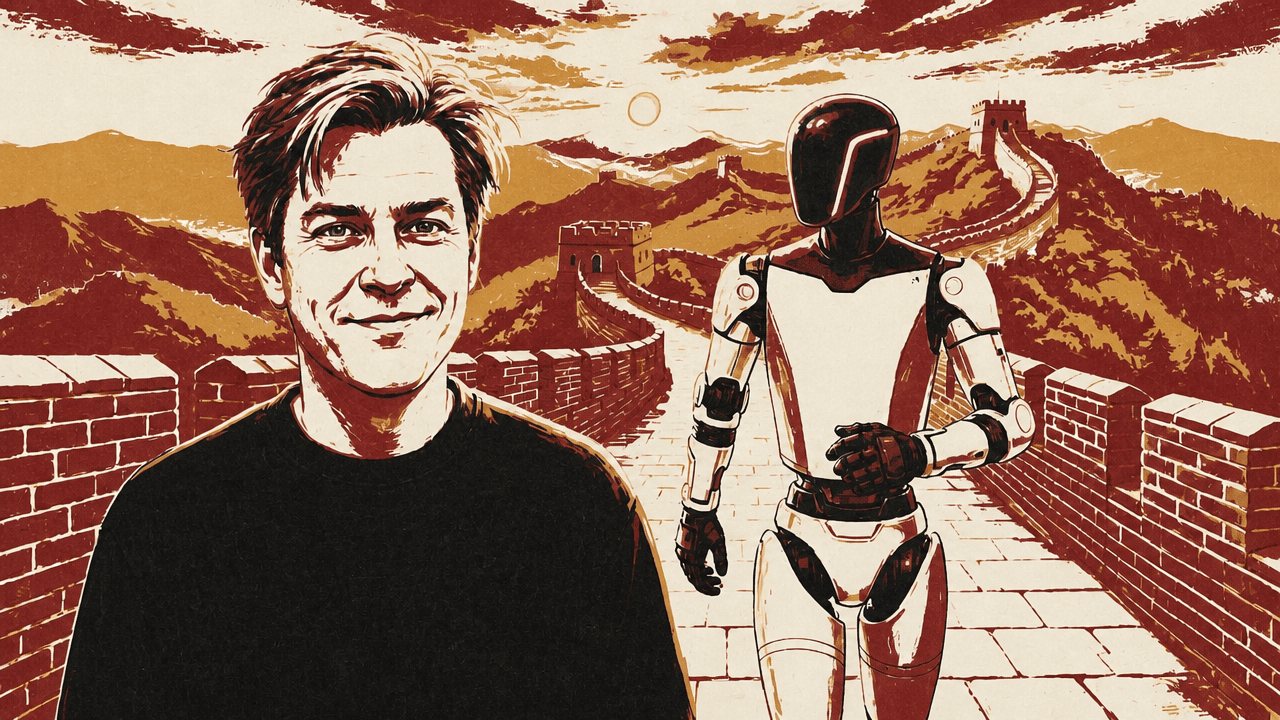
Integrated digital rails make China feel unusually frictionless—and unusually legible
Nathan Labenz returned from Beijing and Shanghai with a ground-level impression: China’s consumer technology is not just a collection of apps. Payments, transit, tourism, delivery, restaurant ordering, translation, social coordination, and customer service are organized around a set of common digital rails. The result is a city experience that feels unusually low-friction—and one in which a great deal of ordinary life is visible to platforms and, potentially, the state.


For a visitor, the basic lesson was simpler than the security lore around China suggested. Labenz used a separate Android phone, fresh accounts, two international phone lines, and a VPN backup after receiving strongly precautionary advice from contacts with national-security backgrounds. But in practice, the setup mattered less than international roaming. His U.S. roaming plans gave him normal access to Gmail, Google Play, and other services that visitors might expect to be blocked by the Great Firewall. He never needed the VPN.
His understanding was that an international roaming connection routes traffic back through the user’s home carrier before it reaches outside services. He was not claiming expertise on the underlying network architecture; the practical point was that it worked smoothly. The firewall, which had appeared to be the central technical obstacle in online advice and AI-generated travel guidance, was largely irrelevant to his experience.
For an ordinary visitor, Labenz’s recommendation was correspondingly straightforward: make sure international roaming is active, download the essential Chinese apps before departure, and do not lose the phone. The core tools were WeChat and Alipay for communication and payments; DiDi for rides; Trip.com for hotels, rail, flights, attractions, and tickets; and Meituan for delivery and restaurant services.
The difference is not merely that China has local equivalents of Uber, Venmo, Expedia, DoorDash, and WhatsApp. The platforms act as common infrastructure. WeChat is at once a messaging network, social graph, business interface, QR-code identity system, and payment rail. Alipay is another major payment system with a broader ecosystem of services. Trip.com centralizes much of the practical work of tourism. A visitor does not have to stitch together a set of niche services that may or may not be interoperable; the relevant platforms are already standard.
Labenz could load international credit cards into WeChat and Alipay, though he could not use every domestic peer-to-peer transfer function. That uncertainty made his first payment after landing in Beijing feel consequential. At 3 a.m., he bought a fruit drink at an airport self-checkout kiosk, scanned the product, presented the machine with his payment QR code, and watched the transaction complete on his phone. Once that worked, the rest of the system became available.
China, as he encountered it, was nearly cashless. Labenz did not see cash in ordinary use during the trip and had to ask an acquaintance to retrieve some banknotes from an office so he could bring souvenirs home for his children. He was told that businesses are legally required to accept cash, but it was plainly not the default way people transacted. The phone functioned as wallet, ticket, address book, menu, ride-hailing device, booking system, and translation layer.
DiDi looked familiar to an Uber user: rapid pickups, several vehicle tiers, and a liquid market in Beijing and Shanghai. One small difference was that lower-cost rides could begin with an estimated fare and be settled afterward rather than paid in advance. The larger difference was price. Labenz repeatedly took long cross-city rides for amounts that he thought could cost close to ten times as much in the United States.
The surrounding retail economy felt more formalized than the older image of China that he had expected. At tourist sites, he found displayed prices, little haggling, limited sales pressure, and no meaningful experience of being hustled. The ordinary transaction was generally direct: identify the item or service, scan, pay, and leave.
Translation software made this system accessible despite the language barrier. Hotel staff, drivers, and service workers routinely spoke into translation apps and showed visitors the resulting text. Labenz used screenshots and Google Lens to understand interfaces without a full English-language version, particularly in Meituan. In some restaurants, QR codes at the table opened a menu, enabled an order, and initiated payment without a conversation with a server. He described the result as travel that remained adventurous without producing the sense of disorientation a foreign visitor might have faced a few decades earlier.
The individual conveniences were less striking than their accumulation. In DiDi, Labenz could see the countdown clock on the red light holding up the car sent to collect him. In one hotel, the room television displayed whether the free laundry machines were available. When he woke in the night with a short-lived allergic reaction, a companion ordered over-the-counter allergy medicine through Meituan while they were traveling by bus. The medicine reached their destination in roughly 20 minutes, before they arrived.
His thought experiment was to remove price differences and historical context, send a visitor first to New York or San Francisco and then to Beijing or Shanghai, and ask which country seemed richer. On the basis of newness, connected services, low-friction payments, and the sense that systems anticipate the next task, Labenz thinks many visitors would answer China. That was not a claim about national wealth measured by an economic statistic. It was a claim about lived experience: the phone is designed into almost every routine transaction.
The same convenience rests on pervasive observation
Nathan Labenz saw the systems that reduce friction making people visible as well. Cameras were indoors and outdoors, including multiple cameras covering restaurant interiors. International visitors were required to produce passports for high-speed rail and entry to the Forbidden City, and sometimes for public parks. Outside a private room, he concluded, a person should assume they are on camera.
Nominal park fees added another small point of uncertainty. They were often only a few yuan, and Labenz was unsure whether they served identification, revenue collection, maintenance, or some combination of those purposes. Beijing also had a large number of clean public toilets, substantial street-cleaning labor, and visibly maintained parks and sidewalks. The public toilets in particular stood out to him as an unglamorous but meaningful public-service achievement, given how difficult they can be to find in many American cities.
The immediate payoff of the system, as experienced by a visitor, was safety. People he met often spoke as if low crime were simply the expected condition of public life. Labenz felt safe throughout the trip and heard from women and families that being outside at night can feel comfortable in ways it often does not in New York. In one part of Beijing at around 11 p.m., he saw many children still out in public.
The recovery of a lost phone illustrated how surveillance and information integration can work together. Because so much daily life is mediated through the phone, losing one can be a serious problem. Yet Labenz heard multiple stories of people leaving phones in taxis and recovering them quickly. A person could go to a nearby police post, indicate where they had exited the vehicle, have officials review footage, identify the license plate, locate the driver, and ask that driver to return the device. He repeatedly heard that this could happen within an hour or two.
China has definitely picked its place, and for now I think it is working for them.
That is not a story of surveillance as either pure public service or pure coercion. Both were present in Labenz’s description. People generally understand that they lack digital privacy and are being monitored. In exchange, at least as a visitor experiences it, public life feels orderly, safe, and less predatory. He felt able to lower his guard rather than constantly worry about theft, scams, or whether a taxi driver would exploit him.
The potential for abuse, I think, is pretty high. But from what I saw as of now, it seems to be working.
The risk, he argued, is concentrated in what happens if the political context changes. Labenz asked people what might happen if President Xi retired or died suddenly and found no clear answer about a successor. An apparatus connecting cameras, identity checks, payment-linked activity, and other forms of administrative visibility could become especially dangerous during a power struggle or period of instability. The present arrangement may work partly because people know the boundaries and generally do not cross them. A different political context could make the same machinery much more abusive.
He connected this to a wider question that AI will force on other societies. Modern legal and policing systems often operate with an implicit understanding that many minor violations will not be noticed, investigated, or prosecuted. If AI systems can review enormous volumes of video, documents, transactions, and identity data, that understanding changes. China has already moved further toward a system where detection is technically plausible and people expect to be watched.
The practical reality of the firewall provided a second example of a system in which formal rules and actual practice diverge. VPN use is technically illegal, but many of the people Labenz met used VPNs openly, including company-provided VPNs. They were not especially concerned about punishment; one person compared the prospect of trouble to being struck by lightning. Some people who complained about censorship also said they understood why the government might restrict access to sensitive information for a broader public they considered less able to interpret it.
The relevant point was not that everyone approved of censorship. Several people did not. It was that a restriction, a workaround, and a rationale for the restriction could be treated as coexisting realities. That accommodation helps explain why formal rules alone did not tell Labenz much about what a foreign traveler or a Chinese knowledge worker could actually do online.
Useful models are already everywhere; trusted agents need a place to act
Nathan Labenz used Chinese AI products as practical travel tools before he used them as objects of analysis. He deliberately left his usual Claude and ChatGPT accounts aside during his first days in Beijing, downloaded DeepSeek, Kimi, and MiniMax, and used them to revise itineraries, explain historical sites, and answer questions while moving through the city alone.
The use case did not require frontier-level autonomy. Heavy rain closed parts of the Great Wall on the day he had intended to visit; Trip.com notified him of the closure and refund. He turned to the models with a situational question: given where he was, the time, and the day, what should he do instead? The answers were useful enough to redirect the day.
At the Lama Temple, a Tibetan Buddhist site in central Beijing, the models helped him understand how such an institution fit into the city’s history. At the Temple of Confucius and the Imperial College, he asked why Confucius, understood as a philosopher rather than a god, could nevertheless be the focus of ritual reverence and imperial obligation. Kimi 2.6, which he used before the release of Kimi K3 around the World Artificial Intelligence Conference, was fast and capable enough to make the sites intelligible while he was standing in them. The apps were free.
That is a category of AI value that can be lost in arguments about benchmark leadership, long-horizon agents, or cyber capabilities. A system does not need to be the best model in the world to be useful. For itinerary changes, translation, historical context, and ordinary planning, Labenz found the Chinese products fully capable.
Their limitations were visible too. Questions approaching sensitive political territory could prompt a partial answer followed by a retraction and refusal. He encountered this around questions adjacent to Tibet and Taiwan, and when he asked about the contemporary status of the Manchu ethnic group that founded the Qing dynasty. Different apps handled the same territory differently; one might answer where another refused.
Labenz took the pattern as evidence that censorship often sits in the deployed application layer rather than necessarily in the underlying model. He could sometimes see an answer begin to appear before it was replaced with an apology. He compared the result with over-refusal in Western AI products: attempts to satisfy regulators or act responsibly can overshoot and make systems less useful.
MiniMax was the most consistently straightforward of the three in his experience, particularly on refusals. Kimi was his preferred product overall, with what he called the best “vibes” and taste. But the important distinction emerged when the stakes rose. During the nighttime allergic reaction, Labenz woke with intense itching and hives across his torso. Despite being satisfied with the Chinese apps for tourism and historical questions, he downloaded ChatGPT when the issue felt medically consequential.
He did not log into his usual account or create a paid account. He wanted the health experience he regarded as the strongest available, based partly on prior experience using ChatGPT in relation to his son’s medical care. Over roughly 15 minutes, the interaction helped him track whether symptoms were improving. As the hives subsided, the guidance shifted from seeking immediate medical attention to monitoring the situation and sleeping if the improvement continued. The symptoms passed.
The difference was not simply capability. It was trust: which product did he feel able to rely on when the consequence became personal and potentially serious? A model may be good enough for an ordinary informational task while still not being a user’s first choice in a health-related moment.
That distinction matters because the next stage of AI diffusion is not simply about persuading people to open a chatbot. China already has consumer AI with broad reach. The product Labenz heard about most often was Doubao, ByteDance’s consumer AI assistant. He was told it had roughly 150 million users, was highly voice-native, and occupied a companion-like role among a broad range of users.
DeepSeek, he heard, may be more prominent in Western conversation about China than in ordinary Chinese consumer use. Qwen was described as more relevant to technical users, particularly for fine-tuning and cost-sensitive startup applications, than to everyday retail use. For ordinary consumers, people repeatedly named Doubao.
Labenz tried to access the international version, Cici, which required using a VPN to appear to be in another country because it was unavailable through his U.S.-registered app environment. He did not use it extensively. The more consequential evidence came from the social role people described.
A tour guide at the Forbidden City immediately understood AI as a valuable career field: a place where money, energy, and opportunity were concentrated. When Labenz asked what people actually used, she named Doubao. People in their late twenties and thirties told him their parents used it. Two women described mothers who had compared them unfavorably with the system: why, they had been asked, could they not be as kind and sweet as Doubao?
The guide described Doubao’s value more intimately. Some matters, she said, are hard to discuss with another person. Someone thinking about leaving a boyfriend might talk to Doubao about it. Before a system like that, she said, the person might simply keep it to themselves. “Nobody will judge you” was her formulation: Doubao would not judge, and users would not be judged for turning to it for emotional support.
These accounts were not a survey of Chinese society. They do, however, identify a different measure of AI diffusion. The socially important product may not be the model most admired by researchers or most discussed in Western media. It may be the one that reaches parents, speaks naturally, becomes emotionally acceptable, and gives people somewhere to articulate concerns they would otherwise keep private.
The enthusiasm around AI was not uncomplicated optimism. Labenz heard concern about job loss, competition, and the economic outlook. The familiar logic—that AI may not replace a worker directly, but another worker using AI might—appeared to be one reason people felt pressure to adopt. He heard a story of a former software engineer now driving DiDi after losing work for AI-related reasons. He could not verify the story, but took it as reflecting a broader sense of economic anxiety.
That can make pro-AI sentiment defensive as well as hopeful. People may be adopting because they see opportunity, but also because they fear falling behind users who learn to use the technology more effectively.
WeChat could turn an agent into an operational service at population scale
Nathan Labenz sees the prospective WeChat agent as more consequential than an ordinary chatbot launch because WeChat already mediates so much of daily life. It is where people communicate, exchange QR codes, connect to businesses, make payments, book services, and manage appointments. An agent embedded in that environment would not merely recommend a restaurant or draft a message. It could potentially make the reservation, pay for it, coordinate with a contact, and arrange transportation.
He heard that WeChat was testing its own agent after blocking an attempt by another company to build a cross-platform “super agent” that could operate through WeChat. The competitive tension was unsurprising: control of the agent layer would also mean control of access to the most deeply integrated consumer platform in the country.
No single Western app, Labenz argued, combines WeChat’s ubiquity with its depth of connection to payments, contacts, services, and real-world bookings. Western companies can integrate AI into search, email, social networks, or a payments product. But the user’s life is distributed across more separate services. WeChat begins with a more comprehensive map of the workflows an agent would need to act on.
Labenz did not use the beta and heard conflicting reports about the extent to which Chinese companies can scale AI services. Serving a potential audience of more than a billion users would require substantial compute even for Tencent. Still, he considers a broad WeChat agent launch one of the most important deployments to watch. If it works at scale, agent use could become part of daily life quickly—not because users must adopt a wholly new workflow, but because the workflow already runs through WeChat.
The same distribution logic may apply to healthcare. Ant Group, the company behind Alipay, is developing an AI doctor, according to the people Labenz spoke with. He repeatedly heard concern about China’s aging population, including discussions of robots as potential sources of elder care and AI medicine as a way to extend health support.
The demographic pressure was described in personal terms. After generations shaped by the one-child policy and its cultural aftermath, many younger adults may be the sole child and sole grandchild in a family structure with two parents and four grandparents. That creates an inverted pyramid of care responsibilities. Where will the doctors, caregivers, and resources come from?
The Ant Group product, as Labenz heard it described, resembles Western AI-health efforts in its cautious framing: free access, attention to reliability, disclaimers, and a position as a resource for patients and clinicians rather than a replacement for doctors. The potential difference is distribution. Alipay already sits on an enormous number of phones and handles an enormous volume of daily transactions. If Ant Group decides an AI product is ready for broad release, it can place that product into ordinary life quickly.
The AI advantage in this account is therefore not necessarily that Chinese chat models are categorically superior. Chinese systems were useful for low-stakes assistance, and Labenz still reached for ChatGPT in a medical moment. The larger advantage may be that pre-existing platforms give agents the permissions, interfaces, and real-world hooks to become operational services rather than stand-alone conversational tools.
Hardware ambition was visible; reliable autonomy was harder to find
Nathan Labenz found the World Artificial Intelligence Conference in Shanghai notable less for unfamiliarity than for resemblance. Its scale and trade-show language reminded him of CES and NVIDIA GTC: convention-center halls, giant corporate booths, polished displays, and the expected mix of major companies and technology demonstrations. A lunch at a Chinese hyperscaler, arranged through a LinkedIn connection, felt much like visiting Google, from the guest badge and huge cafeteria to the communal tables. The company’s startup mixer likewise resembled a Silicon Valley event, with founders pitching early-stage ventures while a large platform company supplied the space, food, and potential cloud or AI-inference credits.
Those parallels matter mainly as context for a more limited conclusion. China’s AI and technology ecosystem did not look like a sealed-off alternative system. It contained familiar platform dynamics, founder reverence, startup hustle, and large companies cultivating developer and entrepreneurial ecosystems. Labenz also saw an Apple-like retail aesthetic in Huawei and Xiaomi stores, except that the stores sold cars alongside phones and laptops.
Robotics was the area where the gap between industrial ambition and demonstrated autonomy was most apparent to him. He saw delivery robots at hotels carrying meals to guests’ rooms and small wheeled machines cleaning public spaces. At Tencent’s booth, he tried a brief robot massage. The machine applied real pressure around his shoulder area; it was more than a theatrical prop, though he would still choose a human massage.
At the Robot Expo Hall, many more ambitious demonstrations were paused or not working. A robot presented as capable of cooking was not cooking. A human magician said he had spent six weeks training a robot to perform a card trick, but the demonstration appeared scheduled for only one showing during the multi-day event. When Labenz extended his hand toward a walking robot, the operator standing behind it signaled that it would not shake hands; it was being teleoperated.
His exhibition-floor read was provisional: China’s hardware momentum, manufacturing potential, policy support, and number of companies entering robotics were obvious. Reliable general-purpose autonomy was not. He suspected Chinese companies may be better positioned to scale robot production while American companies may be further ahead on the models needed to power broadly autonomous humanoid and similar form factors. He identified Unitree as a possible Chinese exception and did not present the comparison as a settled industry assessment.
Labenz connected this industrial push to what he called China’s “mayor economy,” while stressing that it was his interpretation rather than a comprehensive political-economic account. In his telling, local officials advance by earning approval from higher levels of the party rather than by winning local elections. That gives them an incentive to show that they can grow successful local economies and support nationally important industries.
When electric vehicles, humanoid robots, or another strategic sector becomes a priority, municipal and provincial leaders have a reason to help local companies become winners. Labenz did not describe this as simple command-and-control planning or the selection of one state-owned champion. He described intense competition among private firms, reinforced by officials who know that a successful local company can help their own advancement.
That incentive structure may help explain why policy priorities can produce broad fields of competing private-sector activity. It also suggests why the question of AI diffusion cannot be separated from the institutions that distribute, finance, manufacture, regulate, and operationalize the technology.