Young Women’s Shift Left, More Than Men’s Shift Right, Widens Political Divide
A researcher argues that the widening political gap between young men and women is driven chiefly by young women moving left, not by young men moving sharply right. He says party signals may deepen the divide: Democrats can leave men feeling unrepresented, while young women may see little reason to feel represented by Donald Trump.
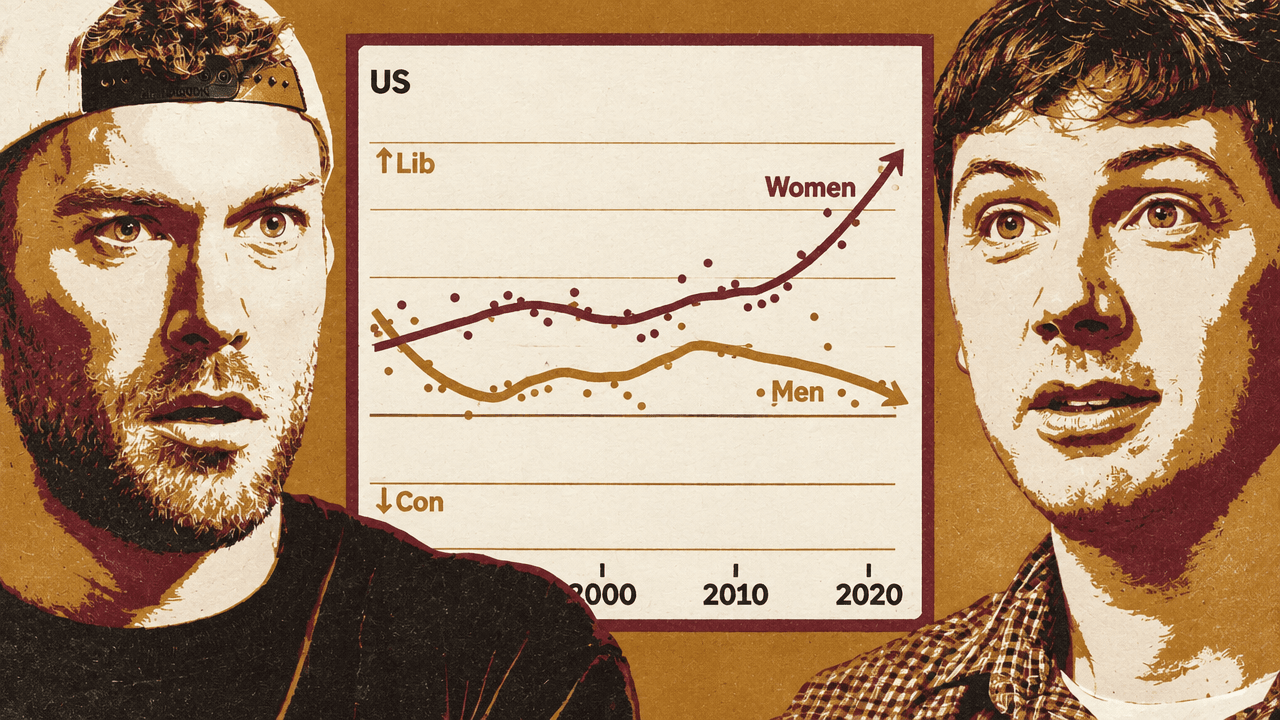
The widening gap is driven more by women moving left than men moving right
The widening political gap between young men and women is not, in the researcher’s account, primarily a story of young men moving sharply to the right. He said he began investigating after noticing a divergence in Gallup data dating from around 2016: young women were becoming much more liberal than young men. The gap appeared across political and cultural measures, including feminist identity.
Among Baby Boomers, men and women were within about five percentage points of one another in identifying as feminists, with both groups in the high 30s or low 40s. Gen X showed a similar pattern. For Gen Z, however, the gap was about 15 points: a majority of young women identified as feminists, compared with roughly 40 percent of young men. The researcher clarified that Gen Z men were at about the same level as millennial men; the divergence was driven by women’s higher identification.
Chris Williamson described a graph he had seen showing men’s and women’s political orientations drawing close to parity before separating again, with a gap of 23, 26, or 30 points. He asked whether women had moved sharply left while men stayed relatively flat. The researcher’s answer was that the pattern was not young men moving far to the right, but women becoming more liberal.
Abortion is one area where he sees a particularly sharp shift among young women. He said attitudes changed substantially after Roe was overturned, and contrasted the more nuanced discussion of abortion in the 1990s with the terms of debate in the 2020s. He also said elected Democrats had once talked about the issue differently. He connected this shift to a broader political problem: leaders can make the divide worse when they frame an issue as a contest in which one side’s gain must be the other side’s loss.
Williamson called that a zero-sum approach. The researcher agreed, arguing that it leaves little room for common ground or compromise. He described this as part of a wider change in Democratic politics, from a stronger emphasis on class and economics toward greater attention to cultural issues. In that setting, political signals about who is represented can carry added weight: voters may see not just a disagreement over policy, but an indication that the other side has no place for them.
The parties send different signals, but neither earns every young voter’s trust
The researcher pointed to a Democratic Party “who we represent” page that listed about 17 groups, including veterans, immigrants, African Americans, and women, but not men. He said the omission was conspicuous and that he could only conclude it was purposeful: in his view, men were not a group the party was advocating for.
The contrast he drew was not that Republicans had built a welcoming alternative for young women. He described Trump as a candidate who did not seem sympathetic to many young women’s concerns, citing his marital infidelity, his sexual encounter with a porn star, and sexual-assault allegations. In the researcher’s framing, young women could see little reason to feel represented by Trump, while the Democratic Party’s presentation could leave men feeling overlooked. As Williamson put it, “Who the fuck do you think they’re going to vote for?”
Williamson called the Democrats’ omission an “elected own goal.” The researcher agreed, saying it was especially perplexing for a party whose reason for existing, as he understood it, was to advocate for marginalized people and people who were struggling. Working-class men, he argued, had suffered particularly in recent years. He said job growth in service-sector and health-care work had gone disproportionately to women in those communities. A focus on working-class people, he suggested, could appeal across race, class, and religion; he questioned why Democrats had not taken up that potential point of connection.
Feeling unrepresented by one party does not necessarily mean trusting the other. The researcher said roughly one in three young men—or perhaps close to four in ten—reported that they trusted neither the Democratic nor the Republican Party. Some had seen Trump as an outsider to a broken political system, someone who might “clear the swamp.” But that did not mean they trusted the Republican Party itself.
Williamson connected distrust to being overwhelmed by conflicting information. In his view, a constant stream of opposing claims may not persuade someone of one particular position; it may instead leave them unsure what to believe. He argued that, in that state, certainty can become a proxy for expertise: someone who speaks without hesitation can seem to have the answer.
The goal of like pressure hosing you with conflicting points of view is not to convince you of any one particular perspective. It's to make you completely nihilistic and throw your hands up and say I don't, I don't fucking know.
Williamson noted that Republicans had chosen Trump as their candidate, leaving no alternative within the party for voters who disliked him. He saw Democrats’ failure to signal that men belonged in their coalition differently: as a choice the party could have made otherwise. The researcher’s account leaves both signals in view. Young women may see little welcome in Trump, while young men may feel neglected by Democrats and still distrust Republicans.
A changing Democratic coalition is another part of the explanation
The researcher linked Democrats’ difficulty appealing to men to changes in the party’s composition. He said self-identified Democrats had been about 60 percent women and 40 percent men over the preceding two decades. The party had also become more college-educated: college graduates, he said, had shifted from being roughly evenly distributed between Republicans and Democrats toward the Democratic Party.
In his account, college-educated women were a major part of that change. About one in three Democrats was a college-educated woman, and he said their views on abortion and reproductive health, climate change, and trans issues differed substantially from those of many other groups. Williamson suggested that the party had less diversity of viewpoint within it than in the past. The researcher separately pointed to campaign staffing, saying college-educated women were disproportionately represented in important Democratic roles.
These coalition and staffing observations sit alongside the researcher’s concern about men’s absence from the party’s list of represented groups. He did not explain that omission as a result of the party’s composition. Instead, he described it as perplexing given the party’s stated concern for people who are struggling, particularly when working-class men are also facing employment changes.