Status Anxiety Is Turning Female Privilege Into Public Grievance
 Chris Williamson
 Tania Reynolds
 William Costello
 Freya IndiaChris WilliamsonThursday, May 7, 20267 min read
Chris Williamson, Tania Reynolds, William Costello and Freya India argue that some young women’s pessimism is partly a status phenomenon: material advantage can coexist with incentives to present as injured, caring or constrained. In their account, gendered expectations make women easier to read as victims than agents, while beauty, higher-education status games and social media turn grievance, attractiveness and relationships into public signals.
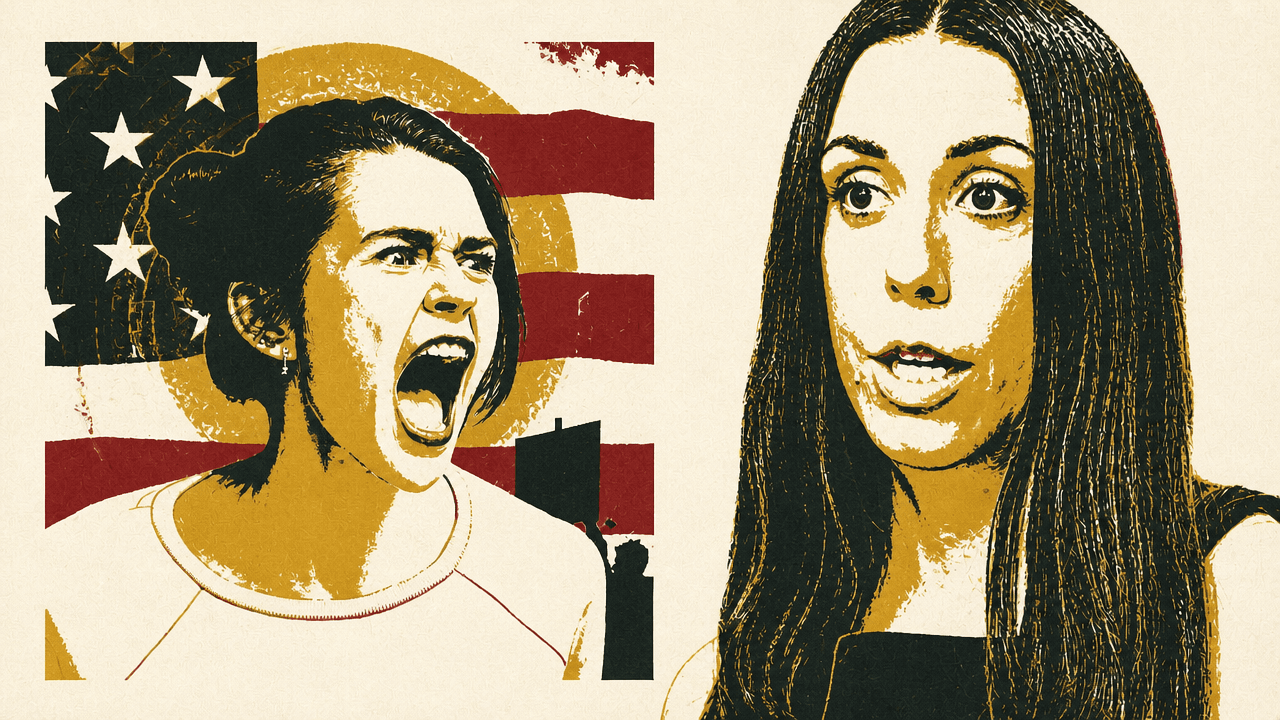
Status anxiety can make privilege look like grievance
Chris Williamson frames the puzzle as a mismatch between material position and subjective pessimism: young men are now more likely to be unemployed than young women, he says, yet young women are “far more financially cynical,” including being 21 points less likely than young men to believe they will ever out-earn their parents. He also cites a finding that white women are more likely than non-white middle-class women to feel the country is racist.


Tania Reynolds suggests one explanation is not simply ideology but a constraint on female status display. She links the pattern to findings that women may be permitted to be agentic only when acting on behalf of someone else. In ethnographies of adolescent girls, she says, popular girls had to be “super, super nice”; status was allowed if it was overpaid for in kindness.
Reynolds connects this to Joyce Benenson’s work on “leveling,” where women are more likely to respond to someone surpassing them by invoking equality: “we should all be equal.” Her hypothesis is that women with more going in their favor may need to present themselves as especially caring, self-sacrificing, or injured in order to avoid resentment from other women. The “martyr” posture, in that account, is not only an expression of suffering; it can be a social technology for making achievement tolerable to peers.
Williamson offers a sharper version of the same idea through an analogy from a private group chat: when there is no high parasite load, the immune system “gets bored” and begins reacting to dust and pollen; when the middle class lacks serious threats, its threat system begins treating trivial irritants as danger. His examples include white privilege, gender identity, ultra-processed foods, oat milk, and microaggressions. The claim is not that all grievances are fabricated, but that sensitivity rises when the background level of threat falls.
Freya India gives the same dynamic a psychological and social-media form. With more time to introspect and ruminate, she says, girls and young women scrutinize partners for “icks,” then turn the same diagnostic gaze inward: pathologizing themselves, overanalyzing personality traits, and asking what is wrong with them. In her view, problems that might once have been absorbed by raising children or managing larger responsibilities are now redirected inward or against romantic partners.
William Costello adds that the behavior is rewarded inside the status ecosystem of higher education, where women now dominate. Espousing these views, he argues, signals that one understands “the ideology of the leading status people” in that world. Williamson glosses the posture as “showing fealty to the cause.”


The victim-perpetrator template disadvantages both sexes
Reynolds describes a set of studies on a “victim and perpetrator” cognitive heuristic. When men and women are involved in an instance of harm, she says, people are more likely to see women in the victim role and men in the perpetrator role. They are more likely to blame men and more likely to feel sympathy for women.
That asymmetry, in her account, helps explain why men may receive little sympathy even when harmed: it is “cognitively harder” to see them as victims. But she resists treating the pattern as a simple female advantage. The same template that makes women easier to see as victims also makes them harder to see as agentic actors in domains where agency matters, such as selecting a CEO or president.
Williamson summarizes the tradeoff as: one sex does not get sympathy, and the other does not get belief. He connects this to workplace behavior. Women who need to be assertive or dominant may “temper the throttle” because they fear being read as bitchy. Costello supplies a related label: women do not want to be seen as “a bitch” or “a diva.”
Reynolds casts the problem as an agency-warmth continuum. Women are expected to remain closer to warmth; if they move too far toward agency, they are judged low in warmth. Men are expected to occupy the agency side; if they display warmth, for example by crying, they risk being seen as less competent. Both sexes, she says, are encouraged to “stay in our lanes.”
Williamson presses the point further: too much warmth can itself make women seem pliable or not competent, because brusqueness is often read as a sign of competence. Costello argues that protectiveness toward women is often “repackaged as oppression.” He grants that paternalism can be real and that abuse of women can occur under the guise of protection, but says it remains striking how much more protective people are of women than men.
Some advantages are easier to name than others
Williamson asks whether attractiveness is under-acknowledged as a kind of privilege. Costello says yes, and argues that both ends of the attractiveness distribution matter: there are benefits to being attractive and serious costs to being unattractive. He notes that “pretty privilege” can have costs too, including other women seeing attractive women as more promiscuous, but says the benefits are “enormous” across the board for men and women.
Costello’s stronger claim is that people are reluctant to recognize attractiveness as a form of privilege at all, even while readily acknowledging other kinds. He says his lab has unpublished data, alongside other evidence, showing an attractiveness discrepancy between women and men: “women are just more attractive.” From that he infers a feminine advantage in a domain that can be converted into resources.
He also links beauty to female status. Studies, he says, show beauty functions as status for women, with women deferring to more beautiful women in a way analogous to men deferring to more physically formidable men. If beauty is status, then pregnancy and motherhood can be perceived as threatening a woman’s status position. Costello suggests this may be one under-acknowledged reason some women are put off having children: they hear “horror stories” and expect to take “a massive beauty hit.”
Williamson notes that the beauty cost of having children may be lower than it has ever been, but still exists. He also points out the contradiction: if women avoid having children partly because motherhood affects beauty, then the social value of beauty cannot simultaneously be denied.
Costello says some women do acknowledge this directly, using language such as “I’m not sacrificing my body for that.” He also cites new data, as he describes it, showing that parents and non-parents have similar levels of happiness, while parents have greater meaning — especially women — and lower relationship satisfaction. Parenthood, in this account, may increase meaning while taking a toll on the couple relationship and on a woman’s perceived mate value through changes to beauty.
Social media turns mate value into a public product
India argues that social media platforms have incentivized women to see themselves less as human beings and more as products. Their lives become exercises in marketing and optimization. Under those incentives, a child disrupts the image of the “perfect, pristine product.”
The evolutionary point, as Williamson frames it, is paradoxical: at base level, wanting to look good is connected to reproduction and attracting a mate. But Instagram can provide enough dopamine and status that online display becomes the higher priority.
Costello responds by distinguishing evolutionary outcomes from conscious goals. He says it is a misconception that humans possess “fitness optimizing mechanisms.” Instead, he describes people as “adaptation executioners”: they enact desires that, over evolutionary time, tended to produce offspring, but they are not consciously trying to maximize reproductive success. People may want sex, status, mate value, and desirability; historically those motives would often have led to children. In the modern environment, those same motives can be detached from reproduction.
Reynolds adds a supporting claim from Joyce Benenson’s cross-cultural work: among young people, finding a romantic partner is one of the primary goals, while having children ranks among the lowest. Benenson’s argument, as Reynolds presents it, is that humans likely evolved a desire to attract mates, but did not need to evolve a separate desire to have children, because sex reliably led to children before effective contraception.
Costello calls reliable contraception an evolutionarily novel technology that has “thrown the whole thing up in the air.” India then applies the point to dating norms shaped by platforms: for some young women, the relationship itself becomes an accessory to display online. Williamson recalls her earlier line that “relationships are just brand partnerships now.” India says partner selection is therefore shaped not only by private attraction or compatibility, but by how other women will react when the relationship is displayed — the “launch” of a partner online.