How Wojtek and Sergeant Reckless Kept Ammunition Moving in Battle
The Fat Electrician presents Wojtek the bear and Sergeant Reckless the mare as military assets whose value came from keeping ammunition moving under battlefield conditions. In his account, Wojtek began carrying artillery shells after watching Polish soldiers at Monte Cassino, while Marines trained Reckless to haul ammunition up hills in Korea when trucks could not reach their positions.
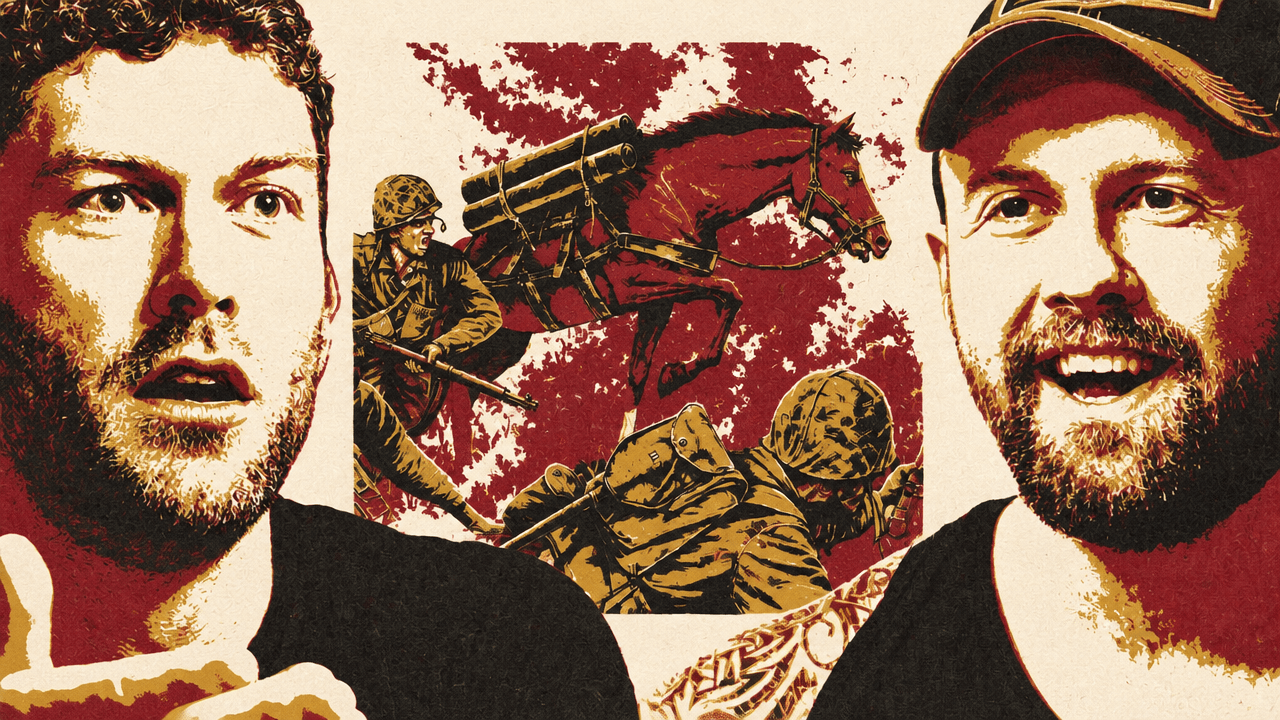
Wojtek and Reckless solved the same problem in different ways
Wojtek carried artillery shells because he learned to follow the soldiers doing the work. Sergeant Reckless carried ammunition because Marines trained her for a specific battlefield route. In both accounts, the animals mattered not as symbols but as ways to keep supplies moving where people and vehicles struggled.
Nic described Wojtek as a bear taken in by Polish soldiers on their way to fight at the Battle of Monte Cassino. They loaded artillery shells onto his back. Nic said Wojtek watched soldiers carry ammunition during battle and began carrying shells to the guns himself. He also recounted soldiers using the bear to frighten a prisoner during an interrogation, threatening to feed him to their pet. When a photograph was shown, Nic clarified that it was a mockup, not a real picture; he said the underlying story was real.
Reckless’s work was more deliberate. Near the end of the Korean War, Nic said, American forces were holding high ground near the 32nd parallel while peace negotiations were underway. Chinese and North Korean forces wanted to break through toward Seoul, about 15 or 16 miles away; taking the city, Nic said, could improve their position in negotiations. The Marines needed to hold the hills, but trucks could not reach them.
They relied on 75-millimeter recoilless rifles, which Nic described as “a big bazooka on a tripod.” Soldiers could carry the weapons uphill, but repeatedly hauling ammunition became exhausting. The Marines went to a Seoul racetrack and acquired a Mongolian mare. They trained her to tolerate gunfire and carry ammunition up and down the hills during firefights.
At the Battle of Outpost Vegas, three hills named Reno, Nevada, and Carson formed a position that Nic said opposing forces wanted to break through on the way to Seoul. He recalled Reckless making repeated ammunition runs during the fighting and carrying wounded soldiers back down. Nic said she carried hundreds of tons of ammunition and covered an extraordinary distance, though he could not remember the exact figures. His account presents her value as cumulative: one horse repeatedly moved supplies to the guns while the Marines tried to hold the hills.
A photograph shown during the discussion places Reckless beside a 75-millimeter recoilless rifle. Its visible caption identifies the image as coming from Andrew Geer’s 1955 book Reckless, Pride of the Marines.
Reckless became part of the unit she had served
Nic’s account of Reckless shifts from battlefield logistics to the Marines’ insistence that she remain with them. When they were preparing to return home, they refused to leave her behind. Enlisted Marines arranged to get her from South Korea to the United States by way of Japan. At the port, officials raised concerns about bringing livestock into the country. The Marines pushed for a blood test, then brought her to a Marine Corps ball after the official left. Nic recalled that she ate flowers there and was given whiskey and soda.
The military eventually gave Reckless a home on a Marine base. She was made a sergeant; a photograph shown during the discussion identifies her at her promotion to staff sergeant in 1959. Nic said lower-ranking Marines had to address her by rank, and no one was allowed to ride her. A Marine assigned to care for and exercise her ran alongside her each morning, sometimes for about ten miles.
That formal rank sat alongside an everyday bond with the unit. Nic also told a story about a confused attempt to arrange for Reckless to have a foal with a famous racehorse. Her caretaker did not know the plan and initially tried to keep the horses apart. After the foal was born, the Marines turned the mistake into a publicity moment with a sign announcing “It’s a…” before revealing whether the foal was male or female.