A UK Tour Turned Nerves Into Confidence Through Repetition
 Chris WilliamsonChris WilliamsonWednesday, October 28, 20269 min read
Chris Williamson’s new live tour across Britain tested a developing set and brought him back to cities and people from his early career. He opened in Edinburgh under pressure, revised the material as the tour went on, and said he had found his rhythm by Manchester. Williamson’s account presents confidence as something built through preparation and repeated performance, not something he had to wait to feel before beginning.
Edinburgh was both an opening night and a return to a formative place
For Chris Williamson Williamson, beginning the tour in Edinburgh meant starting in his favourite city in the UK. He had lived there for about nine months when he was 20, and remembered walking up to the Royal Mile and going to the University of Edinburgh gym every day. That was nearly half a lifetime earlier, he said. Returning to the city to begin a tour felt significant: “Beginning tour in my favorite city in the UK is pretty sick.”

The scale of the production made the return a nerve-racking one. Williamson described the opening week as “awesome, intense”: four shows in four cities in four days, with a bus between them. A crew, sound technicians, call times, set times, a tour manager and a driver all had to come together. Williamson said he felt that much of the operation was resting on his shoulders. He wanted to do a good job, and worried that the pressure could make it harder to find the relaxed, funny, improvisational quality he wanted onstage.
The bus was home for the team for three weeks, shared by ten men. It came with rules as well as bunks: the driver, Gary, said the toilet was for “pee only,” and tour manager Steve explained that, in an emergency, a person could use a bag. The conversation about upper and lower bunks was practical, too. Steve preferred the bottom bunk because you could roll into it rather than risk falling out. He joked about what might happen when guests were on board and said he would take the first bunks so he could get his people off first.
The crew also made room for tour-specific rituals: shirts you could not buy, a vape on a retractable lanyard, and meals together after shows. The arrangements were part of what Williamson had been looking forward to experiencing—not just performing, but touring with his friends rather than juggling the stage with a podcast recording schedule back home.
The first night did not settle his doubts. At intermission, Williamson wondered whether he needed to put more energy into the first half so people would leave feeling they had received enough value. Afterward, he said the new comedy material had worked and the meditation section had gone well. He also described the room as difficult: a high ceiling, wings that put some audience members farther away, and an unusual ticket arrangement. Edinburgh had gone well, he said, but something still felt missing.
Post-show interviews recorded by editor Max offered a few specific responses, not a verdict on the whole audience. One person said the show was funnier than expected and appreciated its shifts between humor, seriousness and vulnerability. A woman who listened as a mother of a son called Williamson’s expression of vulnerability, and his encouragement of it in men, “a breath of fresh air.” Others said the material had resonated or arrived when they needed it. One man told Williamson the show had helped him take a first step back from a low point; another said he had waited four years to thank him for helping him through the darkest part of his life.
Williamson was still evaluating what needed work. Those audience members described what particular moments had meant to them. At the end of the Edinburgh show, he also spoke about a question he had not resolved: after creating a lot of happiness through pursuit, could he find happiness without it? “I’m still in the process of doing it,” he said. “I’ll tell you when I come out the other side.”
Preparation and repetition gave him a way to work with nerves
Williamson’s anxiety was not only about the production or the Edinburgh room. He traced it, by asking himself why he feared the event might go badly, to a more fundamental worry: that failure might mean he was not good at his job, and that people would stop wanting him. Follow that chain far enough, he said, and it reached the fear of being alone and abandoned. He called that “the number one fear that everybody has.”
He recalled a line he thought came from Formula One driver Ayrton Senna: “Don’t look at the wall.” As Williamson explained it, where a driver looks is where the car goes. His application was that focusing constantly on how things could go wrong could make those fears take over, even when the feared outcome was not yet present.
That did not give him a simple way out of nervousness. Williamson said some of his repeated adjustments to the set were a way of burning off nervous energy: if he worked on it more, perhaps it would feel safer. He was not sure whether his doubts meant the material needed more time, whether he needed more stage experience, or whether they were intensified by sleeping only a few hours. But he did notice that each time he performed and worked on the set, he felt less nervous.
The tour was the culmination of substantial preparation. Williamson said he had recorded four podcast episodes a week for nearly three months so he would not need to record while away. He had also been doing work-in-progress performances in Austin: invite-only shows for about 50 people in a small comedy club, every Monday. He wanted to give the tour his attention rather than keep switching between performing and recording a podcast episode in the gaps.
Volume negates luck and work ethic kind of defeats fear.
Williamson also described himself as “the poster child for impostor syndrome,” saying he had “permanently outachieved” his own potential. He called potential “the speed governor of self-belief”: a limit shaped by what a person thinks they can do. He particularly hoped British working-class people who had never been told they could amount to much would hear that they did not need someone else’s permission. In his view, a person could be stubborn enough to keep going and get results without first being told they could succeed.
Fatigue and a sharp audience kept the set in revision
The travel schedule put strain on the work as well as on the performers. After the first night, Williamson slept badly in a top bunk at the back of the bus, over the rear wheels. He said the movement over bumps gave him enough leverage to leave the bed, and reported two and a half hours of sleep in twelve hours. A chart shown during the bus sequence paired hours slept, from eight down to one, with increasingly distorted meme faces. The next drive, from Edinburgh to Portsmouth, took about twelve and a half hours.
In Portsmouth, Williamson said he could tell that the set was not quite ready, despite the strong Edinburgh crowd and the beautiful venue. He went back to the drawing board. He was both more accustomed to being onstage and more tired, and described the tour as a place where much of the learning was happening on the job.
He also found the audiences he met in person smart and difficult to bluff. In Portsmouth, he said, a man in row C answered a question Williamson had expected to stump a room of a thousand or two thousand people. He had asked the question before in Australia, to an audience of 2,500, and nobody had answered it. Williamson described the experience as a blessing and a curse: he could not “pull the wool over” his audience’s eyes, but found them supportive. He was impressed that about a thousand people had come out on a Monday night.
The schedule had a bodily limit, too. Williamson relayed a colleague’s observation that the constraint on live events was no longer simply how long someone could stay awake, but how long their back could stand being upright. After four shows in four days, Williamson’s own back hurt. He had six days off before the tour resumed, though he said those days included energy-drink taste testing and a Black Friday shoot. Bus sleep improved after the rough first night; later, he reported getting eight hours.
The Birmingham interlude gave Williamson time away from working alone on the set. He joked about the city, stopped at a packed Wetherspoons and handed out cans of Neutonic. After days spent working in his room, he said, it was nice to go to lunch, see people and have a laugh. Before the Birmingham show, he made more changes to the material and said it felt close to perfect. By Manchester, he said he trusted the set and was looking forward to performing it.
Manchester brought the tour’s scale back to its beginnings
Manchester brought Williamson together with his father and Dave Gardner-Chan Dave Gardner-Chan, his former business partner of 15 years. Williamson said he had spent half of his club-promoting career in the city and loved it. He described Gardner-Chan as the closest thing he had had to an older brother, and said they had not seen each other in about half a decade.
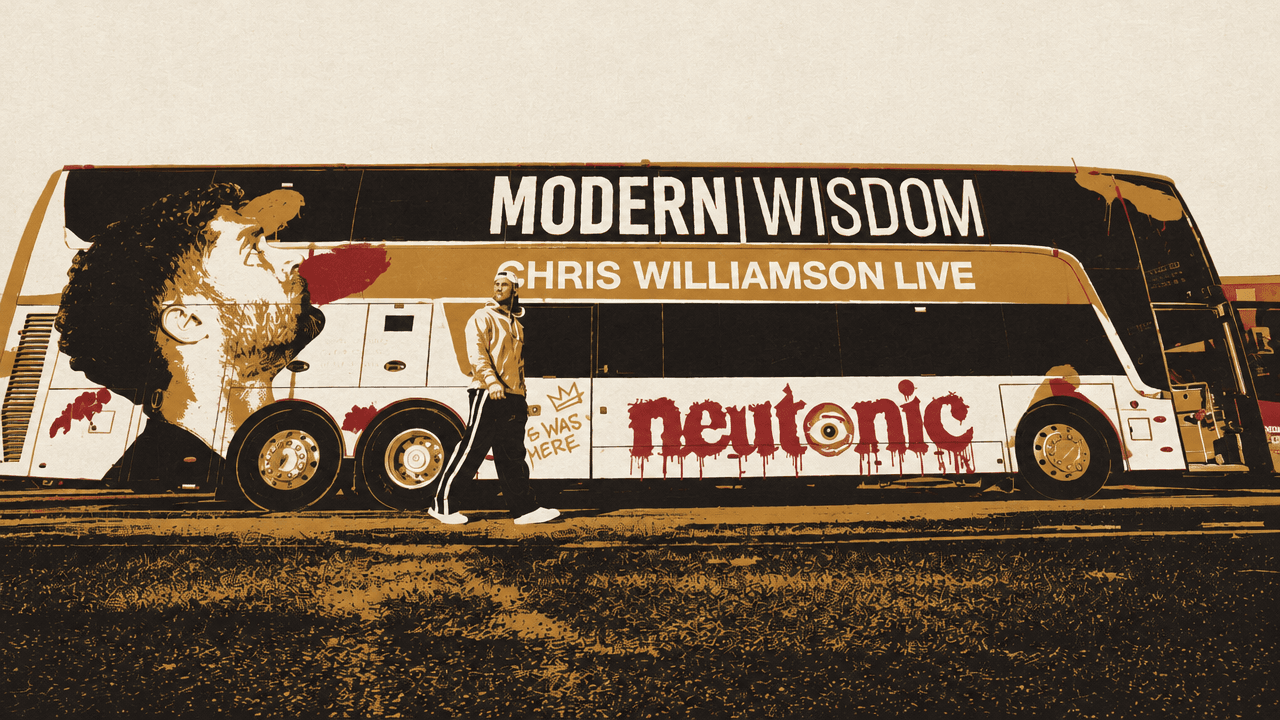
Gardner-Chan remembered Williamson as an 18-year-old student with “massive hair,” who worked hard, was ambitious and was enthusiastic. Seeing Williamson’s face on the side of the tour bus was “mad,” he said. He was not shocked that Williamson had done well, but the level he had reached still surprised him. He felt proud.
Williamson’s father said his son had set the agenda from the start. The live tour, he suggested, was built on the work that came before it: without a thousand podcasts, Williamson could not have done this. He and Williamson’s mother, he joked, could not claim credit for their son’s focus.
For Williamson, seeing people from earlier in his life gave the milestone a particular weight. He recalled asking Gardner-Chan to share the thumbnail of a new YouTube video on Instagram, back when the audience was much smaller. He said it felt beautiful to be in a city he knew well, with people who had been part of his life for decades.
Williamson credited Gardner-Chan with helping him see that he could be more than he was, and with teaching him how to operate in business and how to be polite and firm. He told the audience, “You need to find your Dave.” He also encouraged people to notice when things went well and to find people they could celebrate with. Gardner-Chan’s advice was to stay on one’s path, be oneself, remain positive and be kind to people on the way up.
Before the Manchester show, Williamson said he wanted to tell people that if they thought they were built for more, they could pursue that in Britain. His own path—from club promotion to podcasting to touring—was part of what he wanted them to see. By then, he said, he had found his rhythm with the show.