Gen Z’s Turn Toward Tradition Is Moving From Culture to Politics


Conservative media personality Isabel Brown argues that Gen Z’s interest in marriage, motherhood, Christianity and “traditional” life is not a passing aesthetic but a reaction against a culture she says has destabilized sex, family, gender and moral authority. In a long interview with Chris Williamson, Brown casts looksmaxxing, SSRIs, OnlyFans, declining fertility, distrust of institutions and youth politics as parts of the same shift: young people, especially women, are rejecting the stories they were told about liberation and looking for older sources of meaning. Williamson presses her on the evidence and limits of that case, including whether some trends have peaked, whether cultural fears become unfalsifiable, and whether frustration with Trump reflects a rejection of conservatism or demand for a more aggressive version of it.
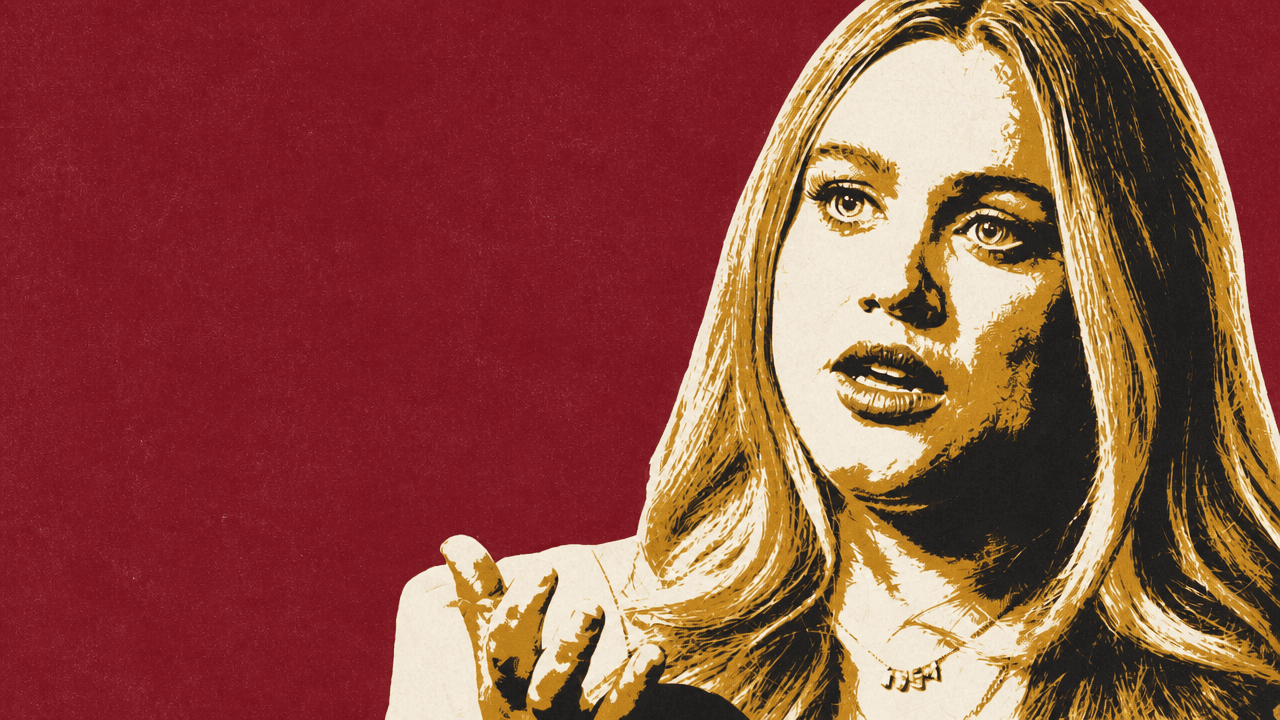
Brown sees a crisis of femininity arriving behind the crisis of masculinity
Isabel Brown treats female looksmaxxing not as an isolated online pathology, but as one expression of a wider attack on womanhood. The material shown to her described girls and young women on Reddit, Discord, and social platforms uploading selfies for strangers to rate, then receiving advice on “hardmaxxing” their way into becoming a “Stacy,” described in the clip as the highest tier of attractiveness. The examples ranged from corset binding to shrink the rib cage, unlicensed weight-loss drugs, “peanutmaxxing” to change the jaw, and breast-enlargement devices such as the EVEBRA, shown on screen as a $2,499 non-surgical device promoted with “8+ studies,” “30+ years,” and “patented.” The clip said girls as young as 13 were posting photos, a 17-year-old had been told her skull had “serious flaws,” and a 14-year-old had been encouraged to get a rhinoplasty.
Brown’s immediate reaction was that it was “really sad,” and she placed it alongside male looksmaxxing while arguing that the female version felt more sinister because it intersects with a broader cultural effort to erase the value of femininity itself. She allowed that beauty standards matter, and argued that culture has “lost” the ability to distinguish ugly from beautiful not only in bodies, but in architecture, fashion, and art. But in her view, the correction has swung into two damaging extremes: the normalization of morbid obesity on one side and the glamorization of skeletal thinness on the other. She cited a viral New York Post headline about Demi Moore at Cannes, which described Moore as showing off “toned arms” even though Brown thought the photos made her look dangerously thin.
Chris Williamson distinguished the male and female versions by instinct rather than by a clean principle. Men, he said, can understand the teenage desire for bigger arms, a better haircut, or a beard. But seeing teenage girls pushed by older girls online toward body modification struck him differently: “a girl who’s complaining about the size of her boobs” felt closer to the male anxiety around height, something largely outside ordinary control. Brown agreed that male height anxieties exist, but said she sees male looksmaxxing as more of a fringe internet subculture, while female looksmaxxing plugs into existing pressures around women’s appearance.

Brown’s larger claim is that masculinity was attacked first and that the successful pushback against that attack has made the next cultural fight clearer. In her account, “anything remotely labeled masculine” was branded toxic for decades, but masculinity could not be eradicated because men retain a protective instinct and eventually found voices telling them it was acceptable and necessary to be men. She named Jordan Peterson, Williamson, and Charlie Kirk as examples. The attack on femininity, she argued, goes deeper because it does not merely stigmatize a trait; it tells women to outsource what is distinctive about womanhood.
That outsourcing, for Brown, has several forms: intimacy moved away from marriage and toward casual hookups; emotional fulfillment moved away from family and toward climbing a corporate ladder; pregnancy moved to surrogacy or avoided entirely. She also cited reports of “pregnancy robots in China” that, in her telling, would grow and birth a baby for $14,000, as a horrifying endpoint of the same impulse.
Williamson offered the sharpest version of the thesis: “the crisis of femininity will make the crisis of masculinity look like a vacation.” Brown said she “100%” agreed, arguing that in 2024 society was already telling women in their late 20s and early 30s that the things unique to womanhood are beneath them. For teenage girls, she said, the message becomes more direct: “you don’t have to be a girl at all.” She connected this to gender transition, saying Planned Parenthood is now the number two provider of cross-sex hormones and puberty blockers for adolescents in America “with no history of gender dysphoria.”
Williamson pushed on whether youth gender transitions may already have peaked and begun to decline, citing data he had seen suggesting a high point around 2021 and a subsequent pullback. Brown said the trends look that way but are recent enough that several more years of data are needed. Her explanation for the possible shift was cultural: young people, she said, are tired of negativity, blackpilling, the removal of meaning, and the loss of objective truth, and are now asking questions about identity, purpose, and meaning.
Williamson raised a second concern: some claims about looming authoritarian or institutional plans become unfalsifiable. He recalled COVID-era fears about global health passports and a viral photo of a British army member in London that was circulated as evidence that the army would hold people in their homes at gunpoint. When the feared scenario did not happen, he wondered whether anyone who amplified it would retract the claim. The same structure, he argued, appears in cultural fights: if a feared policy does not arrive, activists can say their pushback prevented it. Brown responded that something similar is now happening around youth transition: people insist no one ever wanted to transition children, while countries such as the UK with national health systems have, in her telling, acknowledged going too far and begun reversing course.
SSRIs become part of the same argument about young women’s bodies
Brown extends the same framework to antidepressants, especially SSRIs. She said she had recently done a deep dive into the issue and was shocked by what she found. Her figures were that about 12% of American adults had taken some form of antidepressant in the past year, rising to almost 17% among Americans aged 18 to 24. She described meeting a young woman named Danielle at a Health and Human Services event who said she had been prescribed SSRIs at age seven after doctors told her parents she needed the medication or she would die. Brown compared that language to the phrase used in child gender transition debates: “Would you rather have a dead daughter or a living son?”
Danielle, Brown said, took SSRIs for about 15 years and later stopped without being warned about withdrawal. Brown described her as now having “permanent brain damage,” sexual dysfunction, and “chemical asexuality.” Brown said many people are calling such drugs “chemical castrating drugs,” in a comparison to puberty blockers and cross-sex hormones.
The most concrete evidence shown was testimony from Lauren Friedman, identified on a C-SPAN2 broadcast as a mental health and drug safety advocate at a Washington, DC event titled “Drug Safety Advocates Discuss Mental Health Care.” Friedman said she lives with post-SSRI sexual dysfunction, or PSSD. She described sexual dysfunction as “one of the most common and reliable side effects of SSRIs,” saying that “50 to 70% of all patients taking these will have sexual side effects.” What patients are not warned about, she said, is that those side effects can be permanent after the last dose.
Friedman emphasized that PSSD is not simply low libido. She described it as a “full nervous system injury” involving neurological loss of sexual function and genital numbness. Speaking personally, she said her clitoris was completely numb, “as if it’s the back of my elbow,” that she had no internal sensation, and that at 23 she had lost the ability to orgasm and her libido in a sudden-onset “chemical asexuality” that had not gone away.
Brown said she had met Friedman a few weeks earlier and would not have known she was dealing with that condition until seeing the testimony. The question for Brown is how many young women and men now treat such problems as normal and why mainstream media coverage is scarce. She said that while studying SSRIs in the context of criticism of Health and Human Services Secretary Bobby Kennedy, she mostly saw headlines attacking him as anti-science and implying that the science was settled. As someone who studied science, Brown called “the science is settled” a red flag because science is “a constant process of discovery.”
Williamson asked whether the absence of coverage might be empathy, a reluctance to stigmatize people taking SSRIs, or pharmaceutical money. Brown said money was “a huge aspect” and connected the issue to what she learned while studying science policy and living in Washington, DC: unlike the military-industrial complex, where she said there are restrictions on generals quickly going to work for contractors such as Lockheed Martin, there are not equivalent protections for Big Food and Big Pharma. She described a revolving door between companies such as Pfizer and agencies such as the FDA. She also said pharmaceutical companies have influence in media, medical education, and politics.
When Williamson asked what more men should understand about the women’s mental health crisis, Brown resisted setting men and women against each other. She acknowledged that young men have faced a substantial mental health crisis, unlike anything in her lifetime, but said men have begun redefining strength, masculinity, and ownership of life. At the same time, she said statistics now suggest that for the first time in modern history young women are struggling with suicide, substance abuse, anxiety, and depression at higher rates than young men.
Brown’s claim is not only pharmaceutical. It is cultural. She says young women are being told that “existing as a woman is unacceptable,” and that over-medication and transition serve as ways to turn girls away from womanhood. Her proposed answer is not female self-help alone; she explicitly called for “masculine protective instincts” to help fight those messages.
OnlyFans, Euphoria, and sex-positive therapy language collapse into one cultural script
Williamson brought the discussion from medicalized distress to cultural instruction, using Euphoria and Sydney Sweeney as the emblem. A viral clip shown on screen included a woman saying, “Like if a man today were to say that he wants a girlfriend that can cook or clean, he might as well be screaming the N-word,” followed by a second exchange in which someone says, “Well, you sound like a Democrat,” and the response is, “I’m not retarded.” Brown said she does not watch Euphoria, but had seen the clip and found it funny that the show now had Sweeney “cosplaying” as an OnlyFans creator turned podcaster.
Williamson described Euphoria as having moved forward in time after pushback that the characters were too young for the show’s sex and drug content. He noted that he was relying on secondhand information, but saw the pattern as obvious: to get people to watch, show the most ridiculous sexualized thing available. He also cited a Variety piece saying OnlyFans models were angry about being misrepresented by Sweeney.
Brown rejected the premise that OnlyFans creators are marginalized in today’s culture. In her view, OnlyFans has become normalized in a “pornified culture.” What is ostracized, she said, is not a woman making money on OnlyFans, but a woman leaving that world. She cited Nala Ray, whom she described as one of the top-performing OnlyFans creators, making millions of dollars a year before leaving the platform, being baptized as a Christian, getting married, and speaking publicly about leaving the porn industry. Brown said many former adult-film actors describe the move in similar terms, as “escaping” the industry, and pointed to trafficking and non-consensual activity as part of what makes that language understandable.
Williamson added an anecdote from a friend who had asked a newspaper editor whether they would ever run the reverse of the familiar empowerment story: not a mother starting OnlyFans to find freedom and income, but a woman leaving OnlyFans to become a mother. The answer, according to Williamson’s story, was no.
The deeper disagreement is about sex and empowerment. Brown argues that sex has been degraded from “this beautiful union with the purpose of making a new person,” which she also described as potentially “an act of worship for God,” into animalistic behavior marketed as empowerment. She recalled a Catholic high-school morality teacher describing sex within marriage as “the closest feeling to heaven on Earth.” For Brown, that is the better message to sell to teenagers than the version of sex education she associates with Planned Parenthood.
Williamson played a clip of Alex Cooper telling women to do what feels right to their bodies on dates. In the clip, Cooper said women could kiss on the first date, sleep with someone the first night, or “let him in my back door on night two,” adding that they did not have to but could if it felt right. Williamson identified the strangeness as a fusion of “sex-positive OnlyFans adjacent Euphoria world” with therapy language: “you have to do what feels right in your body.” His objection was not that choice never matters, but that instinct can be impulse, and impulse often produces bad decisions.
He framed the paradox this way: sex is treated as both so sacred that violation can be one of the most traumatic experiences of a person’s life, and so ordinary that it can be freely traded on the market or given away after dinner. The strongest defense he could construct for that contradiction was consent: if someone chooses the act, it is liberating; if not, it is violation.
Brown said she understands why people reach that conclusion but thinks it collapses under scrutiny. She compared it to an abortion debate in which, she said, a family physician told her that a baby is a baby from conception when wanted, but not a baby in the womb when unwanted. In both cases, Brown’s objection is that subjective desire is being allowed to manipulate reality. She connects that to what she calls “malignant narcissism,” the “God of self,” and the removal of God as an objective moral authority.
Motherhood is being reframed as a limitation, and Brown wants it treated as an adventure
Brown’s rejection of modern advice on marriage and careers is not a rejection of work. She described herself as “trad-lite” or “trad-adjacent” in response to criticism from the right that she is insufficiently traditional because she works, owns a business, travels, and gives speeches. Her argument is instead that women have been told a false story: that marriage and motherhood are incompatible with ambition, fulfillment, and competence.
She said a cultural shift around motherhood has become visible in the last six months, with young women beginning to ask whether they truly want a life of isolation, casual hookups, and an identity built around a cubicle. She also described a network of young Christian women on social media documenting motherhood, including her own daily group chat with Riley Gaines and Brett Cooper in which they share baby pictures and help one another at 3 a.m. with infants.
A viral video shown on screen, captioned “The friend who ‘doesn’t want kids’ holds a baby for the first time,” showed a young woman crying while holding a newborn and saying she needed to have a kid. Williamson called it “Rapid Onset Baby Fever.” Brown embraced the term and described intentionally bringing her own baby into public life in Washington, DC because there are not many babies there, especially in politics. She said the reaction is usually not annoyance but delight: police officers, National Guard members, Metro workers, and restaurant servers come over to admire the baby. In her view, culture creates an “intentional lack of baby fever” by telling mothers not to bring babies into public and depriving young women of ordinary contact with infants.
Williamson tied that to mimetic behavior. If teenage girls can cluster around eating disorders, suicide, or gender transition, he suggested, then family formation may also require social exposure. If friends divorce, one’s chance of divorce rises; perhaps if friends have babies, the likelihood of wanting a family rises too. Brown connected the idea to Abigail Shrier’s discussion of clusters in Irreversible Damage and to earlier eating-disorder and suicide clusters among teenage girls. She wondered whether positive clustering could happen around marriage and childbirth.
Brown then set out the demographic stakes as she sees them. She said America has the lowest marriage rate ever recorded since such rates began being recorded in the 1860s, and a fertility rate of 1.6 children per woman. She noted that replacement rate is 2.1 children per woman and argued that the real crisis is underpopulation rather than overpopulation, saying two-thirds of the world’s population now lives below replacement.
Her explanation is ideological as well as practical. She brought up the “45 goals” of the American Communist Party, which she said were read into the Congressional Record in 1963. She read selected goals aloud: discredit American culture by degrading artistic expression; eliminate obscenity laws by calling them censorship; break down cultural morality by promoting pornography and obscenity; present homosexuality, degeneracy, and promiscuity as normal and healthy; infiltrate churches to replace revealed religion with social religion; discredit the family as an institution; encourage promiscuity and easy divorce; emphasize raising children away from parents; and attribute children’s problems to the suppressive influence of parents. Brown’s claim is that modern anti-family culture looks like the realization of that program.
The personal counterargument she offered is sacrifice. In her first two years of marriage and first year raising her daughter, she said the greatest moments of her life have come from “laying my life down” for her husband or child: getting out of bed at 3 a.m. after months without sleep, or giving up time with friends to prioritize her spouse. She said those sacrifices give her more purpose and fulfillment than “doing the easy thing” and binge-watching Netflix.
When Williamson asked what critics make of that—given that Brown has multiple degrees, a high-powered career, and the credentials of the modern “lean-in girl boss”—Brown said she does not think they believe she is lying. Rather, she thinks many young women have been systematically told by education, Hollywood, media, politics, and even churches that they are not equipped to “have it all.” She called this “the bigotry of low expectations for women” and “misogynistic” when framed as feminism.
Her examples were pointed: women are told that if they get pregnant in college they will not graduate and should have abortions; that marriage prevents a fulfilling career; that employers would rather pay for out-of-state abortion travel than offer better maternity leave. Brown conceded that family and work are difficult to combine and require sacrifice, but said the difficulty does not make them impossible or disempowering.
Williamson clarified that he does not think anyone should have children or get married if they do not want to. His concern is that culture is persuading people who might want those things that they do not, or causing them to realize too late that they missed them. He cited demographer Stephen J. Shaw’s claim that, on current trends, 40% of 15-year-old girls will never become mothers. Brown added that by 2030, “45% of women age 15 to 45 are going to be single and childless,” and said she does not know what society does with that.
The biological asymmetry matters to Brown. She argued that the attack on masculinity can happen at any age, while the attack on womanhood targets a short window of female biological capacity, especially during adolescence and young adulthood. In adolescence, she said, girls are awkward, impressionable, and uncomfortable in changing bodies; culture then persuades some to render themselves sterile through SSRIs or transition, and others to postpone marriage and children in the name of fun and selfishness until the biological window is nearly gone.
Gen Z conservatism, in Brown’s account, begins in culture before it reaches elections
Brown said she predicted that Gen Z would be “the most conservative generation ever,” and was mocked for it even within conservative circles. Her basis was not a conventional electoral model. It came from years spent on college campuses after meeting Charlie Kirk, attending an early Turning Point USA Young Women’s Leadership Summit in Texas in 2017, and later working as a contributor for Turning Point after Kirk persuaded her not to go to medical school. From 2019 onward, she said, she watched young people’s cultural habits change.
Her operating premise is that politics is downstream from culture. To predict politics five to ten years out, she said, one should look less at Capitol Hill and more at what young people are dating, watching, eating, reading, whether they attend church, and how they think about family. In Gen Z, she saw a radical rejection of what came before, but with the content reversed from earlier youth rebellion. To be punk rock now, she argued, is not tattoos and punk bands; it is marriage, children, real food, moving out of big cities, homesteading, rejecting mainstream media, reading, and listening to figures such as Jordan Peterson.
She said her 2024 book, The End of the Alphabet: How Gen Z Can Save America, made this case, and that media appearances promoting it often ended with people laughing her off because Gen Z was still stereotyped as a generation of “37 genders and rainbow hair.” After the 2024 election, Brown argued, young men under 35 decisively helped return Donald Trump to the White House, confusing Washington’s political class. She added that young women shifted 11 points away from the Democratic Party toward Trump from 2020 to 2024, despite being told to vote for someone who shared their biology.
Williamson then showed a Gallup chart on the political ideology of 18- to 29-year-olds by gender from 1999 to 2023. The chart showed young women becoming much more liberal while young men stayed roughly flat, with the gender ideology gap more than doubling from 12 points in 1999 to 23 points in 2023.
| Measure shown | Value or trend |
|---|---|
| Gender ideology gap among US 18- to 29-year-olds | More than doubled from 12 points in 1999 to 23 points in 2023 |
| Young women’s net ideology in 2023 | +23 liberal minus conservative |
| Young men’s net ideology in 2023 | -1 liberal minus conservative |
| Brown’s claim about young women from 2020 to 2024 | Shifted 11 points away from Democrats toward Trump |
Brown accepted the Gallup chart as correct but argued that the women’s line has begun moving back down from its peak around 2020. Her worry is that the political right will see the chart and give up on young women, treating them as unreachable. She thinks that would be a mistake because young women are roughly as liberal now as they were a decade ago after a rapid change, and because many are making culturally conservative decisions before they necessarily identify politically as conservative.
The example she gave was the birth-control pill. Brown said young women are asking why they have been taking it for 10 years because doctors told them to, despite feeling fat, depressed, and uninterested in sex. She described women quitting the pill as part of a larger cultural shift that could later become political, but only if conservatives address young women on subjects that matter to them.
Williamson suggested that the volatility in young women’s ideology may reflect the same mimetic dynamics discussed earlier: a national version of the lunch table. Brown partly agreed, but framed it as empathy being hijacked. Men, she said, are more intrinsically skeptical, while women are built for empathy and emotion. She rejected the idea that this is bad. “Facts don’t care about your feelings,” in her view, worked with some audiences, but not with young women. Her revision was that feelings and facts do not have to be divorced. Empathy becomes destructive, she said, when it is turned into what Allie Beth Stuckey calls “toxic empathy”: affirming abortion, physician-assisted suicide, gender transition, or socialism because one does not want to hurt anyone’s feelings.
Brown’s proposed conservative message to young women is not to suppress emotion but to direct it toward human flourishing. If one wants people to feel comfortable in their skin, she said, one should not affirm castration as self-love. If one wants a pregnant woman to be supported, one should tell her she is strong enough to bring her child into the world with community help. If one wants economic opportunity, one should avoid the failures of communism and support wealth creation.
Her sharpest agreement with liberals is that markets should serve families, not replace them
When Williamson asked what Brown most agrees with liberals on, she first challenged the label. She argued that today’s Democratic Party is not classically liberal but “unabashedly leftist,” especially on free speech. Free speech, she said, is a lowercase-l liberal idea foundational to Western civilization, while leading Democrats now favor mass censorship. She cited the previous administration calling Mark Zuckerberg to pressure Facebook over the Hunter Biden laptop story and COVID treatment discussions, and claimed figures such as Hillary Clinton, Barack Obama, and Kamala Harris now speak about imprisoning podcasters for dangerous misinformation or hate speech, comparing it to trends in the United Kingdom.
Brown said classical liberals may now find a friendlier home on the right, citing Tulsi Gabbard and RFK joining the Trump administration as part of what she called a unity party. But she did identify one area where the right should learn from the other side: not everything is about profit.
Her example was family policy. Brown said Turning Point USA, under Charlie Kirk, had become prominent in conservative media and activism by offering employees six months of paid maternity leave, which she described as unmatched in that world. She also quoted Vice President JD Vance’s March for Life line that “a cubicle and a computer screen will never love you back the way that your children do,” and argued that systems and policies should make it easier for young people to choose children, not necessarily to abandon work.
This moved into childbirth costs. Brown said Vance, while a senator, introduced a bill to make childbirth free in America. Williamson was shocked to learn from the room that giving birth without insurance could cost around $25,000, and with insurance commonly a few thousand dollars, with another voice estimating $4,000 to $8,000. Brown said those costs are powerful because expense is used to dissuade people from family formation.
Brown’s policy orientation is not socialist. Asked directly whether the United States should have socialized healthcare, she said no. Asked whether healthcare should be freely available to those who cannot afford it, she said it already is in the emergency-room sense: hospitals cannot legally turn away someone in an emergency because of citizenship, insurance, or ability to pay. Williamson replied that access followed by bankruptcy is not the same as usable access, and told a story about a New Orleans ghost-tour guide with cracked teeth who could not afford care and told him, “If you get hit by a bus, you better walk it off.”
Brown did not deny that American healthcare is expensive. Her diagnosis is that the United States lacks a real free market in healthcare. Patients do not know prices before treatment; insurance companies and hospital executives negotiate behind the scenes; bills arrive months later; and itemized bills often fall sharply once challenged. She gave the example of a $350 Tylenol pill in an emergency room as an arbitrary price imposed by the management and insurance side, not by doctors. In her view, physicians are wrongly cast as the enemy in some Make America Healthy Again discourse when the financial decisions are often made elsewhere.
Her preferred reform is price transparency. She praised the Trump administration’s push for hospitals to publish service prices so patients can compare costs and create competitive pressure. Williamson called this putting the “menu” out front.
The dispute with socialized healthcare turned on trade-offs. Brown argued that countries such as Canada and the UK pay not with visible bills but with time, which can cost lives. She claimed Canadians may wait 18 months for hip replacement or years for imaging to confirm cancer. She also cited the UK case of a severely disabled baby she identified as Charlie, saying the NHS ultimately decided it would not continue care despite parental pleas and Italian offers to take the child. Williamson, coming from the UK, agreed the NHS is slow and described waiting 13 days to have a fully ruptured Achilles tendon reattached, partly because he wanted a specific surgeon available on the NHS.
Williamson still argued that the NHS sweeps up people at the bottom of the distribution, including those needing psychiatric care, before they fall through cracks in the way many homeless people appear to in America. Brown answered that American programs such as Medicaid are supposed to serve that function, but she believes fraud and dysfunction prevent the money from reaching the people who need it.
She then connected this to pregnancy resource centers. Brown said a Health and Human Services “moms.gov” initiative was trying to inform people about resources already available. She claimed there are about 600 Planned Parenthood locations and about 3,000 pregnancy resource centers across the country. In her account, Planned Parenthood facilities largely provide abortion despite public claims about cancer screenings, prenatal care, and other services, while pregnancy resource centers offer free prenatal care, diapers, babysitting, mortgage help, and other support, often through nonprofits and charitable giving. She argued that the federal government gives Planned Parenthood $800 million in taxpayer money to keep operations running, though not directly for abortions, and asked why that money does not instead go to clinics providing free prenatal and maternal services.
Brown’s final healthcare principle was explicit: she wants Medicaid and the VA to work, and she wants charitable giving and public support for “the least of these.” But she does not want the whole American system turned into the VA, because she thinks that would lower the ceiling rather than raise the floor.
Trump’s numbers are, for Brown, a warning about weak conservatism rather than a rejection of conservatism
Brown said she is often asked why young men appear disillusioned with the Trump administration. She disputed the media interpretation that young men merely had a flirtation with conservatism in 2024 and will now return to the left. Her claim is that young conservatives are frustrated not because Washington is conservative, but because it is not conservative enough.
The examples she gave were concrete. She said conservatives in Washington are not going on offense to defund Planned Parenthood, not banning corporations from buying single-family homes and turning young people into lifelong renters, and not opposing what she described as mass amnesty bills. She specifically cited the Dignidad Act as a Republican-introduced, Republican-co-signed bill that would give 10 million illegal immigrants permanent residency status. Brown called this a perversion of conservatism: conservative rhetoric on the campaign trail, without conservative policy action in Washington.
Williamson framed the divide as libertarian or hands-off conservatism versus a more interventionist conservatism. Brown preferred the terms “defensive conservatism” and “offensive conservatism.” Her frustration is aimed less at Trump personally than at the Republican Party at large, which she said is misreading young people.
Williamson cited Trump’s approval moving from a peak of 51%, higher than any point in his first term, to 34%, lower than any point within 18 months. Brown called that a big swing, but warned against interpreting frustration as abandonment of conservative principles. She also dismissed scenarios proposed by Professor Jiang in which Trump might seek a third term through emergency war powers or through Donald Trump Jr. winning in 2028 and abdicating in favor of his father. Brown said there is no constitutional mechanism for that, and argued that if Trump had wanted to seize power unlawfully, he would not have left office in 2020.
On the 2026 midterms, Brown said prediction markets such as Polymarket or Kalshi capture only part of the picture. She noted that, to her knowledge, only once in American history has the party winning the White House held onto the House majority between a presidential election and a midterm. People become frustrated and the pendulum swings back, she said, which makes midterm backlash normal rather than evidence of national collapse.
The more important midterm variable, in her view, is redistricting. She explained that each state has its own process for drawing congressional districts, and that both parties use district lines to political advantage. She criticized race-based districting associated with post-Civil Rights Act efforts to create majority-Black districts likely to elect Democrats, saying she finds it “disgusting” to assume someone will vote Democratic because of skin color. She said such an approach had been struck down by the Supreme Court as discrimination and racial profiling.
Virginia, where Brown lives in Northern Virginia, was her live example. She said the state is supposed to use a nonpartisan independent commission, not ordinary legislative maneuvering, to redraw congressional districts. A new map had, in her telling, been advanced through a special-election process, heavily campaigned for in Northern Virginia, passed narrowly, and then struck down because that is not how Virginia law permits the map to be drawn. The matter, she said, had been appealed to the Supreme Court.
The religious revival Brown describes is a search for something older than the self
Brown sees Gen Z’s return to Christianity as unexpected and central to her optimism. Demographic trends during her lifetime, she said, had pointed toward each generation becoming more atheist and “godless,” with Gen Z predicted to be the most atheist generation in history. Instead, she said, young people are leading a “dramatic 180” back to Christianity, especially traditional Catholicism and Orthodoxy. She singled out the Latin mass as an especially traditional form drawing young people.
Her explanation is stability. Traditional Christianity, she said, is immovable and does not change with political, social, or cultural fashion. The mass, in her account, links the present to the apostles, the Last Supper, and Christ’s establishment of the church. Young people, she argued, are disillusioned with being the arbiters of morality and truth because they have watched a society built on “my truth” and “your truth” lose the ability to answer basic questions about reality. Without a shared moral order, she said, people become aimless, mental health worsens, and the destruction of human life becomes easier to justify.
Williamson framed the turn to religion as understandable after a series of failed modern promises: sexual liberation, leaving intergenerational housing, mental health decline, happiness and meaning metrics moving in the wrong direction. If looking forward has not worked, he said, people may try something ancient that is new to them. He jokingly called the Eucharist “ancient spiritual Ozempic” for a calorie-dense spiritual environment. Brown accepted that there was “something to that,” especially in the simplicity and sensory depth of the Latin mass.
Brown described the Latin mass as not being about the attendee’s experience. The priest faces the crucifix rather than the congregation while preparing the Eucharist, the prayers are in Latin rather than ordinary language, and the setting includes incense, bells, stained glass, and statues. For Brown, those features take people out of constant overstimulation and into a slower space where they can think and hear God.
She also described “Pizza to Pews,” a New York movement led by Kate DePietro and a friend named Anthony, in which young people gather for pizza before Sunday evening mass so they do not have to attend alone and can find community. Brown said the events have drawn hundreds of people, with some churches so crowded that people stand outside craning to see mass through the doors. Media headlines calling Catholic mass the “hottest club in New York City” pleased her because, in her view, it indicates cultural healing.
Williamson asked whether making mass fashionable risks turning religion into personal branding: well-dressed people attending because it is cool, not because of spiritual conviction. Brown was not especially worried. If it becomes cool to go to mass, she said, that itself is a win. There will always be sin, bad motives, and self-worship, but she believes the truth of the church outlasts those abuses.
Her stronger concern is not that traditional worship becomes stylish, but that churches become too much like the world. Brown contrasted the current Gen Z attraction to tradition with the late-1990s and early-2000s “seeker-friendly” movement, which she said tried to attract millennials by adding trendy music, pyrotechnics, smoke machines, drummers, and frictionless calls to accept Jesus. She said the intention may have been noble, but the result was a weakening of truth.
The example shown was the “Sparkle Creed,” a clip of a female pastor reciting: “I believe in the non-binary God whose pronouns are plural,” “Jesus Christ, their child, who wore a fabulous tunic and had two dads,” and “the rainbow Spirit” refracting light into “a rainbow of gorgeous diversity.” Brown contrasted that with the Apostles’ Creed and Nicene Creed and said it shows what happens when the church tries to become like the world. Gen Z, she argued, is rejecting that because it already knows the brokenness of the secular world and wants something transformative.
Her closing optimism rests on that revival. Brown said she sees no room for blackpilling because there is not time for it. She is optimistic that young people are returning to “one nation under God,” seeking moral guidance beyond TikTok and politicians, and wanting to leave a legacy beyond bank accounts. But she emphasized that the revival she wants has not yet arrived; the work is ongoing, and the only viable posture is to be a “happy warrior.”