Monk Mode Can Turn Self-Improvement Into Avoidance
Chris Williamson argues that “monk mode” is dangerous not because isolation and discipline fail, but because they can work well enough to become self-justifying. Drawing on his own long periods of abstinence, meditation, journaling and rigid routine, Williamson says the practice should be treated as a temporary retreat with an exit, not a permanent identity. Its real test, he says, is whether private self-improvement leads back into work, friendship, partnership and ordinary public life.
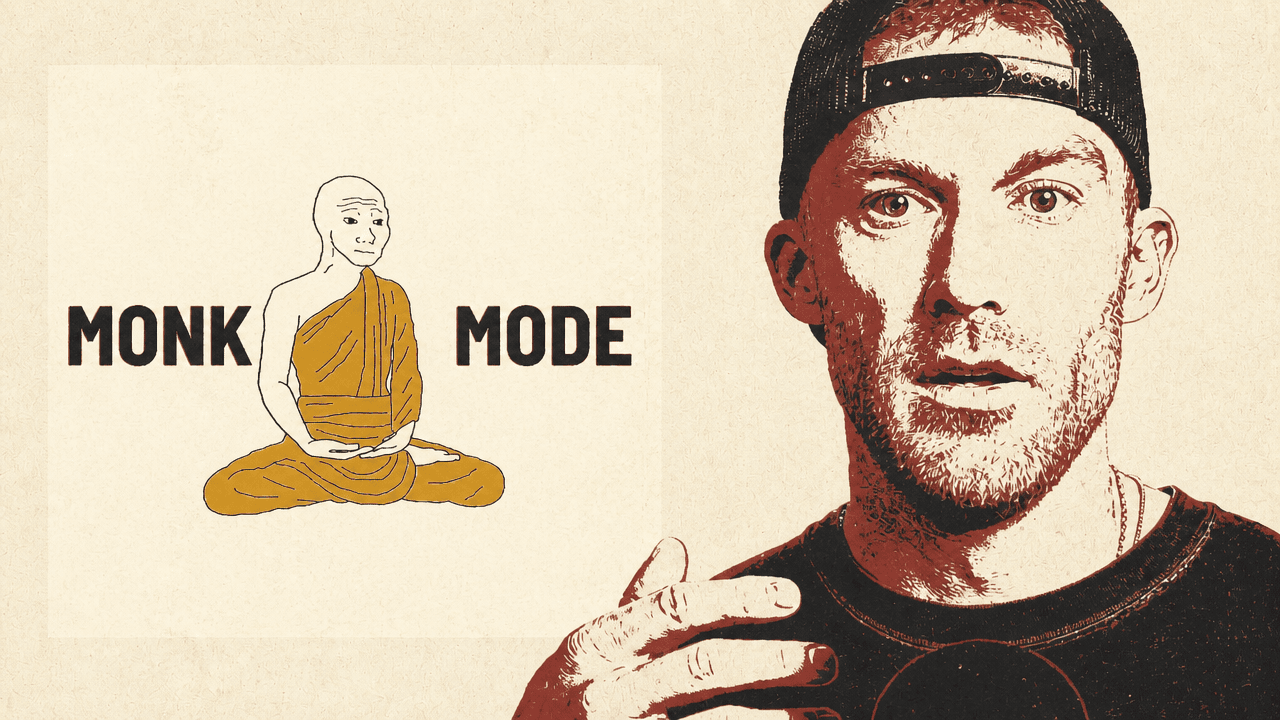
Monk mode works, which is why it can become a trap
Chris Williamson’s criticism of “monk mode” is not that isolation, discipline, and self-improvement are useless. It is almost the opposite: the practice can work well enough that its costs become easy to miss.

Williamson says he first encountered the idea in 2014 on the Illimitable Men blog. In the passage he cites, monk mode is described as a temporary retreat from the world: a way to “fine-tune your focus,” “calibrate your direction,” confront weaknesses, and reduce time spent on social obligations and “junk activities” that bring little return. Williamson summarizes the model around three I’s: introspection, isolation, and improvement.
The warning, in his account, is also present in that early framing. The blog called monk mode a “beneficial, productive, and dare I say, even addictive lifestyle.” Williamson treats the final phrase as the clue to the darker side.
Monk mode justifies a retreat from your life, a retreat from risk-taking and adventure, and repackages it as self-development.
That is the central distinction: retreat as preparation versus retreat as avoidance. Monk mode can mean fewer social obligations, fewer distractions, less risk, and less friction, while making that withdrawal feel morally serious. It can let a person feel noble in isolation.
Williamson’s concern is especially sharp for men already inclined toward introspection, solitude, and rigid routine. For them, monk mode may not correct an imbalance. It may exaggerate the direction they were already moving in.
The stated purpose of the private work is to return to the world more capable: to function better in business, progress in a career, make better friends, find a partner, and “show up in the world in a better way.” But if the routine becomes rewarding enough on its own, the return can keep being delayed.
Williamson is criticizing a practice he has used heavily
Chris Williamson does not present this as an outside critique. He says he has gone “full monk mode” many times, with “really great success.” He names long periods of intense self-regulation: all of 2017 and 2018, then mid-2019 through the COVID period until he moved to America in 2021.
He also cites 500 days without caffeine, more than 2,000 meditation sessions, five years of daily gratitude journaling, more than 300 yin yoga sessions, and 500 hours of Stu McGill’s Big Three to rehab his back. Much of it, he says, was done alone in a bedroom in Newcastle upon Tyne, usually first thing in the morning.
The point is not that the inventory is universally transferable. It is that Williamson is not dismissing discipline, solitude, or repetitive private practice. He credits concentrated periods like this with facilitating “almost all” of the most important progress he has made.
That is why the cost matters. A practice that clearly fails is easy to drop. A practice that improves your life can become harder to stop, even after it has served its purpose. Monk mode offers visible effort and a clean story: I am not avoiding life; I am improving myself. The more successful the period feels, the easier it becomes to extend it.
Williamson frames the danger not as wasted effort but as attachment. The routine can become the reward. The person can remain in the identity of someone preparing, refining, and disciplining himself, while the life that discipline was meant to improve stays at a distance.
Integration is the missing fourth I
Chris Williamson adds a fourth “I” to the usual monk mode triad: integration. Isolation, introspection, and improvement are not supposed to be the final state. They are meant to feed back into public life.
With monk mode, you practice in private so that you can perform in public.
The warning is that private practice, taken to an extreme, can result in no public performance. Williamson connects this to Bill Perkins’s line that delayed gratification in the extreme results in no gratification. In the monk mode version, a person can keep delaying the return to work, friendship, partnership, and ordinary functioning in the world in the name of more preparation.
Williamson gives the example of a friend from around 15 years earlier who was preparing for a bodybuilding competition. The friend was already introverted and socially shy. The competition then justified 8 p.m. bedtimes, militant routines, and rejecting social invitations. But after the competition ended, the routine stayed. Williamson says it took years for him to move back toward “some sense of normality.”
That example captures the broader mechanism he is warning about. A temporary demand can become a default life. A defined goal can end, while the habits built around it remain. The original reason for isolation gets lost, but the isolation itself continues.
The risk is not just short-term loneliness. Williamson argues that someone with a sheltered, routinized, unsocial life may be moving away from the thing they most need over time: a real-life support network. Monk mode can make that movement feel intentional and noble, even when it is deepening the problem.
A retreat needs an end date
Chris Williamson’s practical answer is not to abandon monk mode. It is to periodize it. A serious retreat should have a deadline.
In his experience, three to six months is a useful range. Someone who has never done it before might go longer; someone further along in their development might go shorter. The important part is not the exact duration. It is that the retreat has an exit.
He says the more he did the isolation, introspection, and improvement, the harder it was to integrate. That is the uncomfortable part he thinks is missing from public discussions of monk mode. The virtues are easy to sell: focus, sacrifice, productivity, seriousness, self-mastery. Reintegration is “way less sexy.” It is also the part that determines whether the private work turns into a better life.
For Williamson, monk mode remains valuable. His objection is to the comforting idea that withdrawal is automatically growth, or that more private optimization is always the answer. The test is whether the discipline makes a person more capable in the world, not merely more attached to the rituals that keep the world away.