Brown Argues Anti-Family Culture Teaches Women to Fear Sacrifice


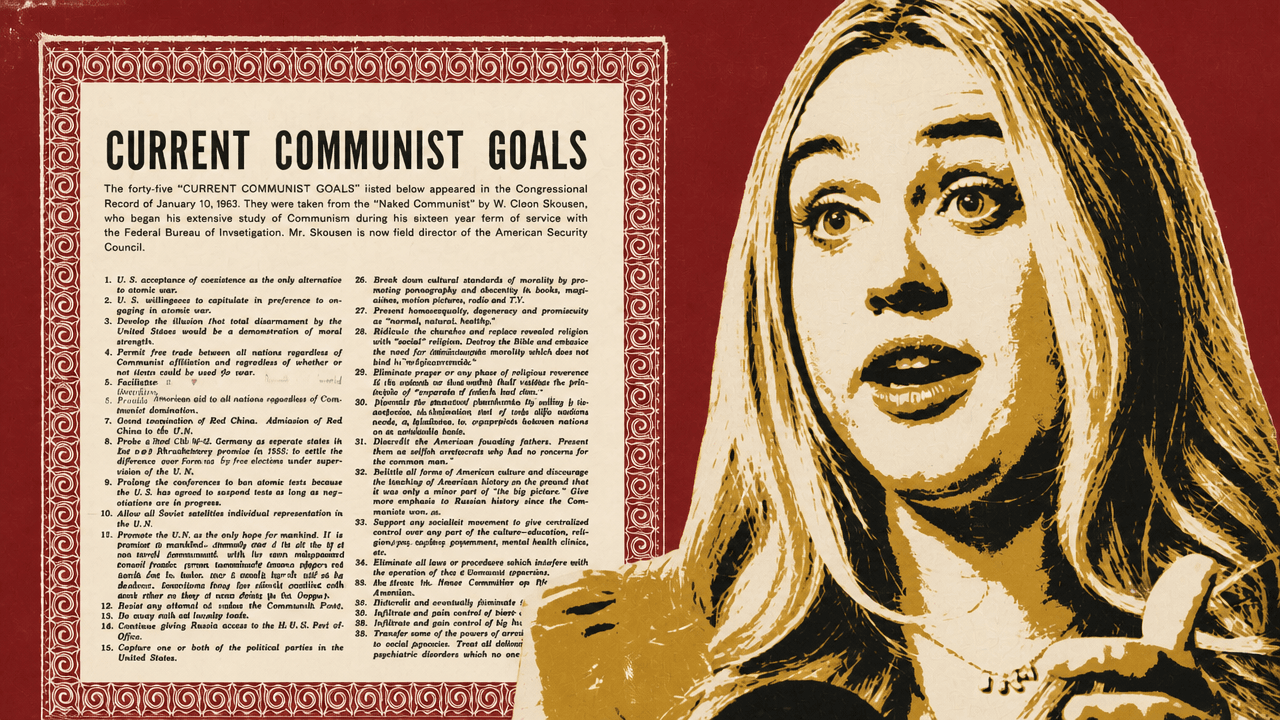
Isabel Brown argues that America’s hostility toward marriage, motherhood, religion, and traditional family life reflects a decades-long cultural project rather than an accidental social drift. Drawing on a list of 1963 communist goals she says were entered into the Congressional Record, Brown tells Chris Williamson that the family is the last major barrier to social control, and that schools, media, politics, Hollywood, and parts of the church have helped recast sacrifice as oppression rather than meaning.
Brown treats the family as the last institutional barrier
Isabel Brown’s central claim is that the family is the final institution standing between individual people and broader social control. In her account, successful societies and empires rise and fall with family strength; the family is “the foundation for a moral, thriving society.” That is why she treats attacks on marriage, parenthood, religion, obscenity laws, sexual norms, and church authority as politically consequential rather than merely cultural.


The family [is] the last line that they have to fight against in order for complete societal control.
Brown builds the argument on a set of “45 goals” she attributes to the American Communist Party in 1963, which she says were read into the Congressional Record. She presents them not as obscure Cold War material but as a template for the present: “a screenplay for the current culture that we’re living in.”
The goals she chooses to read are cultural rather than military or economic. Brown says many of the list’s aims concerned normalizing the USSR and Soviet-style communism, but the passages she emphasizes involve media, universities, art, sexual norms, religion, and family life. She describes the strategy as “taking over the media and taking over college campuses,” fomenting student riots, and using cultural institutions to normalize socialism.
Chris Williamson pushes back lightly on the Soviet-normalization point, calling it “a very early and quick failure.” Brown does not dispute that narrow point. Her claim is that the broader cultural project mattered more and lasted longer.


The quoted goals Brown reads include discrediting American culture by degrading artistic expression; eliminating obscenity laws by framing them as censorship and violations of free speech and free press; breaking down moral standards by promoting pornography and obscenity in books, magazines, motion pictures, radio, and television; presenting “homosexuality, degeneracy, and promiscuity” as normal, natural, and healthy; and infiltrating churches to replace revealed religion with “social religion,” while discrediting the Bible as a crutch for the intellectually immature.
She reads the family-specific goals as: discredit the family as an institution; encourage promiscuity and easy divorce; emphasize raising children away from the “negative influences” of parents; and attribute children’s prejudices, mental blocks, and developmental retardation to parents’ suppressive influence.
Brown’s conclusion is not simply that a political party once had radical aims. She argues that the goals she reads were taken up through surrounding institutions: schools, Hollywood, American politics, media, and “the larger conversation” across Western civilization. The result, in her view, is a culture that tells young women birth is degrading, tells men and women marriage is a scam or trap, and celebrates what she calls “malignant narcissism”: radical selfishness recast as empowerment or feminism.
Family sacrifice is presented as meaning, not diminishment
Modern culture, in Brown’s account, treats “hard things” such as marriage, children, and family as limitations rather than adventures because human beings default to avoiding difficulty. Isabel Brown frames this not as a new feature of the present but as a standing fact of human nature: people resist what is difficult and challenging.
She connects that claim to storytelling. From ancient Greek stories through Rome, the Middle Ages, the Renaissance, and modern movies, Brown says the enduring narrative pattern is overcoming personal limits in service of something greater than oneself or in service of other people. That is the moral frame she applies to marriage and motherhood.
Brown gives the argument a personal form. In her first two years of marriage and first year raising her daughter, she says the greatest moments of her life have come when she has “laid my life down” for her husband or daughter. She clarifies that she does not mean literal death, though she allows that such sacrifice could be required in some circumstances. Her examples are ordinary: getting out of bed at 3 a.m. after months of poor sleep to comfort her daughter, or giving up time with friends to prioritize her spouse.
The contrast is with ease. Brown says those sacrifices have given her more purpose, fulfillment, and meaning than “doing the easy thing,” such as binge-watching Netflix on a Friday night. Her case is not that family life is frictionless. It is that the friction is part of what makes it meaningful.
Brown uses her own ambition to reject the incompatibility claim
Isabel Brown rejects the common social-media narrative that her own path is a luxury position inaccessible to other women. She describes working hard for roughly a decade since high school to build a career that diverged sharply from her original plan. She wanted to be a physician, specifically a surgeon, and earned her first two degrees in sciences with that goal in mind. She says God pulled her life in another direction and that she is glad she listened.
Her biography matters to the argument because Chris Williamson frames her as an awkward case for standard stereotypes: she is working on a third degree, has built a high-powered career, and fits much of the “lean-in girl boss” ideal of socioeconomic success, competence, ambition, and independence. The question under that framing is whether critics see her as lying, unusually constituted, or speaking from a position other women cannot access. Brown says she does not think they believe she is lying.
Her broader claim is that young women have been “systematically told” by major American cultural institutions that they are not equipped to combine family and vocation. She names the education system, Hollywood, mainstream media, politics, and even parts of the church. In her words, women are told they are not strong, smart, or capable enough to “have it all.”
It is the bigotry of low expectations for women, and actually, frankly, is misogynistic against women when women are told that.
The examples Brown gives are deliberately stark. A pregnant college student is told she will not graduate and must have an abortion to be successful. A woman considering marriage is told she cannot have a fulfilling career because her husband’s career will always come first, sacrifice and compromise are impossible, and marriage is patriarchal. A pregnant woman in a high-powered job is told flexibility will be a problem.
Brown then extends the critique to corporate incentives. She says a Fortune 500 company may prefer to pay for an employee to travel out of state, stay in a luxury hotel, and obtain an abortion rather than offer better maternity leave. She presents that as evidence that a culture calling itself feminist and pro-woman often communicates the opposite message: that women are too weak, stupid, or ill-equipped to have both a family and another vocation.
Her alternative is not a promise of ease. She says combining family and ambition is difficult, challenging, and sacrificial. It may mean less time for leisure, Netflix, or weekends with friends. But she argues it is “beautiful and empowering and fulfilling unlike anything else the world has to offer.”