Peptide Experiments Produced Striking Effects, but Their Causes Remain Unclear


Andrew Huberman says BPC ended shoulder pain and Pinealon changed his sleep, but he cannot tell whether those effects came from the compounds, placebo or other factors. He was less positive about growth-hormone secretagogues, which he said disrupted his REM sleep and raised his PSA. In the discussion, Chris Williamson questions using peptides or other interventions with no defined aim beyond feeling “better”; Huberman’s accounts, by contrast, are personal experiments he describes with uncertainty and caveats.
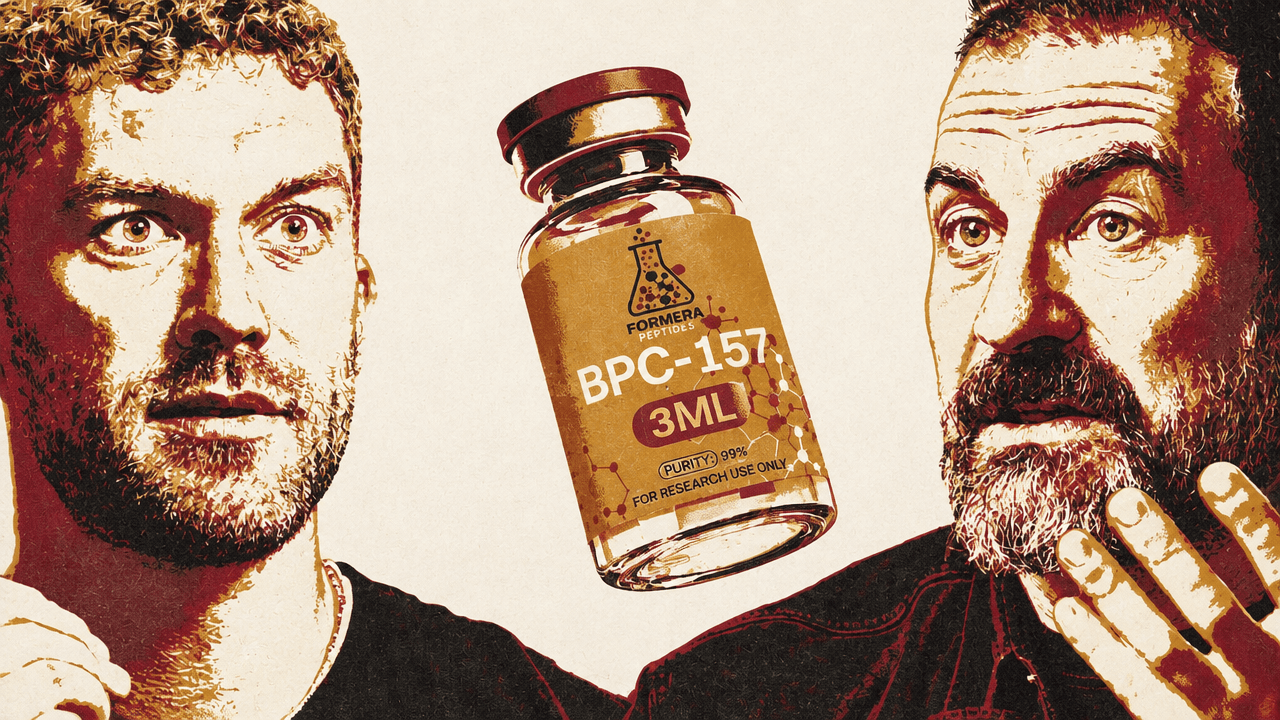
Huberman’s peptide results are striking, but he is unsure what caused them
Asked which protocols he believed in but could not scientifically prove, Andrew Huberman described personal experiments whose effects he found striking but could not separate from placebo or other explanations. He began with BPC, after shoulder pain developed while he was doing heavy pressing. External-rotation exercises had not resolved it, and he was considering backing off. He said he injected BPC twice, at roughly 100 or 200 micrograms per injection, after which the pain disappeared.

“Is it placebo? I don’t know. Maybe it is,” Huberman said. A better experiment, he noted, would have involved someone substituting saline without telling him what he was receiving.
He also pointed to animal data on BPC, including tendon repair, and recounted hearing from people whose older dogs seemed more mobile after receiving it. He acknowledged possible confounders: the owners had not used saline controls and might have changed other aspects of the dogs’ care. He described the animal data as impressive, while noting that it was animal data rather than human data.
He also raised a risk: “Maybe I gave myself a tumor by injecting the BPC.” He said a whole-body MRI had not found one.
His second example, Pinealon, concerned sleep. Huberman said he had taken roughly a tenth of an IU every third or fourth night. On those nights, he reported two and a half to three hours of REM sleep within six to seven hours of total sleep. He said the increase continued on subsequent nights, so he reduced use to once a week or once every ten days and still noticed the effect.
The next day, he found it harder to become fully alert, though he could still focus. Williamson suggested “sleep inertia”; Huberman did not explicitly adopt the description. He had heard of people taking Pinealon during the day because they liked working in a shallow state between sleep and wakefulness, but said that was not for him. He also mentioned rumors of people using it during long, laborious workdays, without endorsing those reports.
Huberman was less positive about growth-hormone secretagogues, naming tesamorelin, ipamorelin and CJC. He said they had always “nuked” his REM sleep and raised his PSA, and had not worked well for him. Exogenous growth hormone, or somatropin, interested him more. But at 51, while feeling well, he did not think he was ready to experiment, despite clinical trials exploring low-dose growth hormone.
A defined treatment goal is different from wanting to feel “better”
Huberman described combining MDMA and psilocybin in a clinical setting, with therapy before, during and after. He said psilocybin alone had helped him but had not resolved certain things. In his account, MDMA helped him acknowledge and feel emotions. The combination helped with what came next: moving through the experience by uncoupling negative feelings from the underlying event and replacing them with positive feelings.
He said he knew of clinical trials on MDMA-assisted psychotherapy for PTSD and on psilocybin for depression and PTSD, but not much evidence combining the drugs. He emphasized the need to be thoughtful about the setting, the people involved and adequate support throughout. He said the lack of FDA approval for the single-ingredient approaches, and the limited evidence on combining psychedelics, meant people might go abroad for treatment or encounter illegality.
That account was specific to a clinical setting and a therapeutic purpose. Williamson questioned the broader impulse to use peptides—or other interventions—as open-ended upgrades. People ask whether they should use peptides, he said, without naming an intended effect beyond “better.” He compared that with asking whether to invest in something and answering that the goal is “more money.” He also questioned the rationale for ibogaine for a friend who did not have a substance-abuse problem, while allowing that PTSD might be relevant.
The discussion of ibogaine and DMT brought their different concerns into view. Huberman called the ibogaine data intriguing and said people he knew had reported that it helped them. He was not especially afraid of ibogaine in a proper clinic with heart-rate monitoring; DMT concerned him more. He knew people who had taken DMT and were fine, and others who had become “legit weird” afterward.
Huberman recognized the appeal of wanting to feel better. He asked whether someone’s definition of a “10 out of 10” might change: could an improved state reset the scale, making what used to feel like a 10 into an 8 on a better scale? He left that as an intriguing possibility, not a recommendation to pursue a particular intervention.