Doomscrolling Requires Rebellion, Phone Boundaries, and Practice Being Alone

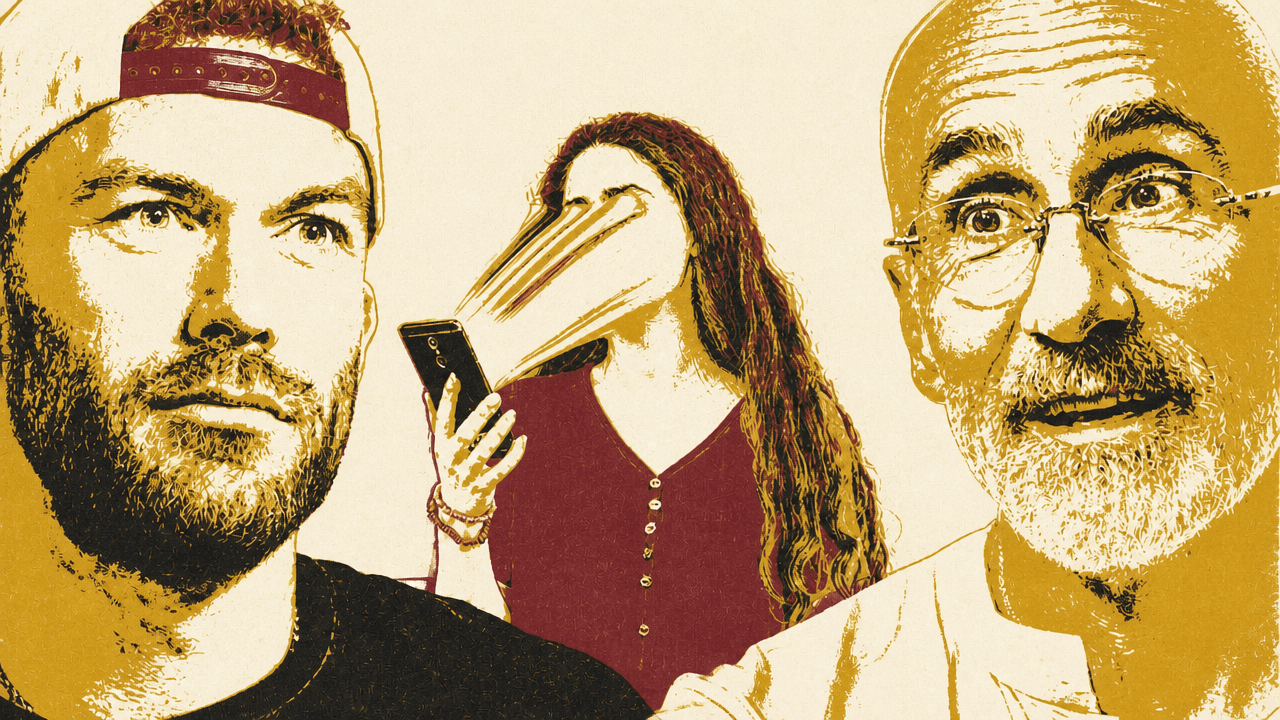
Harvard professor Arthur Brooks argues that doomscrolling should be treated as a behavioral addiction when it damages meaning, mood, and relationships but remains compulsive. His prescription is not phone abstinence but rebellion against the loop, followed by strict boundaries — phone-free hours, spaces, meals, bedrooms, and periodic fasts — and then the harder work of becoming able to sit with one’s own thoughts without reaching for a device.
The first step is not optimization. It is rebellion.
Arthur Brooks treats the doom loop as a behavioral addiction problem, but conditionally: if technology is “breaking your brain,” interfering with meaning, making you angry, depressed, anxious, and lonely, and you keep returning to it anyway, then you are in the territory of addiction. The pattern, as he describes it, is continuing to do self-destructive things despite knowing the cost.

His model has three steps. The first is anger. Not vague annoyance at wasted time, but a refusal to remain “subjugated” by a company, behavior, or culture. The person trying to stop needs to see the loop as a cage and want out of it. Without that “spirit of rebellion,” Brooks says, the exit strategy is unlikely to hold.
The second step is technical: find the specific method that interrupts the behavior. Brooks calls this an “algorithm,” and argues that for any addictive substance or behavior, there is research on how to stop. He is clear that he is not talking about medical interventions, which differ across gambling, alcohol, methamphetamine, and other addictions. He is describing the behavioral structure common to getting out.
The third step is the hardest: learning to live with yourself again. Brooks says addictive behavior often functions as an escape from being “home in your head.” He uses his own experience with alcohol to make the point. He has not had a drink since age 38, and says that in his 30s he did not like being alone with his own mind. Alcohol gave him “a little vacation in the bottle,” until it became clear that it was going nowhere good. After his father died, people close to him told him, in effect, that he had just seen his own future.
Stopping, in his telling, was not the hardest part. The hard part was being awake, alone, and alive with himself. Brooks applies the same structure to people who are “very, very online”: first rebel, then quit, then do the harder work of being with yourself without distraction.
You have to be able to sit behind the wheel of your car at a red light with nothing to do in your thoughts.
For Brooks, this work is concrete. It means standing in a supermarket checkout line without reaching for a phone. It means walking before dawn without a device, hearing the gravel under your feet, and recognizing it simply as “the sound of my feet on the path.” That, he says, takes work.
Recovery is possible because the goal is boundaries, not total abstinence.
When Chris Williamson asks whether people can recover from the doom loop, Brooks answers without hedging: it is “absolutely possible,” and he says he has seen it repeatedly. He distinguishes phone compulsion from substances such as heroin. The intervention does not require giving up the phone. It requires “proper boundaries,” rules, and habits.

The practical proposal is built around protocols. If a person already has a functional life, Brooks argues, they likely already understand habits: waking at a certain time, exercising, eating like an adult rather than “an 11-year-old.” The phone needs the same kind of behavioral architecture.
| Protocol | Brooks’s rule | Reason Brooks gives |
|---|---|---|
| First hour of the day | Ideally, do not look at the phone. If work requires a check, make sure nothing is on fire and put it down. | He describes the opening hour as important for “neurocognitive programming.” |
| Meals | Do not eat with a device. It is best not to eat alone; if alone, read a book or listen to music rather than look at the phone. | He says eating with another person promotes bonding, naming oxytocin as the most notable neuropeptide involved. |
| Last hour before sleep | Do not look at the device in the final hour of the day. | He points to sleep architecture, blue light, melatonin, and the psychological and relational importance of being present before rest. |
| Bedroom | Keep the phone out of the bedroom entirely, ideally on another floor or in a closet. | He says checking a phone at 3 a.m. can shut off melatonin and spike cortisol. |
The meal rule is where Brooks gives the most explicit account of what the phone displaces. Williamson asks why eating with a device matters, and Brooks answers in social-neurochemical terms. He says the neuropeptides in the brain, “most notably oxytocin,” flow liberally when people eat together. He places the claim in evolutionary terms, describing humans forming kin bonds around a campfire, eating, talking, and looking into each other’s eyes. If the phone is on the table — “God forbid” if the person is looking at it — Brooks says that neurochemistry does not happen.
The last hour of the day matters for a different reason. Brooks names the familiar physiological concerns: sleep architecture, blue light, the pineal gland, and melatonin. But he says the issue is also psychological and relational. The end of the day is when a person understands themselves and prepares to rest. If they live with a partner, he argues, the last hour is important because it allows both people to be present as they drift off to sleep together.
The bedroom rule is the strictest version of the same logic. The phone should not be in the bedroom “ever,” Brooks says, because waking at 3 a.m. and checking it is a mistake. Williamson says he has had that experience. Brooks’s explanation is that the interruption is not only about melatonin; it can also spike cortisol. His prescription is specific: the phone should be on a different floor, in a closet, plugged in somewhere else, from an hour before bed until an hour after waking.
Brooks’s school argument escalates from distraction to friendship.
Brooks applies the same phone-free logic to education, but with more force. He says there should not be phones in classrooms “in any school in the world between kindergarten and PhD,” because they interrupt what education is trying to do. His language escalates sharply: he calls phones in classrooms “child abuse.”
But his sharper concern is not only the classroom. When Williamson notes that this makes cafeterias even more important than classrooms, Brooks agrees. Lunch, in Brooks’s view, is the most important hour for students not to have phones, because that is where social life should form.
He is blunt about school itself, saying much of what happened in his own public schooling was not very interesting and felt mostly like babysitting. But he says at least he had friends. His worry is that students with phones do not get even that. The device does not just compete with instruction; it competes with the ordinary formation of friendship.
A phone fast is meant to prove the device is not necessary.
Beyond daily rules and phone-free spaces, Brooks recommends periodic technology fasts. His benchmark is 96 hours per year. He says there is “a little bit of research” suggesting that this can weaken the relationship with the device by proving to the person that they do not need it.
Brooks’s own example is a four-day annual spiritual retreat without a phone. The first day, he says, feels like “children screaming in my head.” By the second day he is calming down. By the third, he likes it. By the fourth, he wishes it could last the whole year.
He reduces the practical program to three categories: phone-free times, phone-free zones, and phone fasts. But he is careful not to confuse the behavioral interruption with the whole cure. These protocols address the second step — how to stop. They do not supply the first step, rebellion, and they do not complete the third step, becoming comfortable with yourself again. Those, Brooks says, are different processes.