Meaning Depends on Coherence, Purpose, and Significance

Arthur Brooks argues that feeling stuck is often a meaning problem with three separate parts: coherence, purpose and significance. In a conversation with Chris Williamson, Brooks says people need an answer for why life is unfolding as it is, a direction that lets them experience progress, and a sense that their life matters without having to earn love or public approval.
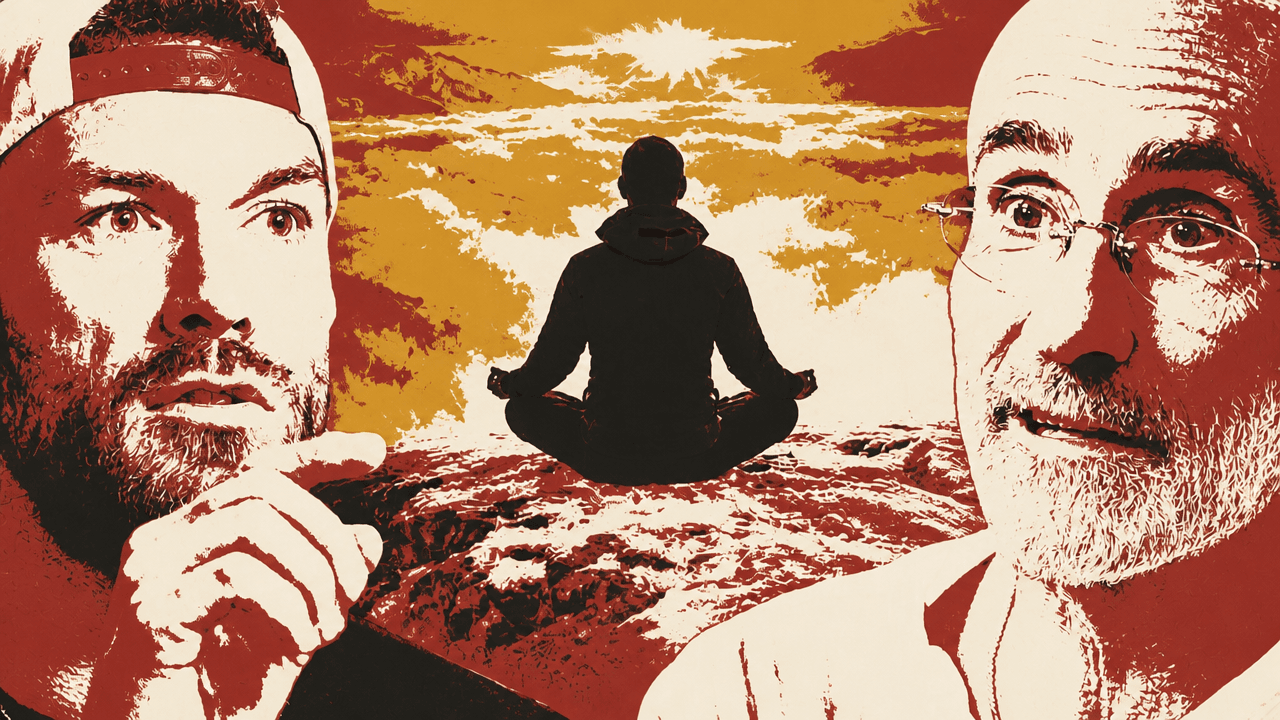
Meaning breaks into three why questions
Arthur Brooks frames meaning as three distinct answers rather than one abstract feeling. Drawing on work he attributes to social psychologist Michael Steger, Brooks says meaning consists of coherence, purpose, and significance. Each corresponds to a different “why” question.


The distinction matters because feeling stuck can come from different deficits. A person may lack an explanation for why life is unfolding as it is, a direction that makes effort feel like progress, or a sense that their life matters to anyone beyond performance. Brooks treats those as related but separate problems.
Coherence asks: why are things happening the way they are in my life? People need some account of the pattern behind events. That answer might be religious — “because of the mind of God.” It might be scientific — because these are the laws of the universe. It might be conspiratorial — because powerful people are manipulating events. Brooks’s point is not to rank those explanations here, but to show that each functions as an answer to the coherence question.
That is why conspiracy thinking, in his account, should not be treated first as an information problem. If a relative is “going down the rabbit hole” into extreme theories, throwing facts at them and calling them stupid misses the underlying issue. He describes conspiracy theories as a cry for an answer to the coherence question — a meaning problem and a happiness problem.
Conspiracy theories are nothing more than crying out for an answer to the coherence question, which is a meaning problem.
Purpose asks: why am I doing what I’m doing? Brooks distinguishes purpose from meaning itself. Purpose is the part of meaning that supplies goals and direction, so a person can experience progress. Without it, people are “just going in circles,” like a cruise ship wandering without destination. He describes himself and Chris Williamson as “teleological” people: they want a goal.


Significance asks whether one’s life matters — to a spouse, children, God, a dog, or anyone else. Brooks calls this “the love question.” His diagnosis of modern culture is that many people lack all three: they do not know why things happen, do not know why they are doing what they are doing, and do not believe their lives matter.
When life feels random, agency disappears
Randomness is psychologically corrosive because it removes control. In Arthur Brooks’s account, if events appear patternless, anything can happen at any time, and the person cannot see “levers” to pull. Without coherence, people stop feeling like active players in their own lives.
Brooks uses learning to drive as an analogy. To a new driver, traffic can look like chaos: intimidating, systemless, impossible to read. Chris Williamson recalls learning in a Mini in Britain and feeling dwarfed by other vehicles. Brooks’s point is that any system that appears not to make sense tends to feel meaningless because the person inside it does not know what action would matter.
Different coherence stories produce different forms of agency. If someone believes events unfold according to God’s will, they may pray or seek a relationship with God. If they believe reality is governed by scientific laws, they may study science and try to interact with the world through that understanding. Brooks identifies his own work as a behavioral scientist as “a pure coherence play”: explaining the science so people can act within it. If someone explains the world through conspiracy, they may go online and share theories with friends.
Coherence matters because it gives people a model of reality in which their actions can matter.
Progress matters more than arrival
Directionlessness produces fragility because people without direction cannot make progress. Arthur Brooks’s broader premise is that happiness comes from making progress toward a goal. Without a direction of travel, there is no felt movement.
He uses dieting to illustrate the trap. Diets, he says, are both effective and “catastrophic failures.” They are effective in the narrow sense that almost any diet can make someone lose weight. But Brooks puts their one-year failure rate at 80% to 95%, meaning people regain the weight and then some. Chris Williamson calls the industry “an Ouroboros of nutritional advice”; Brooks describes it as a roughly $40 billion U.S. industry that fails “nine out of 10 times.”
The reason diets can work temporarily, Brooks says, is that they create progress. The reason they often fail is that reaching the target changes the reward structure. Once a person hits the goal weight, the reward becomes “never getting to eat what you like ever again for the rest of your life.” Brooks calls this an instance of the arrival fallacy: the mistaken belief that reaching the endpoint will deliver the satisfaction one is seeking.
His alternative is not to abandon goals, but to choose goals that do not terminate. “I want to be a better dad,” “a better person,” “a better husband,” “a better friend,” “a better citizen,” or to create more value through work. These are not goals one completes. Brooks says he needs “goals I can’t meet,” because the point is sustained progress rather than final arrival.
Public adoration is a counterfeit form of significance
The confusion between significance and public adoration grows out of what Arthur Brooks calls the pathology of strivers. Much of his work, he says, focuses on high achievers: people who do “incredible things” and still do not have perfect lives. In his account, many such people share a childhood pattern. They received attention and affection from parents when they performed — got good grades, made the team, earned first chair in the orchestra, built an unusually successful lemonade stand.
Parents, often immigrants or people who came from poverty, may think they are wiring in success and happiness by rewarding achievement. Brooks argues that what they often teach instead is that love is earned.
That lesson, he says, is powerful when learned in childhood, while the brain is highly plastic. The child becomes an adult trying to earn love repeatedly: in romantic relationships, in marriage, through money, youthfulness, status, gifts, favors, or the approval of people who are not real friends.
Against that learned model, Brooks states the contrary claim plainly: real love is not earned. It is “a free gift, freely given”; a grace.
Real love isn't earned. It's a free gift, freely given, it's a grace. Anybody who makes you earn their love doesn't love you.
The substitution of public adoration for significance becomes more dangerous, in Brooks’s telling, when the old search for specialness scales outward. A person who once might have sought specialness within family, church, city, or community can now seek it from “the whole world on the internet.” Brooks describes the adoration of strangers as an especially strong dopamine hit. Without it, he says, life can feel gray. The more talented a person is, the more danger they face, because talent gives them more access to the addictive cycle of achievement, attention, and temporary specialness.