A Psychedelic Reset Forced a Veteran to Face the Damage at Home
Former Navy SEAL DJ Shipley tells Chris Williamson that his collapse was not rooted in combat trauma but in childhood wounds, addiction and the damage he caused after leaving the military. Shipley argues that ibogaine and 5-MeO-DMT did what years of conventional therapy could not, breaking a suicidal and addictive pattern, but says the decisive test came afterward: returning home to a marriage he had nearly destroyed and trying to prove the change one day at a time.
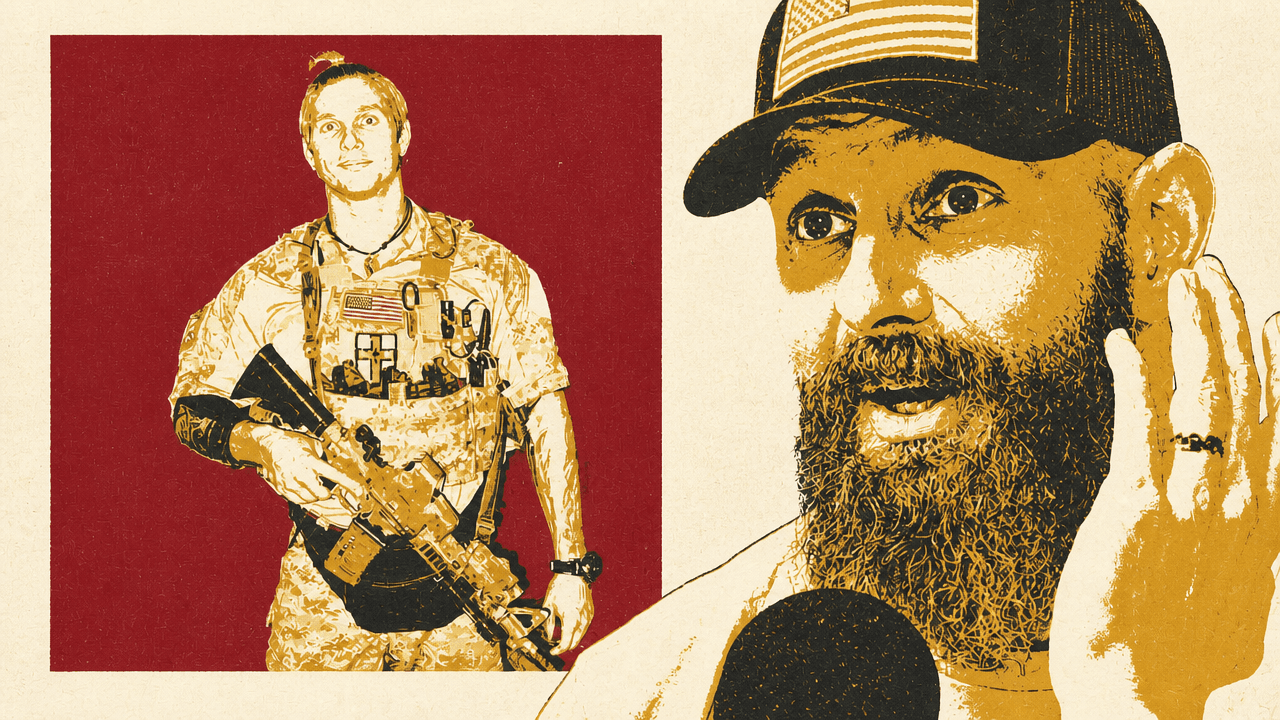
Shipley says the trauma was not the war
Donald Shipley rejects the assumption that his breakdown was primarily about combat. When Chris Williamson frames him as an ex-war veteran carrying PTSD from being shot at and shooting at people, Shipley interrupts the premise: “I don’t have PTSD from that at all.” In his account, “not a single piece” of the experience he went through on ibogaine or 5-MeO-DMT involved the military. The material that surfaced came from childhood, “zero to 16,” and then from the period after he transitioned out. The entire military period, he says, was “gapped.”
That distinction matters to Shipley because it changes the category of the problem. He does not present psychedelic treatment as a niche intervention for special operators haunted by combat. He says the last time he went down, the group included men, women, civilians, and military people, and that “everybody is on the exact same path.” His formulation is blunt: “Trauma is trauma.”
Trauma is trauma. The last time I went down, I went down with co-ed, males, females, civilians, women, everybody. Everybody is on the exact same path.
The specific claim is larger than symptom relief. Shipley says ibogaine and 5-MeO-DMT compressed what he describes as “15, 20 years of therapy in five days.” He says that if he had returned home from ibogaine without 5-MeO-DMT, he “probably wouldn’t be here.” He also says he is now on no medication at all: “Not a pain pill, not an SSRI, not an Ambien, nothing.”
Williamson asks what Shipley thinks happened. Shipley says the medicine “killed everything I had inside me that was bad,” including his addictions. He distinguishes that from becoming a morally perfected person. “Anything I do now it’s because I want to,” he says, adding that this is “not necessarily always a good thing” because he still likes “to do some bad shit too.” But he describes the baseline as reset: the things he was struggling with were “swiped” away.
The 5-MeO-DMT session became a confrontation with suicide
Shipley describes 5-MeO-DMT as unlike anything else he has experienced: extremely fast, with almost no buildup. The setting he describes is physical rather than abstract. He says they sit you down for what is “supposed to be a purge.” The drug is smoked from what he calls a crack pipe — a small glass vial heated in a way he says looks intimidating. On exhale, he says, “your whole body consolidates into a single spark and then it explodes.”
His description moves between bodily sensation and visual metaphor. He compares the launch to the streaking trails in Star Trek. After exhaling, he says, it feels like ending up in the stratosphere, surrounded by “whatever.” The instruction he was given was to surrender completely: if you think you are going to die, die; if you think you are going to explode, explode; if you think you are going to drown, drown. “Just one big exhale and let it take you.”
Shipley says he did not surrender at first. He tried to hold on. He threw his arms out, screamed, curled up, and cried uncontrollably — “the ugliest crying you’ve ever seen,” the kind of crying so hard that he threw up. After the first round, he sat up and was told, “That wasn’t it.” He says he was shocked: “That was everything I had.” The facilitator told them to hit him again. Shipley says he did six rounds back to back.
The sixth round is the one he identifies as the break. A nurse and a “team guy” confronted him directly. The man asked whether he wanted to die. Shipley said yes. The man told him, in Shipley’s telling, to “kill yourself” with the medicine — to stop the theatrics, stop crying, and do it right then. Shipley says the provocation matched his actual state: he did not want to go home, did not want to confess, did not want to face what he had done.
He then took the medicine with the intention of ending himself. He describes trying to coat his whole body with the smoke, pushing it down “to my tippy toes,” holding his breath as long as he could. He felt his eyes flutter and a vibration behind his sternum, “like there’s a cell phone this big” inside his chest. When he exhaled, the “blast off” happened again. “And when that one happened, it killed me,” he says. “Killed my ego. It reset the whole baseline.”
The immediate aftermath was not detachment. It was urgency to return to his family. When he opened his eyes, the facilitator told him, “That was it.” Shipley’s response was: “I’ve gotta get home. I gotta get home right now. I gotta see my old lady. Gotta see my girls right now.”
He frames the experience as lifesaving but not clean. “Everything else kind of fell apart from there,” he says. The experience did not spare him from consequences; it made the return unavoidable. “It was rough,” he says. “It was so worth it, though.”
The new baseline collided with a marriage already detonating
Shipley’s account of reintegration begins with a contradiction: he came out of treatment feeling transformed, but his wife was discovering the full scale of his betrayal while he was unreachable. During the five days he did not have his cell phone, he says, she hacked it and found out about all the affairs. She contacted lawyers, prepared to divorce him, boxed up his belongings, moved them to his shop, and drew up divorce papers.
The people running the process, he says, gave him a script before he crossed the border and got his phone back: tell his wife he was glad to be on the other side of the medicine, that he wanted to come home and explain everything in person, and that it was too much for a text or phone call. He tried calling. She did not answer. Texts did not go through. For three or four hours, nothing.
Then, during the trip from San Diego to Norfolk through Atlanta, his phone powered on and he received a notification that the password to his Instagram had been changed. He realized it was his “ghost account.” His conclusion was immediate: he would not have the chance to tell her himself. “Now there’s no integration,” he says. “Now I’ve lost everything.”
When he arrived at the shop in Norfolk, the social environment confirmed it. Other families and employees were present, but he could feel tension. He says other wives knew because they had seen his wife bring boxes into his office for three days. Upstairs, his office was full of his belongings: “25, 30 boxes,” floor to ceiling, everything folded and organized — socks, underwear, black T-shirts, jeans, military gear, everything he owned.
He performed normalcy briefly. He hugged people, kissed them on the cheek, fist-bumped, and said, “See you on Monday,” while knowing he did not intend to see them on Monday. Then he went downstairs to the armory, grabbed a pistol, put it in his waistband, got in his truck, and drove.
The destination was a private beach behind a military base, near a house they used to have. It was a one-road drive, about 20 minutes, ending at a dead end. His wife was tracking his phone through shared iPhone location. About 10 minutes into the drive, she called. Shipley says his heart rate was 190. He almost did not answer. When he did, she asked where he was and what he was doing. He told her he did not have the strength to see her. He apologized and hung up.
At the beach, he backed into a parking spot and put on “Experience” by Ludovico Einaudi. His plan, he says, was to wait until the song ended, walk into waist-deep water, and shoot himself in the head. No goodbye, no final speech. “Just let me close this thing out and be done.”
His wife had already alerted other wives who lived on the road. They and their husbands had positioned themselves around the vehicle, apparently not knowing what he would do and prepared to intervene. With about 30 seconds left in the song, Shipley says, his wife called again. He looked up and saw her driving toward him.
His wife’s response suspended judgment long enough to keep him alive
Shipley’s description of his wife at the beach is the emotional center of the account. She walked up to him, opened his legs, stepped between them, leaned over, and pulled off his sunglasses. Then she “exploded in hysteria.” Shipley says his eyes were crystal clear and green for the first time in a decade, and that she saw “something had happened.”
They held each other and cried. Then she asked him, “How the fuck could you do this to me?” Shipley says he had no answer and no excuse.
He told her he knew there was no way they could work it out, no way she would let him see the kids again, and that he only wanted an opportunity to say goodbye to them. Her response, as he recounts it, was not forgiveness; it was deferral. They did not have to stay married, she told him. But he could not “close this out” right then. They would solve it tomorrow. They would go home, see the girls, pretend it had not happened for their sake, and “shelf it” for the moment.
Before they did that, she demanded everything. Every detail, every person, every date. “That way I never have to ask you again.” Shipley says he gave it to her: all the affairs, everything he had done. “We got through it right then.”
That night, after returning home and reintegrating with the children, they sat on the edge of the bed and went through his phone. Shipley blocked and deleted every person who represented conflict or potential conflict. He says this included people involved in affairs, family members, and anyone toxic he had been trying to keep in his life. He frames it in operational language from the SEAL teams: “control the controllables.” If a person’s call made his heart drop, they were gone. He estimates the number at about 150 people.
He then proposed a one-day standard. They did not have to stay married; they could get divorced if she wanted. But he asked for “one singular day” to show her he had changed. The day he failed, he told her, she should “shitcan” him. They signed paperwork, including a postnuptial agreement. In his telling, if he did anything again, she would get the house, assets, everything. He did not want anything except the chance to prove the change one day at a time.
Shipley says the result has been “the greatest thing to ever happen to us.” He describes their relationship now as exceptionally strong and calls his wife his best friend. But the guilt remains specifically because he believes he exploited her reliability. She “never left, never strayed away,” he says, and he put her “on the back burner” because he knew he could.
That, rather than combat, is what he says haunts him. When people thank him for his service or assume he is torn up by what he did in war, he rejects it. He says he was paid to do that job and loved it, including “the bad stuff.” The people he sacrificed so he could do the selfish things he wanted to do — especially his wife — are the unresolved moral weight.
Shipley does not think ordinary repair would have reached the same place
Donald Shipley is explicit that he does not believe marriage counseling, talk therapy, and scheduled date nights could have navigated what happened. In his account, the problem after the medicine was not that nothing had changed. It was that too much had changed too quickly for his wife to believe it. The version of him who returned from Mexico was, he says, so far from the person she had known for the previous decade that she thought it was “bullshit.”
He says he tried to explain that he had changed, but the only way he knew to make it intelligible was for her to have her own journey. She did not do ibogaine at first because she thought it would be too strong. Shipley says he later wants them to do ibogaine together as a couple’s journey. Initially, he persuaded her to do psilocybin and 5-MeO-DMT. They also did a joint session involving psilocybin, MDMA, and 5-MeO.
After those experiences, he says, she understood. He describes her as becoming different after psilocybin, and says the experience made his own change legible to her: “By the time we finished those, she knew exactly what it was.”
The mission shifted from going to war to getting people to Mexico
Chris Williamson briefly raises what he describes as Donald Trump signing a bill to fast-track research, with ex-SEALs standing around him. Shipley responds by pointing to a documentary he names as In Ways and War, saying Marcus and Amber were part of that initiative and “really the one that kicked off that whole thing.” He says the film includes Green Berets, regular military, and fighter pilots, and that it shows “success after success after success.”
His frustration is that, in his view, the outcomes are already visible. “Why are we not doing this?” he asks. He attributes resistance partly to “spillover stuff from the 50s, 60s, and 70s” around psychedelics being dangerous or brain-rotting. He does not claim to be able to quantify what happened. He says he knows it works because of his own case and the cases he has accompanied.
Williamson asks why Shipley keeps returning to ibogaine if he believes he already made the realizations he needed. Shipley says the second trip was not originally for himself; he was accompanying a friend who was “really on the struggle bus” and close to ending his life. Shipley told him he would go too, and when the friend challenged him for not planning to take the medicine, Shipley says he did it cold: “No prep, no warm up, just sent it.” He wanted to demonstrate there was nothing to fear.
Other returns were to host: cooking meals, doing dishes, and supporting people as they went through the process. Another trip involved a friend from his second deployment who had been badly shot and whom Shipley had idolized. Shipley says he promised that if the friend ever called, he would stop anything — even a major interview — and fly to San Diego to go to Mexico with him. The friend eventually called. Shipley says he was on a plane within 24 hours.
Williamson observes that Shipley spent years on “hair trigger alert” to go kill people around the world and now seems to be on hair trigger alert to save people through ibogaine. Shipley accepts the comparison and says the newer mission gives him more benefit than killing people ever did, even though he says he “loved killing people” and calls it “the best job you’ll ever have.”
He gives another example of the same posture. A friend who had gone once was ready, about a year and a half later, to go again but did not know if he could do it. Shipley says he flew to San Diego, called him, and told him the bus for Mexico left in 30 minutes. The friend’s girlfriend dropped him off with a backpack. They went down together, and Shipley says the friend has “never been better.”
The claim expands from addiction to whatever a person cannot get past
Shipley’s language around ibogaine is expansive. He calls it “magic” and says that when you take it, “you cannot believe it grows in the earth.” He says he cannot understand why something used for thousands of years has not become more mainstream.
He also insists he cannot quantify it. His certainty is grounded in his own experience: he says he has taken “every drug there is,” including “a bunch of weird stuff” during his transition, and found nothing comparable. His central claim is that addiction disappears instantly: “Every ounce of your addiction is gone instantly.”
Williamson presses on the case of people who do not have addictions. Shipley rejects the premise: “Everybody has addictions.” Sometimes, he says, the addiction is ego. Sometimes it is depression, suicidal ideation, substance abuse, women, or simply the sense that “you just don’t feel right anymore.” His recommendation is the same: “I’d go do that.”