SpaceMob Investors Help Push AST SpaceMobile Toward a $25 Billion Valuation


Bloomberg’s Sana Pashankar reports that AST SpaceMobile’s retail backers, who call themselves the SpaceMob, are helping turn the satellite-to-phone company into a major public-market story. She argues the group differs from earlier meme-stock crowds because its members see AST less as a short-term trade than as a bet on direct-to-device satellite connectivity and the possibility of a much larger business. The segment ties that conviction to AST’s sharp share-price rise, while stopping short of proving how much the online community itself has driven the move.
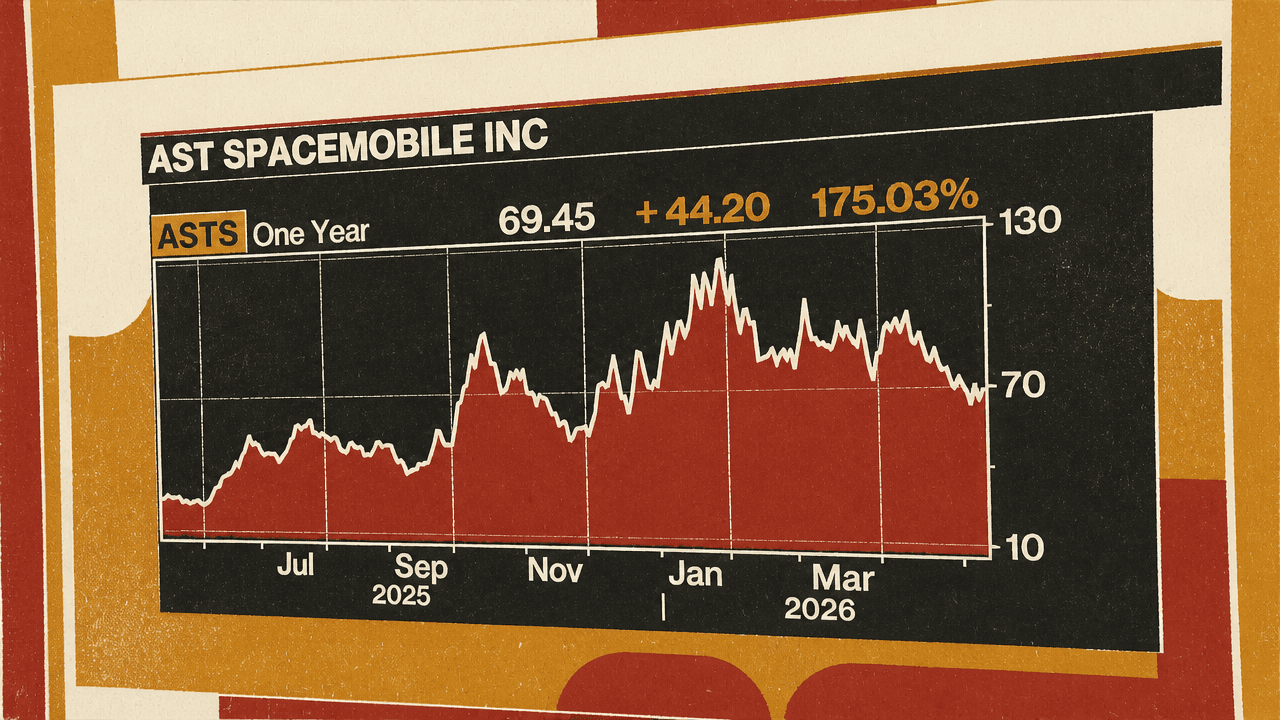
The SpaceMob is not treating AST SpaceMobile like a trade
Sana Pashankar describes AST SpaceMobile’s retail base as a large, unusually committed online investor community: “thousands of retail investors” who call themselves the SpaceMob. The obvious comparison is to the crowds that formed around meme stocks such as GameStop and AMC, but Pashankar draws an important distinction. In her account, the SpaceMob does not see AST primarily as a short-term squeeze or momentum vehicle. Its members believe the company can become “the next trillion-dollar company,” and they believe that because they believe in the underlying technology.


That technology is direct-to-device satellite connectivity. Pashankar explains AST’s pitch as satellites that can “beam cell reception directly to your mobile phone,” something satellites traditionally have not done. The investor enthusiasm is tied to that possibility: if AST can make ordinary mobile phones connect directly to satellites, the company’s backers see a path to a much larger market than its current size implies.
The market has already begun treating AST as more than a speculative small-cap story. A Bloomberg chart shown during the segment placed AST SpaceMobile’s market capitalization at $25.4 billion, in the same range as several household names.
| Company | Market capitalization shown |
|---|---|
| United Airlines | $32.4B |
| Kraft Heinz | $28.1B |
| AST SpaceMobile | $25.4B |
| Tyson Foods | $23.9B |
| Charter | $22.3B |
| Ralph Lauren | $21.4B |
The point of the comparison was not that AST resembles those businesses operationally. It was that AST’s market value has reached a scale normally associated with familiar, established companies. That scale is part of what makes the retail investor story consequential: the SpaceMob is not only posting about a niche space stock; it is rallying around a company whose valuation Bloomberg framed alongside major consumer, airline, food, cable, and apparel names.
The community watches filings, aircraft, and every fragment of corporate signal
Pashankar’s account of the SpaceMob emphasizes intensity more than breadth. Its members “fixate on every shred of corporate intel from the company.” They track regulatory filings. They track planes involved in shipping the company’s satellites. The behavior is closer to a distributed research operation than casual fandom, though Pashankar also makes clear that it has the affective qualities of fandom: “about as devoted as a fan base to a company as you can get.”
That devotion matters because AST’s share price has moved dramatically. Caroline Hyde states that the stock is up nearly 6,000% over a 22-month period. Bloomberg’s on-screen charts showed the same general direction across shorter windows: a one-year chart for AST SpaceMobile showed the stock at 69.42, up 44.17, or 174.93%; a two-year chart showed 69.26, up 66.96, or 2,911.30%; and an intraday chart showed 69.28, up 3.90, or 5.97%.


The segment does not establish how much of that appreciation is caused by the SpaceMob. It does, however, connect the retail community to the stock’s public-market momentum. Hyde frames the devotion as something that “means” the stock has risen sharply, while Pashankar describes moments when the emotional signals of prominent community members can be reflected in the share price.
That distinction is important. The source does not present a quantitative attribution model or separate retail flows from institutional demand, short interest, corporate news, or broader market conditions. What it does show is a market narrative in which a large retail constituency is a visible and active part of AST’s rise: watching corporate clues, amplifying bullish interpretations, and treating the company’s progress as a collective project.
Kook functions as both investor and mood signal
The most specific example of SpaceMob leadership is an anonymous figure known as “Kook.” Pashankar identifies him as a California-based private investor who wants to remain anonymous and has “a ton of money” in AST SpaceMobile. She says his family’s money is in the stock, his children’s money is in it, and “everything” is tied to the company.
That degree of exposure is part of why he has become one of the SpaceMob’s most prominent figures. Pashankar says he “really leads the SpaceMob,” not in the sense of a formal organization described in the segment, but as a visible personality whose posts and emotions are watched by other members. She characterizes him as “very emotionally invested” and says that if someone follows his X posts, “you can track his mood based on how the stock is doing.”
The community’s attention to Kook turns him into a sentiment indicator. Pashankar says other SpaceMobbers follow him and watch for signs of his emotional mood. She also says that “sometimes you can see that reflected in the stock price as well.” The phrasing is careful: it does not claim that Kook mechanically moves AST shares or that his posts alone drive trading. It suggests a looser feedback loop among stock price, community emotion, and visible online leadership.
That feedback loop is what makes the SpaceMob resemble earlier retail-investor movements while still differing from them in motivation. Like meme-stock communities, it has its personalities, its shared symbols, its online vigilance, and its emotional market tape. Unlike the meme-stock comparison as Pashankar frames it, the SpaceMob’s central claim about itself is conviction in AST SpaceMobile’s technology and future scale, not a quick trade.