Starship Reusability Underpins SpaceX’s Long-Term Connectivity Expansion

Mizuho’s Brett Linzey argues that SpaceX’s $200 price target is supported chiefly by nearer-term Starlink, government, enterprise and airline revenue, while the company’s more ambitious AI and orbital-infrastructure plans remain heavily discounted. The larger upside, he says, depends on Starship becoming rapidly reusable: that capability would let SpaceX extend its launch advantage into a broader connectivity business. Linzey views the recent Starship test abort and planned quick return to the pad as an important test of that development path rather than evidence of a structural problem.
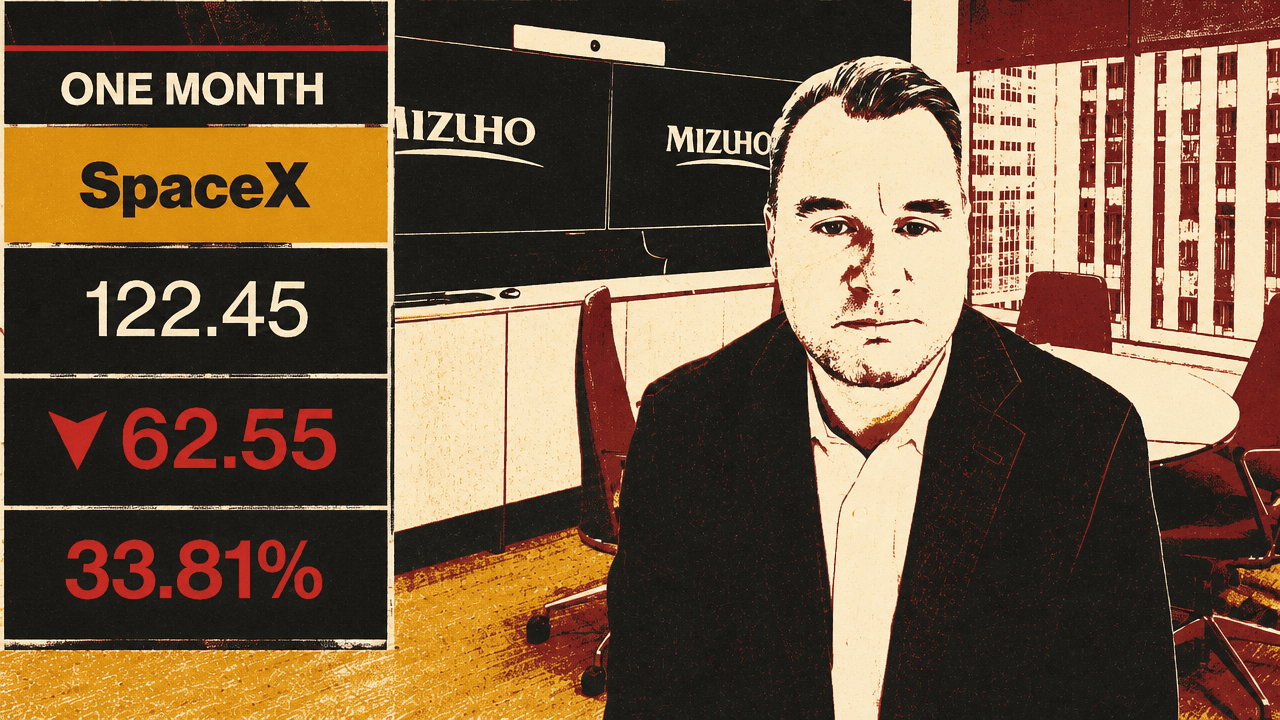
Mizuho’s $200 target rests on near-term connectivity, while Starship governs the larger upside
Brett Linzey’s investment case separates the business SpaceX can monetize on a visible timetable from the businesses that depend on a much bigger technical leap. Mizuho’s displayed view is an outperform rating and a $200 price target, but Linzey said the firm takes a large discount to the prospective AI platform. Its three-year roadmap instead places much of the near-term weight on Starlink, space-related government contracts, enterprise business and more recent airline contracts.
Mizuho anchors that valuation on 2029 and applies what Linzey called a “pretty large haircut” to SpaceX’s internal plan. The distinction matters because SpaceX’s most ambitious possibilities—an AI platform and orbital data centers—are not the primary support for the target. Orbital data centers, in particular, sit in a 2030-and-beyond horizon.
Connectivity is more optionality around the stock and underwriting it on some of the near-term fundamentals.
In that framing, Starlink and connectivity are both the nearer-term commercial case and the bridge to more distant optionality. Starship is essential not because Mizuho needs to assume an orbital-data-center business today, but because a successful, rapidly reusable vehicle would expand what SpaceX can do with its constellation and connectivity infrastructure over time.
A one-week fix is the test of whether Starship’s development remains on track
Ed Ludlow identified the dependency bluntly: SpaceX’s AI, Neo Cloud, Starlink and orbital-data-center ambitions require Starship not only to work, but to become rapidly reusable. He pointed to the market’s sensitivity during the prior week’s attempt, when SpaceX stock fell 4% in after-hours trading after a test was aborted at the final moments. A Bloomberg Tech on-screen chart identified a Thursday target for Flight 13’s next liftoff.


Linzey’s response was that the Flight 13 abort did not indicate a structural failure of the vehicle. Starship Version 3, which he described as a larger and more powerful vehicle that debuted about two months earlier, automatically aborted at ignition after four of the booster’s 33 Raptor engines did not immediately light. The onboard system detected the problem and stood the vehicle down before liftoff—an outcome he characterized as the safety system operating as intended.
According to Linzey, Musk and the SpaceX team identified the root cause within hours, planned to swap two engines and had the vehicle back on the pad for a Thursday relaunch attempt. That implied roughly a week from abort to return, which he viewed as a relatively quick diagnose-and-fix cycle for a rocket at this scale, rather than evidence of something structurally wrong with the ship.
The turnaround does not remove the execution risk. Falcon 9 remains the current vehicle for delivering payloads and densifying the Starlink constellation, and Linzey said SpaceX has good visibility into that existing work. But the longer-term Starlink and connectivity opportunity hinges on Starship’s success and its operating cadence. This year’s launches will therefore matter not just as demonstrations, but as evidence of whether the vehicle can become the practical enabler of the broader thesis.
That launch position gives SpaceX what Linzey called a “big running start” against its competitors. Its existing share of mass sent to orbit is an advantage; turning it into a larger connectivity business depends on whether Starship can reliably extend it.
Musk is a key-person risk, but not the whole moat
Asked about Elon Musk’s role, Brett Linzey acknowledged that key-person risk is a consideration. Musk is a visionary, he said, and remains deeply involved in operations across SpaceX’s divisions and segments.
Linzey nevertheless argued that the company has developed an operating blueprint and defensible strengths that extend beyond one executive. The key differentiator, in his view, is SpaceX’s ownership of launch capability in the United States and globally. That position supports the optionality in Starlink, connectivity and the other businesses that could follow.
Musk helped turn a long-standing vision into a real company, Linzey said. But the valuation case also rests on the launch capabilities, moats and secular strengths the company has built around that vision.