Helium-3 Shortages Could Constrain Superconducting Quantum Computing


Interlune CEO Rob Meyerson argues that a shortage of helium-3—not helium generally—could constrain superconducting quantum computing, which uses the rare isotope to cool chips to millikelvin temperatures. The company says it has nearly $500 million in binding orders beginning in 2028 and plans to meet them first by separating helium-3 from commercial helium on Earth, before pursuing extraction from lunar regolith in the early 2030s. Meyerson’s case for the Moon rests on both its helium-3 reserves and the prospect that mining equipment could share infrastructure with future lunar construction.
Interlune has orders before it has a lunar supply
Rob Meyerson says Interlune has signed binding purchase orders for helium-3 worth just under $500 million, with deliveries beginning in 2028 and extending seven to 10 years into the future. The commercial problem is that its eventual Moon operation is not expected to begin producing until the early 2030s.

Interlune’s proposed bridge is an Earth-based separation process that Meyerson says should produce about 2.5 kilograms of helium-3 annually. Its lunar target is 10 kilograms in the early 2030s—not a stated annual production rate. In Meyerson’s account, the company developed the terrestrial process because it needed a way to serve customers before a lunar operation could exist.
| Supply approach | Output described by Interlune | Timing |
|---|---|---|
| Cold capture at grade-A helium plants on Earth | About 2.5 kg annually | Intended to support orders beginning in 2028 |
| Extraction from lunar regolith | 10 kg of helium-3 | Early 2030s target |
The near-term system uses cryogenic distillation to separate helium-3 from commercial grade-A helium, a technique Interlune calls “cold capture.” Meyerson says the basic idea had existed but had not been commercially pursued, and that Interlune is the first company, to its knowledge, to demonstrate helium-3 separation from commercial-grade helium.
That makes the Moon plan more than a distant resource proposition. Interlune is presenting the same underlying separation capability as both a near-term supply business and a component of a later lunar-extraction system.
The shortage is helium-3, not helium generally
Rob Meyerson describes helium-3 as an extremely rare isotope used to cool superconducting quantum-computing chips to millikelvin temperatures. The constraint, he argues, is distinct from the broader helium supply disruptions familiar to chipmakers and other industrial users.
It comes from the decay of tritium and it’s used to chill down superconducting quantum computing chips down to millikelvin temperatures.
For decades, Meyerson says, helium-3 was obtained from tritium decay in the United States, Canada, and elsewhere. But little tritium is now being made. Because tritium has a 12.3-year half-life, it decays into helium-3; Meyerson’s point is that the conventional source is no longer being meaningfully replenished.
Ed Ludlow frames the question against the chip industry’s wider experience with helium, which is used for cooling and stabilization. He notes that the war in Ukraine and a Strait of Hormuz bottleneck made supply vulnerability more visible. Meyerson distinguishes helium-3 from those logistics-driven disruptions: in his telling, its problem is underlying scarcity on Earth.


Interlune’s central premise is therefore not simply that quantum computing needs more cooling capacity. It is that scaling superconducting systems will require a new source of the specific isotope used to reach their operating temperatures.
The Moon is a resource target and an infrastructure bet
Meyerson says the Sun produces helium-3 in large quantities and that more than one million metric tons lies in the Moon’s regolith, the loose material covering its surface. He expects extraction to have a higher yield there than the Earth-based process and identifies the Moon as Interlune’s longer-term source.
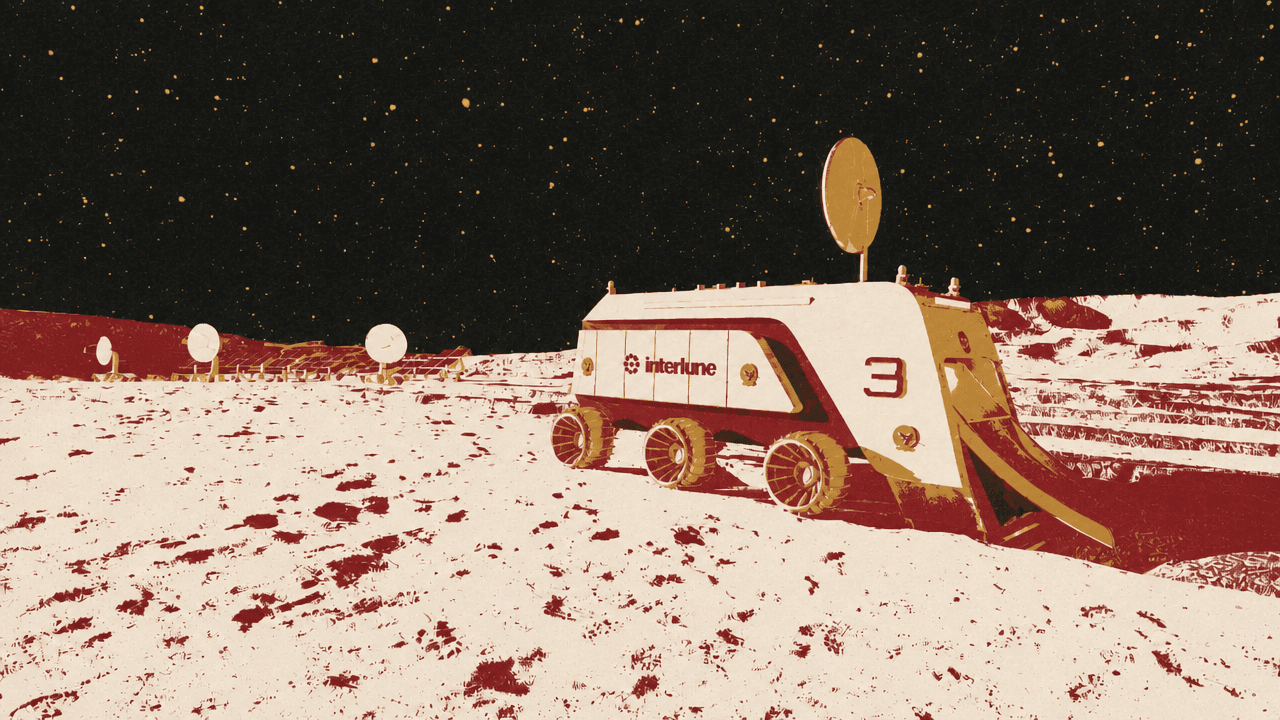
Company animations shown during the discussion depict a four-step harvesting sequence: excavation, sorting, extraction, and separation. Other footage shows a tracked prototype vehicle in a workshop, an employee working on its side, and the vehicle using a front blade to dig into a pile of dirt outdoors. The visuals present lunar helium-3 production as a material-handling operation as much as an isotope-separation problem.
Rob Meyerson says Interlune has time to determine its route to the lunar surface. The company is looking to NASA’s Artemis program, he says, along with launch providers including SpaceX and Blue Origin and lander builders such as Firefly and Intuitive Machines. Its plan is to invest alongside Artemis and use infrastructure developed through that program.
The infrastructure we need to harvest large volumes of helium-3 from regolith is infrastructure that also can help NASA build a Moon base, build roads, and do construction on the Moon.
In Meyerson’s formulation, the economic case depends partly on that overlap: equipment capable of excavating, processing, and moving lunar material for helium-3 extraction could also support the construction work required for a long-term lunar presence.