Nvidia’s $13 Billion Hugging Face Deal Tests Platform Neutrality


Hugging Face co-founder Thomas Wolf says the company chose Nvidia’s roughly $13 billion acquisition proposal over another funding round because it wanted greater resources to expand open-source AI while preserving its role as a neutral platform. Wolf argues that Nvidia shares Hugging Face’s commitment to open models, developer choice and robotics, though the companies have yet to specify how Hugging Face will remain compute-agnostic and independent in practice under Nvidia ownership.
Hugging Face chose acquisition over another funding round
Nvidia’s proposed acquisition of Hugging Face, valued at about $13 billion, followed a strategic choice about how aggressively the company should support open-source AI. Thomas Wolf said Hugging Face had two paths: raise more money and expand independently, or find a partner that shared its mission and could help accelerate the work. Hugging Face approached Nvidia.

Wolf said the conversation began broadly, with investment among the options. Hugging Face had often received offers to invest, he said, but the companies concluded they were aligned closely enough to “go all the way” with an acquisition. In Wolf’s telling, the appeal was not capital alone; it was the prospect of pairing Hugging Face’s open-model platform with Nvidia’s resources and capacity to move faster.
Hugging Face had reached considerable scale while raising comparatively little capital, according to Wolf. He said it had raised less than $500 million, built a hub hosting 3 million models, reached 18 million users, and served 200,000 companies.
Wolf framed the decision against what he called a major moment for open source. Open-source AI was rising, he said, and an attack on Hugging Face earlier in the summer had reinforced for the company that open infrastructure mattered to safety, research, and companies’ ability to control their own data. Those stakes led Hugging Face to conclude it should either invest more heavily on its own or align with a partner that viewed the mission similarly.
Nvidia ownership tests Hugging Face’s promise of user choice
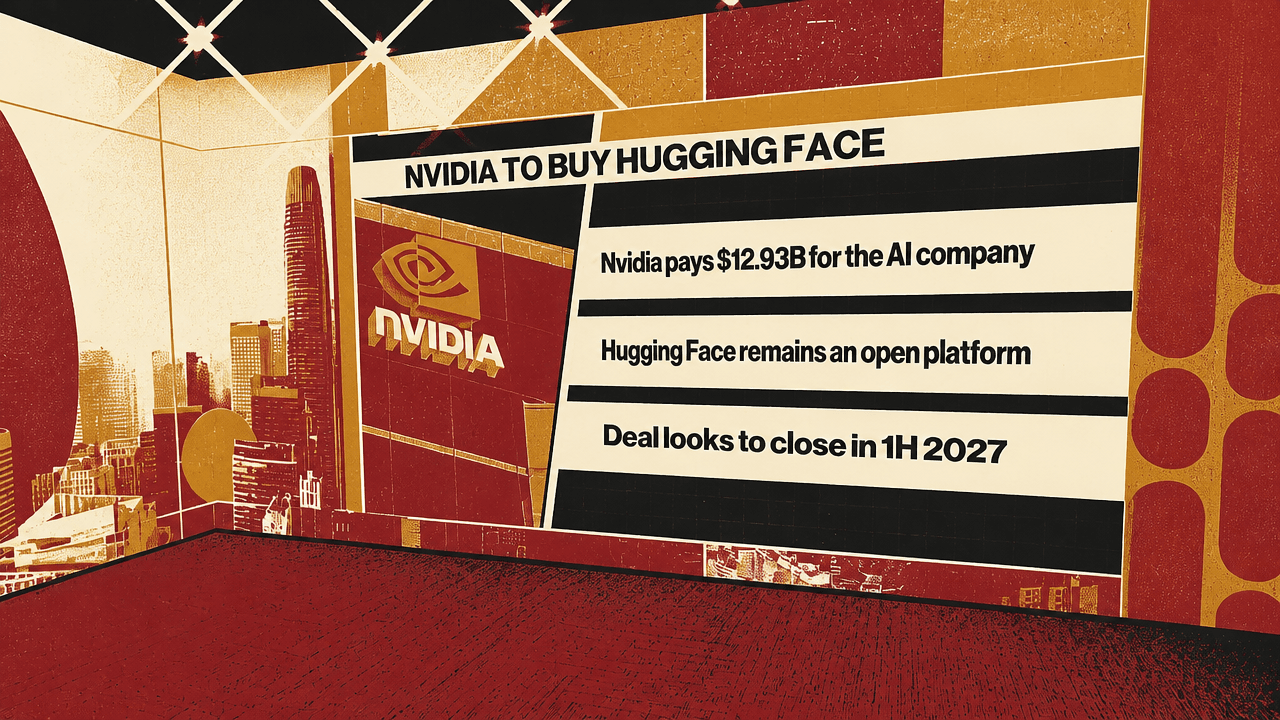
The central practical question is whether Hugging Face can remain a platform where users retain meaningful infrastructure choice after becoming part of Nvidia. Ed Ludlow said Hugging Face’s community would continue to have cloud-platform and inference options, without a requirement to use Nvidia compute. The on-screen transaction graphic likewise described Hugging Face as remaining an open platform, while giving a $12.93 billion transaction value and a targeted close in the first half of 2027.


| Term or disclosure | What was stated |
|---|---|
| Transaction value | $12.93 billion |
| Employee retention | $1 billion tied to stock, according to Ed Ludlow |
| Expected close | First half of 2027 |
| Platform commitment | Hugging Face remains an open platform |
Thomas Wolf said all three co-founders would remain, with at least six years of retention, and that the entire team would join. He described the goal—not yet a fully specified operating design—as keeping Hugging Face “an open, independent, compute agnostic” platform and infrastructure provider. For users, he said, the practical experience should change very little, apart from the backing that would allow the company to accelerate its work.
That distinction matters because “independent” and “compute agnostic” are the conditions that would preserve Hugging Face’s role as a neutral layer for developers and companies using different clouds and inference providers. Wolf did not spell out how those conditions would work under Nvidia ownership. Asked whether the absence of mandatory Nvidia compute was something Hugging Face had insisted on, he emphasized alignment between the companies and said the exact specifics would be defined soon.
Wolf said Nvidia CEO Jensen Huang shared Hugging Face’s belief in community and collaboration. Hugging Face sees open models as requiring collaboration that extends beyond ordinary competition, Wolf said. Huang’s displayed statement made a related case: open models strengthen safety and cybersecurity, accelerate innovation and diffusion, and let developers, startups, universities, industries, and countries build with, customize, and benefit from AI.
Robotics adds another reason to combine
Hugging Face’s robotics work is part of the opportunity Wolf sees in combining with Nvidia. Thomas Wolf said LeRobot, the company’s robotics release, generated demand that surprised Hugging Face. Its reception nearly eclipsed—or may even have exceeded—the attention around rumors of the transaction, he said.
For Wolf, that response suggested Hugging Face could sustain work beyond its model hub and developer infrastructure. Nvidia’s hardware scale and Huang’s interest in robotics create a natural fit, he said, while Hugging Face expects to continue developing its robotics efforts much as it had before.
The deal’s open-platform case will face scrutiny in practice
Wolf declined to predict how regulatory review would proceed or how Nvidia’s competitors would respond. The transaction had only been announced that day, he said. His confidence rested instead on the proposed path for Hugging Face to keep operating as an independent open platform.
That leaves the deal’s central claim as an operating question rather than a settled fact. Nvidia would provide the resources Hugging Face sought instead of another financing round; Hugging Face says users should retain cloud, inference, and compute choice. Wolf said the details governing that arrangement were still to come.
Internally, Wolf said employees were “ecstatic.” Huang joined a Hugging Face all-hands meeting, which Wolf described as a once-in-a-lifetime opportunity for many staff members. He said the team viewed the combination as a chance to build the next stage of the open-model ecosystem.