Unitree’s 460% Debut Prices China’s Humanoid-Robot Lead


Bloomberg’s Peter Elstrom says Unitree Robotics’ 460% Shanghai debut, following a 6.1 billion yuan IPO, gave public investors a roughly $50 billion valuation for China’s early lead in humanoid-robot manufacturing. He argues that Unitree’s shipments, domestic supply chain and state backing distinguish China in a still immature market, while stressing that tens of thousands of robots remain a small base for the industry’s much larger demand projections.
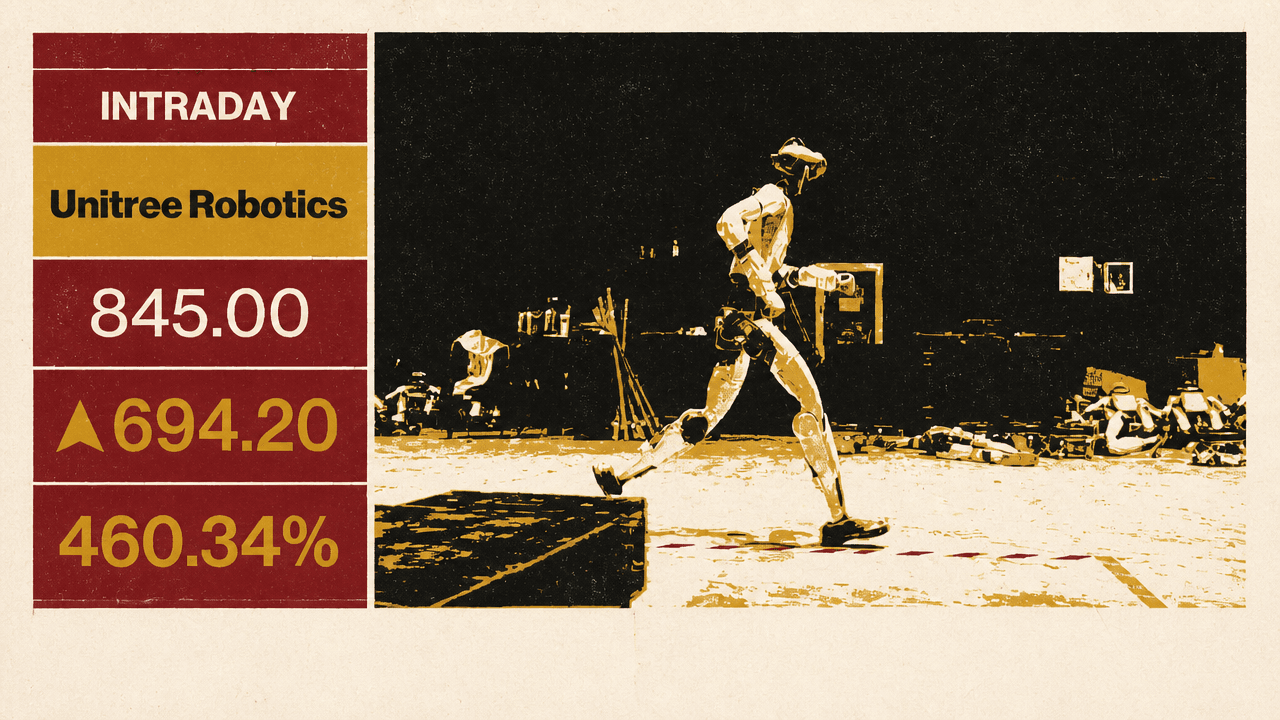
A 460% debut puts a public value on China’s humanoid push
Peter Elstrom described Unitree Robotics’ Shanghai debut as exceptional even in a market accustomed to large first-day IPO gains. An intraday graphic put the shares at 845 yuan, up 694.20 yuan, or 460.34%; the company raised $904 million, or 6.1 billion yuan, in the offering.


Elstrom said the jump put Unitree’s market capitalization at around $50 billion. Unitree is one of several Chinese humanoid-robot makers, but he characterized it as the first in the country to go public and raise money in public markets. The debut, he said, signals momentum for a group of Chinese robotics companies that could produce further IPO candidates.
The company was founded in 2016 by Wang Xingxing, now 36. Elstrom described Wang as a celebrity in Chinese technology circles and as part of a new generation of entrepreneurs following Alibaba’s Jack Ma and Tencent’s Pony Ma. Unitree had produced about 18,000 humanoid robots as of July 2026, and its robots had drawn attention after dancing at the 2026 Spring Festival Gala.
The valuation is a bet on an industry that is not yet mature. Elstrom repeatedly called humanoid robotics “very, very early days,” even as he pointed to a Chinese market that is ready for the products, state support for the companies, and a supply chain that can manufacture them at meaningful volumes. Those conditions, rather than the day’s share-price move alone, were his explanation for why Chinese robotics makers are gaining ground.
China’s lead is visible in shipments, but the category remains small
Ed Ludlow focused less on Unitree’s backflips than on its reported output. Producing roughly 18,000 robots by July suggested to Ludlow that Unitree was shipping machines into real-world use rather than limiting itself to staged demonstrations.


Unitree’s demonstrations remain central to its public profile: company footage showed humanoid robots running, jumping, and performing backflips in a warehouse. Elstrom also cited half-marathon runs and robot competitions, with a robot conference expected to demonstrate new capabilities. But the commercial point, in Ludlow’s framing, was production: a company can attract headlines with an acrobatic robot, yet sustained output is what makes the market more tangible.
Elstrom said Unitree and domestic competitors were already shipping tens of thousands of units. He named Agibot as another Chinese maker and cited a market report estimating that Chinese companies account for “something like 95%” of humanoid robots currently being produced worldwide.
There are tens of thousands of units being shipped by Unitree and some of their domestic competitors.
That production position is substantial relative to the present market, but Elstrom stressed the limited absolute scale. Tens of thousands of humanoids are still far below the volumes envisaged by the industry’s advocates. He invoked Elon Musk’s expectation that every person could eventually have at least two robots and noted that Tesla is also expected to compete in the market.
The contrast is the essential one behind Unitree’s debut: China has an early manufacturing advantage in a category whose eventual demand remains prospective. Unitree’s output, its domestic competitors’ shipments, and the country’s manufacturing infrastructure give investors evidence of present capability. The debut gives investors a public valuation for that future-market thesis.