Lime Pitches Public Investors on Strong Unit Economics After IPO

Lime’s public debut raised $174 million at $25 a share, and chief executive Wayne Ting presented the IPO as a chance to bring in new investors rather than a necessity driven by debt or capital pressure. In a Bloomberg Technology interview, Ting argued that Lime has turned micromobility into a durable public-market business through positive free cash flow, improving city relationships, deeper use in existing markets and trip-level economics strong enough to make acquisitions possible but not required.
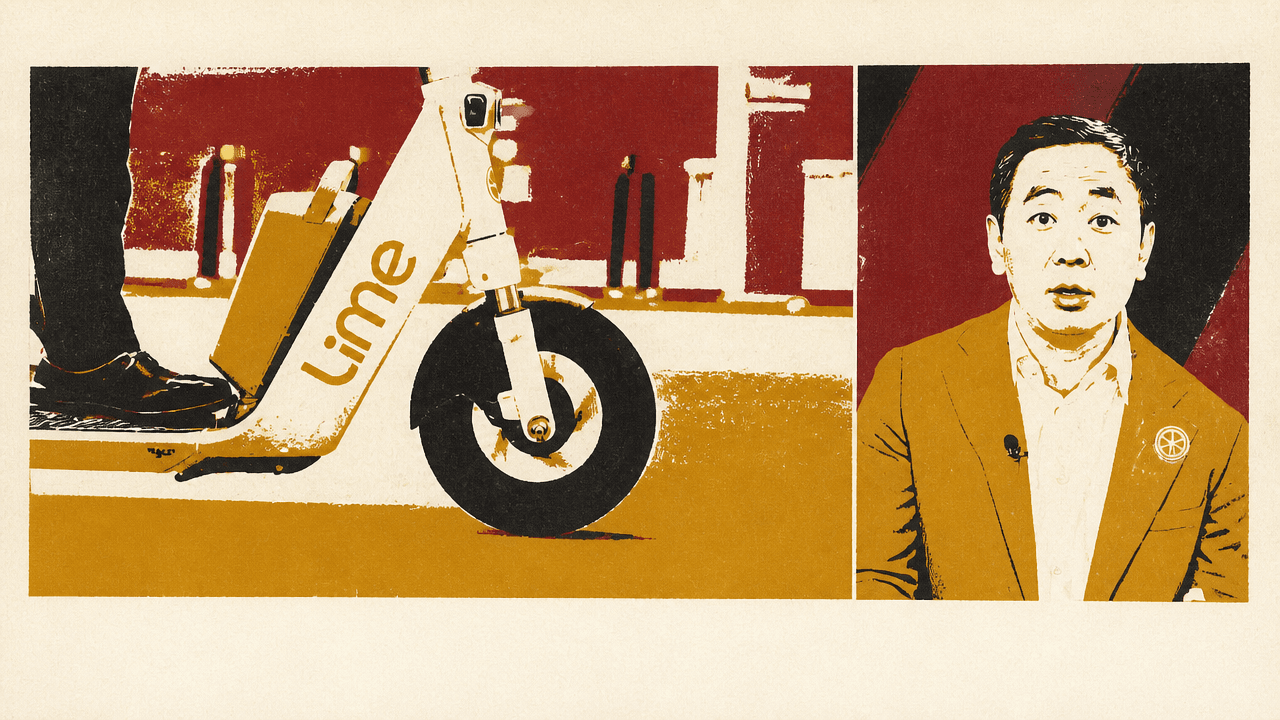
Lime is asking public investors to believe Ting’s operating-economics case
Uber-backed Lime raised $174 million in its public debut, pricing shares at $25, the midpoint of the expected range. Ed Ludlow said shares were indicated to open around $27 and that Bloomberg was describing the IPO as roughly six times oversubscribed.

For Wayne Ting, Lime’s pitch is that the public listing validates a business model that many micromobility companies tried and failed to make work. He described the company as operating in 230 cities across 29 countries and five continents, with “great unit economics,” positive free cash flow, and expanding EBITDA margins.

The on-screen company metrics reinforced the same case: Lime reported more than 1 billion lifetime rides, more than 4 million monthly active users in 2025, reach across 230 cities in 29 countries, and $345 million in 2025 gross profit.
| Metric | Figure shown |
|---|---|
| Lifetime rides | 1B+ |
| Monthly active users | 4M+ in 2025 |
| Reach | 230 cities across 29 countries |
| Gross profit | $345 million in 2025 |
Another graphic identified Lime’s largest single investors as Uber, Fidelity Investments, Andreessen Horowitz, and Sapphire Ventures. That investor list was part of the framing for Ludlow’s description of Lime as Uber-backed, while Ting emphasized the IPO as an opening for new public-market investors.
Ting’s argument was not that the IPO was forced by a capital need. When Ludlow put it to him that Lime went public because it needed capital and had cleaned up the balance sheet, Ting pushed back directly. He said there were “lots of different ways” Lime could have addressed a debt maturity. The reason for going public, he said, was to bring new investors into the company, fund expansion, and offer attractive returns to those investors.
The reason we're going public is because we think this is a great opportunity for new investors to come into Lime.
Ting framed the debut as a growth-capital event for a company that, in his telling, has strong operating economics in a sector that Ludlow associated with vandalized hardware, strained city relationships, and pandemic disruption.
The growth plan starts with denser use in cities Lime already serves
Lime is already in hundreds of cities, but Ting said the biggest growth opportunity is not simply adding more dots to the map. It is getting deeper in existing markets, where the service can become reliable enough for everyday use.
His reasoning was tied to availability. A rider who can count on finding a scooter or bike nearby is more likely to use Lime as part of a daily transportation pattern. That makes mature markets, according to Ting, a source of faster growth rather than a sign of saturation. He cited London as an example, saying it grew faster last year than Lime overall.
The expansion case also includes smaller and less obvious cities. Ting pointed to Lincoln, Nebraska, where he grew up, as a market he would not have expected to work for Lime. Yet he said Lime has built a “great business” there, helped by football games, major events, congestion, and parking shortages.
Ting described Lime as a complement to transportation systems, not a replacement for them. The company’s growth thesis, as he presented it, rests on two layers: more deployment in existing cities where reliability can drive frequency, and entry into many “Lincoln, Nebraskas” that still lack Lime but face transportation constraints the company believes it can address.
Ting says city relationships have improved since the early scooter era
Ed Ludlow recalled arriving in San Francisco in 2018, when scooters were “the story” and the politics were ugly: scooters scattered across streets, residents throwing them into the bay, and a fractious permitting relationship with cities. He also pointed to COVID as a major shock to the business.
Wayne Ting answered that the operating environment has changed materially since 2018. He said cities now have a clearer understanding of micromobility’s value proposition because urban transportation remains under pressure from congestion, affordability, pollution, and climate change.
Lime’s work with cities, in Ting’s description, is not just about negotiating permits; it is about aligning itself with public transportation goals. He said Lime has improved relationships by showing up in support of those goals and emphasizing compliance and safety.
The change he described is reflected in the duration and breadth of Lime’s city relationships. Lime now has relationships in hundreds of cities, and Ting said most are multi-year arrangements. That is a different posture from the early scooter era Ludlow described, when visible consumer adoption of scooters often ran ahead of municipal acceptance.
Lime’s service still depends on city permission and permitting relationships. Ting’s claim is that the company has learned to operate inside that constraint and that cities increasingly see micromobility as part of the answer to transportation problems.
Acquisitions are possible, but Ting says the hurdle is high
Ed Ludlow asked whether Lime would pursue M&A, especially in a city like New York, where deeper penetration might involve other bike businesses. Wayne Ting said the IPO changes Lime’s options for consolidation because the company now has public equity and more capital on the balance sheet.
But Ting set a demanding benchmark before entertaining deals: Lime earns more than 50% cash margins on the average trip and gets payback on bikes and scooters in less than one year.
I would say our bar is very high because we get 50% plus cash margins on the average trip, less than one year payback on the bikes and scooters.
Those figures define the hurdle for any acquisition. Ting said competitors are “nowhere near” Lime’s margins and returns, and that many have been “donating share” to Lime. His implication was that Lime can win market share by out-executing rivals rather than buying them.
That does not rule out deals. Ting said he would “take a look at all the companies out there” and sees an opportunity in consolidating the long tail. But any acquisition, he said, would need to be accretive to investors.