Tesla and SpaceX Fall as Investors Weigh Democratic Scrutiny of Musk


Tesla and SpaceX shares have fallen as investors weigh whether Democratic control of Congress could bring greater scrutiny to Elon Musk’s businesses. Bloomberg’s Craig Trudell argues that the political risk extends from data-center expansion and a possible Tesla-SpaceX tie-up to Musk’s exposure in Washington, while SpaceX’s role in government and defense work gives the company leverage but does not remove the prospect of scrutiny.
Political risk reaches beyond a single project
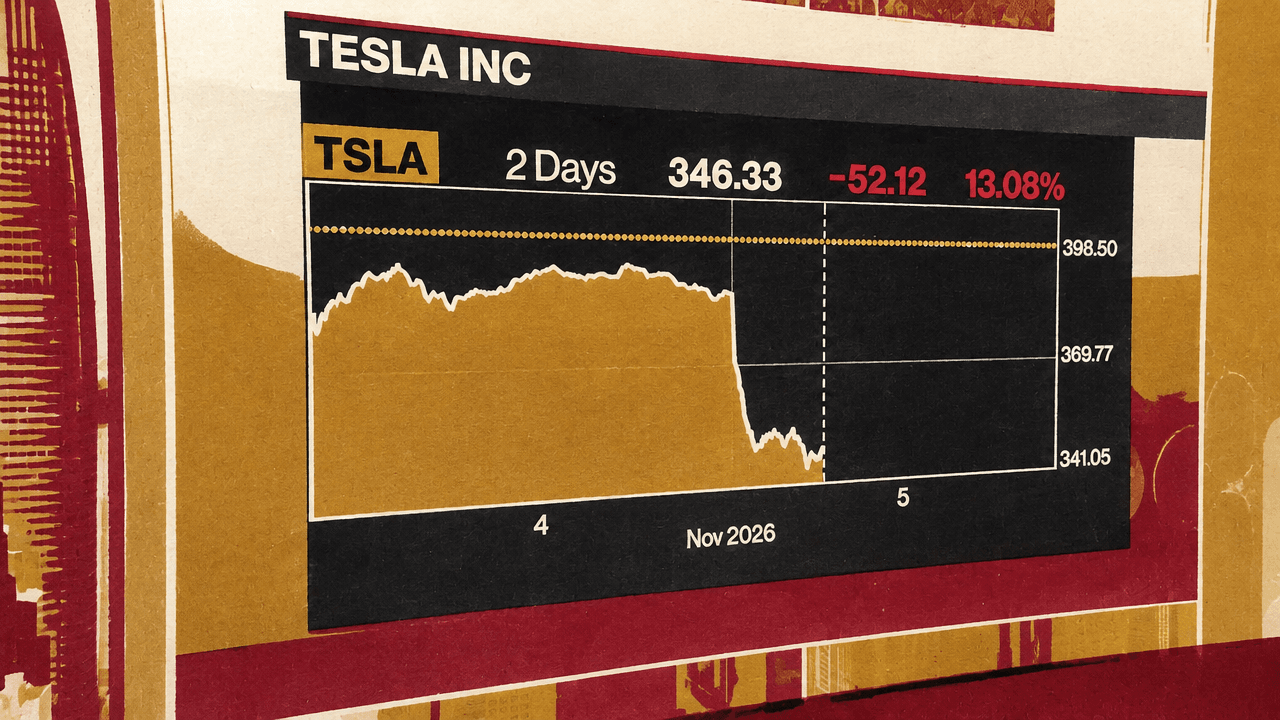
Tesla fell about 13% over two days as investors considered whether Democrats taking control of Congress could constrain Elon Musk’s expanding businesses. Bloomberg’s Craig Trudell identified data centers as a central concern, particularly for SpaceX, though he said Tesla was involved too. A Bloomberg market graphic put Tesla’s two-day decline at 13.03%, from 398.50 to 346.54.
Trudell also cited Terafab, a project Tesla and SpaceX are working on together to make semiconductors. He called it “AI adjacent.” In his account, the data-center plans and Terafab bring political exposure not just to one company but to projects that cross the two businesses.
The broader concern, Trudell said, is Musk’s political profile. He described Musk as a “target-rich billionaire” who has given Democrats reasons to make him a political villain. Investors are weighing whether a shift in power will encourage Democrats taking office in Washington—and in Texas, where both companies are headquartered—to come after Musk and his businesses. The question is about how that change in power might affect the companies, not a single project in isolation.
The on-screen market figures underscored the scale of the immediate move: a separate intraday graphic showed Tesla down 10.04%, while another displayed SpaceX down 8.71% and Tesla down 9.88%. Those snapshots sit alongside the two-day Tesla figure; they are different views of the decline, not additional two-day totals.
A possible tie-up has reasons to move quickly—and reasons to be difficult
Asked whether the political climate changes the story of a potential Tesla–SpaceX combination, Trudell said it might reinforce the push to get a deal together early the following year. He said there had been discussion of that timing already. If a transaction takes time, he suggested, waiting could be unwise if Republicans later lose not only Congress but also the White House.
Moving quickly would not remove the complications. Trudell described the two companies as large businesses and said a combination could be difficult even though one company might work with the other. He pointed to Tesla’s major presence in China and SpaceX’s position as a major U.S. government and defense contractor as interests that could conflict.
That makes the timing argument conditional rather than a claim that a deal would be straightforward. Political uncertainty may strengthen the incentive to act early, in Trudell’s view, while the companies’ different business and government relationships could make the transaction complicated to execute.
SpaceX’s role gives Musk leverage, but does not erase scrutiny
Tim Stenovec raised SpaceX’s defense work and the reliance of the U.S. and other governments on the company, including for Starshield, and asked whether that gave Musk substantial leverage. Trudell agreed that Musk “absolutely” had cards to play, particularly through space launches and the company’s satellite services.
Trudell said governments have tried to develop competitors so they would not have all their eggs in one basket. But, he said, after a couple of years of such efforts, it was difficult to imagine a meaningful competitor emerging soon. His explanation was not only that SpaceX’s satellites and network are impressive: SpaceX can also put satellites into space at a rate others do not match.
The distinction matters to his account of the company’s position. A government may want alternatives, but Trudell argued that the ability to launch at SpaceX’s pace is itself a constraint on how quickly those alternatives can become meaningful. That capability gives SpaceX strategic importance even as investors consider whether a changed political landscape could bring greater scrutiny to Musk’s businesses.