Tech Layoff Plans Rise 33% as Broader Job Cuts Recede

Bloomberg’s Julia Fanzeres argues that the U.S. layoff picture is increasingly sector-specific: tech companies are announcing rising cuts even as broader private-sector layoff plans decline. Citing Challenger data, Caroline Hyde said planned U.S. tech job cuts have reached 85,411 this year, up 33% from the same period in 2023, with AI cited as a factor for a second month. Fanzeres said the pattern does not yet show a wider labor-market break, but raises the question of whether tech cuts are a contained adjustment or an early signal.
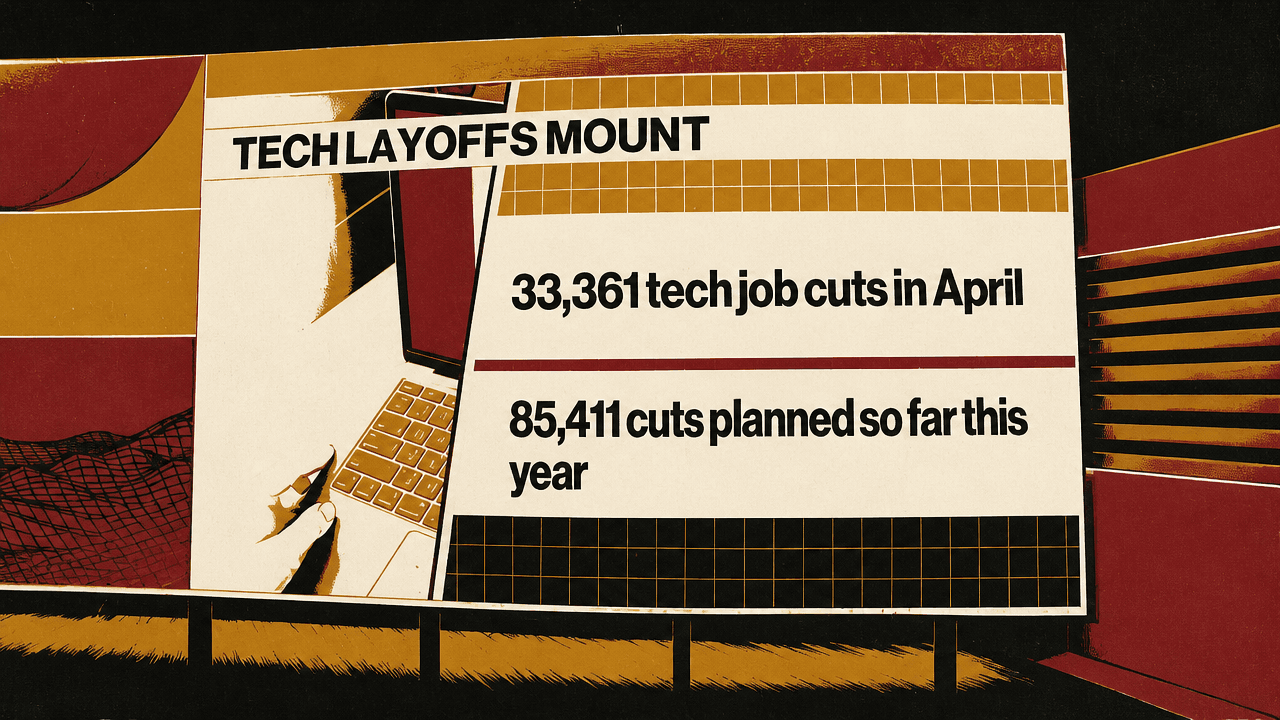
Tech is cutting while the broader layoff picture is easing
The pressure point in the U.S. labor market, as presented by Bloomberg Technology, is not broad-based private-sector layoffs. It is tech. Caroline Hyde cited Challenger data showing 85,411 planned job cuts in the U.S. tech industry so far this year, up 33% from the same period in 2023. On that pace, she said, 2024 is tracking toward a three-year high for tech cuts even as overall private-sector layoff announcements have receded.
The segment framed that number against a run of company-specific announcements. Hyde pointed to recent or familiar examples from Block, Coinbase, and PayPal, while Bloomberg’s Julia Fanzeres added Microsoft, Meta, and Snap as part of the headline pattern that Challenger captures. The importance of the Challenger data, in Fanzeres’s account, is that it turns the anecdotal stream of announcements into an industry comparison: tech is leading layoff announcements.
A Bloomberg graphic, attributed to Challenger, Gray & Christmas, gave the April and year-to-date figures together: 33,361 tech job cuts in April and 85,411 cuts planned so far this year. The same source material also described technology job cuts as a rising share of total job cuts, with a chart showing the share increasing into 2024.
| Measure | Figure |
|---|---|
| Tech job cuts in April | 33,361 |
| Tech cuts planned so far this year | 85,411 |
| Year-to-date change versus the same period in 2023 | Up 33% |
The distinction matters because the reported trend is not “layoffs are everywhere.” It is narrower and more uneven: tech layoff plans are mounting while other job-cut announcements are falling.
AI is being named as the reason, but not simply as worker replacement
Fanzeres said Challenger identified artificial intelligence as the reason for tech layoff announcements for the second month in a row. But she drew a distinction between AI directly replacing workers and AI changing corporate spending priorities.
Her explanation was that the immediate mechanism is not necessarily “AI is replacing workers.” It is that companies need to fund AI investment. The required spend is “taking over,” she said, and job cuts are occurring because companies “need that extra spend.”
Hyde put the same point more bluntly: the anxiety is often that AI will replace a worker, but in the present pattern it may be that a salary is being removed so the money can be redeployed into AI investment. That framing preserves the labor-market consequence without overstating the evidence. In the account Fanzeres gave, the layoff announcement may be AI-related even when the job is not being automated away one-for-one.
That is also why the “AI” label remains hard to interpret. If a company cuts staff while increasing AI spending, the announcement may be genuinely tied to AI strategy. It may also be a convenient way to describe ordinary cost reduction in terms investors understand. Hyde called that possibility “AI washing,” and Fanzeres did not dismiss it. Her point was that, regardless of labeling, the job cuts themselves remain real.
The macro data has not yet confirmed a wider labor-market break
The segment held the tech-layoff numbers against broader labor-market indicators. Hyde noted that, according to Challenger data since 2023, jobs cut “at the expense of AI” were still only about 3.5% of all announced layoffs. She used that figure to temper the more alarmed reading of the headlines: AI-related cuts may be highly visible, but they remain a small share of total layoff announcements in that data.
Fanzeres then pointed to jobless-claims data as a reason the tech cuts have not yet become a broad macro signal. Initial jobless claims had rebounded somewhat, she said, but were still hovering near decade lows. Continuing claims were near two-year lows. Those indicators suggested to her that the layoff announcements are either not translating significantly into the broader data or are not large enough to move the overall picture.
That caveat is important. Layoff announcements are not the same thing as realized unemployment, and sector-specific cuts do not automatically show up as a macro downturn. In Fanzeres’s reading, the data still supports a picture in which the economy has not broken into a high-layoff environment, even though tech companies are announcing substantial cuts.
The unresolved question is whether tech layoffs are a leading indicator
Hyde pressed on the central uncertainty: whether the tech numbers are a leading indicator of a wider wave or a contained sectoral adjustment. Fanzeres framed the economy as potentially still in a “low-hire, low-fire environment,” a phrase that captures the tension. Companies may not be hiring aggressively, but the broader data has not shown a large firing cycle either.
The harder question is what to do with job cuts that are justified by AI. Fanzeres said that even if some of the AI explanation is “AI washing,” the removal of jobs from the economy is still significant. The analytical task is therefore not only to parse corporate motives. It is to watch whether announced cuts begin to appear in the broader labor-market data.
The source leaves the issue unresolved. Tech is clearly the standout sector for layoff announcements in the Challenger figures cited. AI is clearly part of the stated rationale, at least for a second consecutive month. But Fanzeres did not say the data yet shows AI-driven displacement at economy-wide scale, and Hyde’s 3.5% figure argues against treating that as established.