SpaceX Shares Fall as $18.4 Billion AI Spending Overshadows Revenue Beat


SpaceX’s first quarterly report as a public company beat revenue expectations and posted a smaller-than-expected AI operating loss, but its shares fell as investors focused on $18.37 billion in capital spending and management’s plan to maintain a similar pace through year-end. Bloomberg’s Danny Lee said Starlink remains the company’s profitable cash generator and that compute sales are already producing revenue, while Haidi Stroud-Watts characterized SpaceX’s longer-term plan for data centers in space as largely unproven.
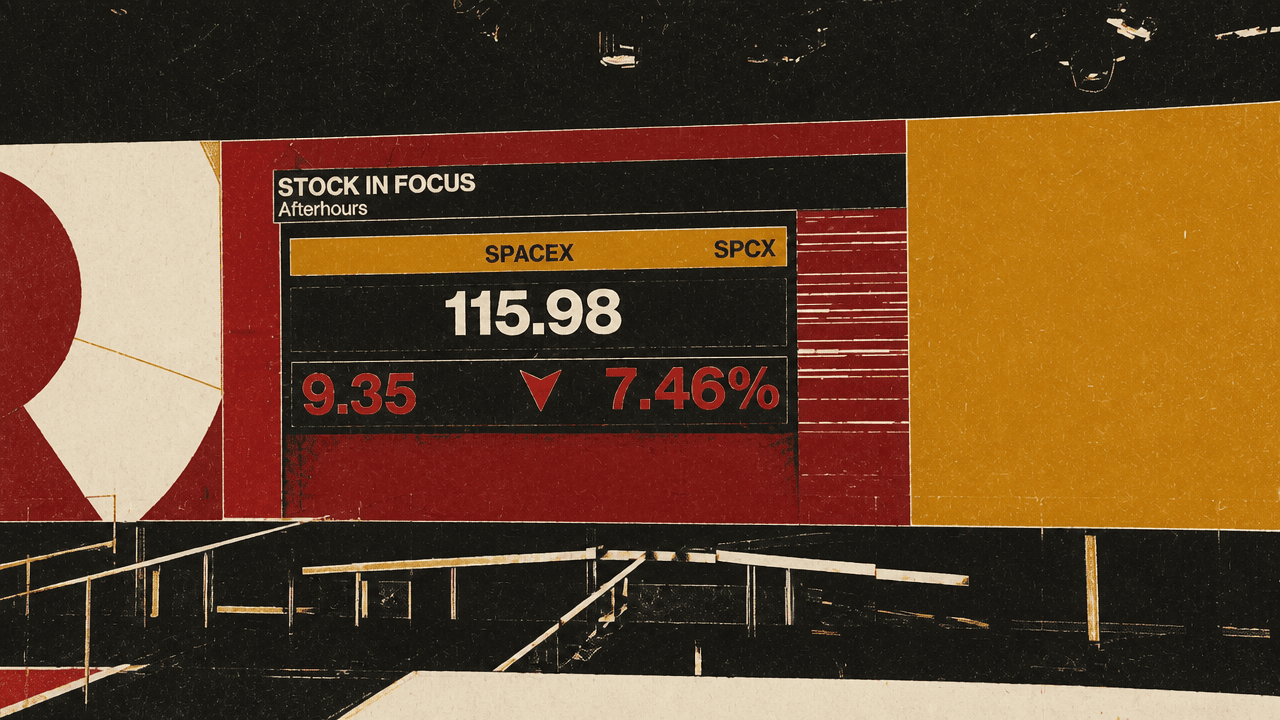
A revenue beat did not offset the scale of SpaceX’s investment program
SpaceX reported $7.8 billion in second-quarter revenue in its first quarterly results since the June IPO, above the $6.81 billion estimate. Its shares nevertheless fell 7.46% in after-hours trading to $115.98 as investors focused on the scale and persistence of spending tied to its AI ambitions. SpaceX expects capital expenditure in the third and fourth quarters to remain similar to the second-quarter level.
Haidi Stroud-Watts described the reaction as investor alarm over how much spending was going into the AI side of the business. The concern was not a revenue miss: revenue exceeded estimates, while the AI segment’s $1.26 billion operating loss was below the $2.39 billion estimate. The issue was the commitment required to fund an AI strategy that includes ambitions such as data centers in space, which Stroud-Watts called largely unproven.


Danny Lee said SpaceX had positioned itself as an AI company before the IPO and continues to do so. He characterized the heavy spending as necessary to fulfill the company’s ambitions and serve some of its clients. But it added selling pressure to a stock he said had already fallen more than 50% from its peak only a couple of months earlier.


Second-quarter capital expenditure of $18.37 billion was marginally below the $18.58 billion estimate. Yet the market’s concern, as Lee described it, was the absolute size of that investment program and management’s indication that spending would remain near that level for another two quarters.
| Second-quarter metric | Actual | Estimate |
|---|---|---|
| Revenue | $7.8B | $6.81B |
| Capital expenditure | $18.37B | $18.58B |
| AI segment operating loss | $1.26B | $2.39B |
| Rocket launches | 38 | 43 |
| Starlink subscribers | 12M | 12.19M |
There’s just that focus on the capex number of 18.4 billion, 18.4 billion, that really just weighs on the company.
Starlink supplies profits while its subscriber count comes in light
Danny Lee described Starlink’s connectivity operation as SpaceX’s “cash cow”: the business unit that is profitable and making money. In his account, it remains the company’s established source of cash generation even as SpaceX funds more capital-intensive initiatives.
The quarter still offered a mixed read on that business. Starlink had 12 million subscribers, below the 12.19 million estimate, and Lee said subscribers “fell light.” At the same time, he said SpaceX’s business units were performing better overall and that revenue came in stronger than expected.
SpaceX is also looking to complement its satellite business with ground-based infrastructure, Lee said. Elon Musk expects a rapid increase in Starlink revenue from V3 satellites, though no timing or revenue figure was provided.
Compute sales offer current revenue beside unproven space-data-center ambitions
The most speculative part of the strategy is SpaceX’s ambition to put data centers in space. Haidi Stroud-Watts described that ambition as largely unproven, connecting the uncertainty directly to the scrutiny of the company’s elevated capital-spending outlook.
Danny Lee distinguished that longer-term ambition from an activity already underway: SpaceX is selling compute capacity to other major technology companies. He said those sales provide “genuinely good revenue” that will flow through the business and help its finances and economics going forward.
That leaves investors assessing two different propositions within the same investment program. Compute-capacity sales are already generating revenue in Lee’s description. Data centers in space remain an ambition whose viability Stroud-Watts questioned. Both sit alongside SpaceX’s expectation that capital expenditure will stay near its second-quarter level in the third and fourth quarters.