Crew-12 Returns After 237 Days as Dragon’s Future Beyond the ISS Remains Unclear


SpaceX’s Crew Dragon returned four astronauts from the International Space Station with a Pacific splashdown off California, completing a 237-day mission. Bloomberg space reporter Loren Grush said Dragon has at least four operational NASA crew flights remaining before the station’s planned retirement, but its future beyond that is uncertain as SpaceX shifts resources toward Starship, which still requires substantial work before it can carry astronauts to the moon.
Dragon’s ISS role continues, but its future is less certain
Crew-12’s return showed Dragon doing the job it has repeatedly performed for NASA: bringing an International Space Station crew back to Earth. The four astronauts splashed down in the Pacific off California after 237 days in space. But Bloomberg space reporter Loren Grush said the program’s longer-term future is in doubt as SpaceX shifts resources toward Starship.


Grush said SpaceX officials have hinted that Dragon could come to an end around the time the ISS is retired, possibly by 2030. At least four operational Crew Dragon missions for NASA remain through the end of the station program, she said. Other Dragon missions may also take place, but beyond the remaining ISS work there is no settled picture of how often the vehicle will fly—or whether it will continue operating.
That uncertainty sits alongside an active crew rotation. Crew-13 had already launched and was in orbit when Crew-12 returned. Grush said the incoming crew completed the typical week-long handover before Crew-12 began its trip home. The two crews’ overlap is part of the transition: Crew-13 takes up the station’s work as Crew-12 leaves, while Dragon continues to serve the ISS program.
SpaceX’s intended focus, Grush said, is Starship, the much larger rocket it is building to send people to the moon and Mars. She said that shift has implications for both Dragon and Falcon, without resolving what either program’s future will be. Dragon has at least four more operational NASA crew missions tied to the station’s remaining life; what follows those flights is a question mark.
A familiar descent unfolds in stages
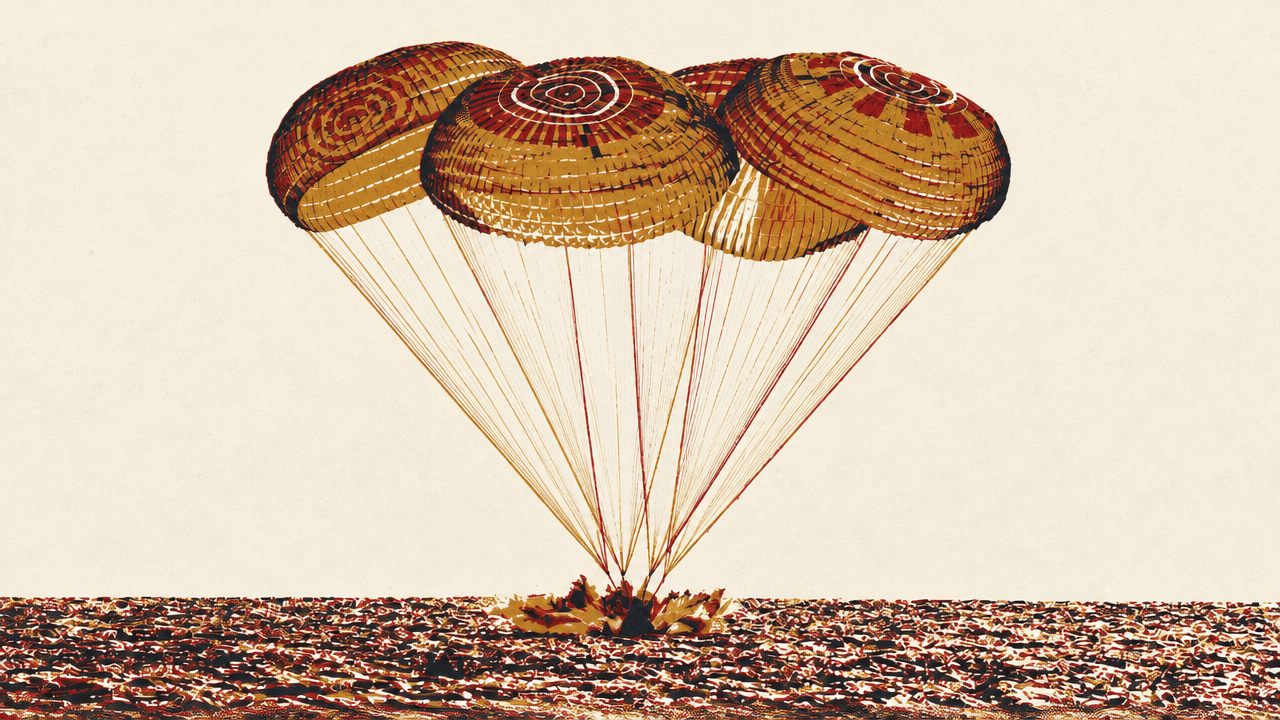
The live feed followed the capsule through a sequence that Ludlow described in numbers: re-entry at about 17,500 miles per hour, or Mach 23, with a peak force of four Gs on the crew. The two drogue parachutes appeared first. Four main parachutes then opened, slowing the capsule to about 119 miles per hour, Ludlow said. He put its speed at roughly 15 miles per hour at splashdown.
The return had begun 27 hours earlier at the ISS. Crew-12 had spent 237 days in space after launching on February 13, Ludlow said. The broadcast showed Dragon descending beneath its red-and-white main chutes before it hit the Pacific, not far off the California coast. The parachutes fell beside the capsule as it touched down.
Grush described Crew-12 as the 12th operational mission for the ISS program and said Dragon’s repeatability is what SpaceX has achieved with the vehicle. But a familiar sequence is not the same as an ordinary one. The capsule’s return still meant a high-speed passage through the atmosphere, a staged parachute deployment and a landing at sea.
As much as we say it's routine, it's certainly not. It's still, you know, just awe-inspiring and shows what can be achieved when we, you know, put all of our resources together into something like this.
Starship’s lunar role still requires substantial work
Grush described NASA’s Artemis program as the next major human-spaceflight effort, with the goal of sending people back to the moon and ultimately landing astronauts on its surface. Artemis II sent four astronauts around the moon. Crew-12 had spoken with the Artemis II crew after that trip, Grush said.
SpaceX is building Starship to serve as a human lander for future Artemis astronauts. Grush said it is intended to carry them to the lunar surface, but that a long list of work remains before it is ready to carry people. Starship’s planned role is distinct from Dragon’s current service: Dragon is returning ISS crews, while Starship is being developed for lunar landings.
That readiness caveat matters to the transition Grush described. SpaceX’s stated direction is to put its resources into Starship, but the vehicle still has substantial work ahead before it can carry astronauts. Dragon, meanwhile, has remaining NASA missions through the end of the ISS program and no clear future beyond them. The source leaves the timing and shape of that shift unresolved.