SoFi Says Its Diversified Business Can Sustain Growth as Rates Rise

SoFi chief executive Anthony Noto argues that the company can keep growing through economic uncertainty because its technology lets it adjust loan prices as rates change, while a broader mix of businesses reduces its reliance on lending. The case rests on recent growth: revenue rose 44% year over year, and SoFi raised its full-year net revenue guidance to about $5.04 billion.
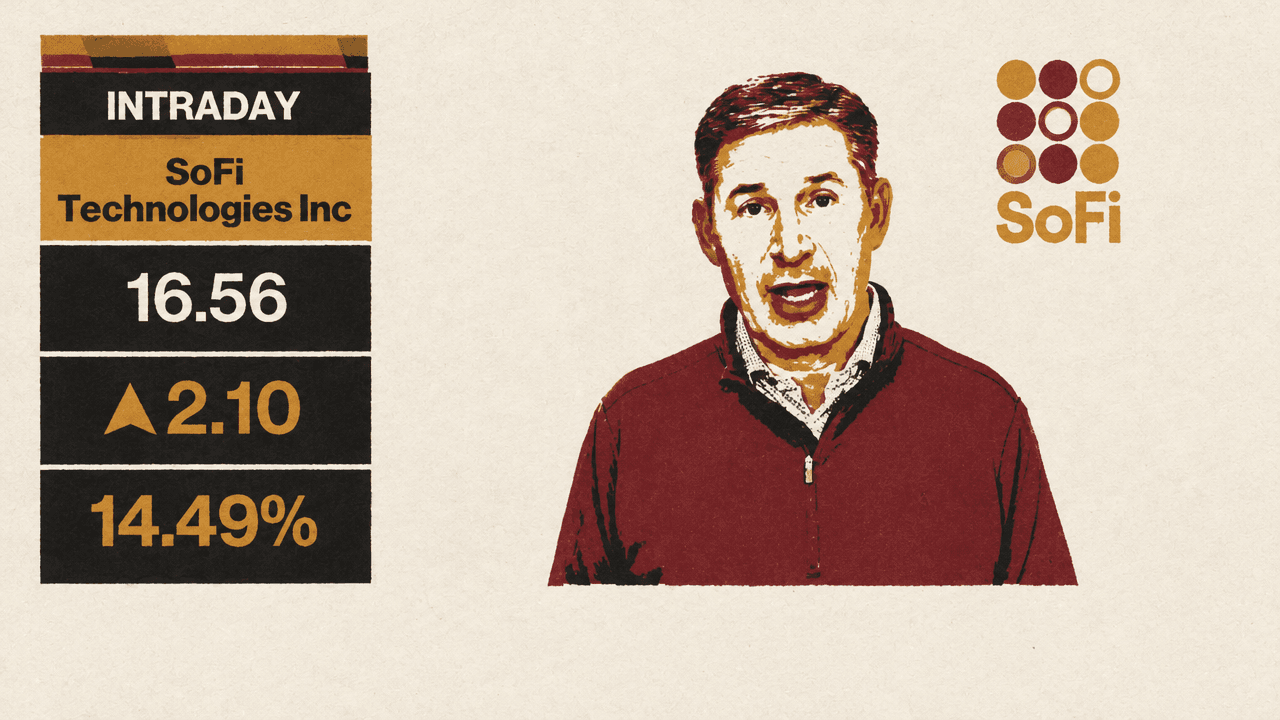
SoFi says rate sensitivity no longer dictates its growth
SoFi’s central claim is that it can keep growing even when interest rates rise. CEO ? anthony-noto said the company entered the quarter focused on whether it could manage that risk: whether higher rates would slow growth, and whether SoFi could pass higher borrowing costs on to customers. His answer was yes. He said he now feels as confident about the business in a rising-rate environment as in a falling-rate one.
Noto credited SoFi’s technology and data with helping it pass higher benchmark rates through to loan prices in real time while continuing to grow elsewhere. The argument is not that lending becomes immune to rate changes, but that the company can adjust loan pricing while drawing growth from other parts of its business. He said SoFi had eight businesses generating at least $100 million in annual revenue, and that 87% of its products were non-lending products. That mix, he argued, gives the company room to navigate cyclical or macroeconomic pressure in lending while continuing to grow overall.
The quarter’s growth figures are central to Noto’s explanation. Revenue rose 44% year over year, alongside 35% member growth. Products grew 44% as well. Noto linked those measures to adding members and increasing the number of products each member uses. He said the matching growth rates in products and revenue made the business easier to understand: in his account, the company’s growth came from both member gains and product growth.
Profit growth is meant to fund the next expansion
Asked by Ed Ludlow how much operating leverage remains after revenue grew 44% and adjusted EBITDA grew 70%, Noto said EBITDA margins could rise over time to 40% or more. Net income margin was 17% in the quarter; he said he expected it to range from 20% to 30%, likely toward the higher end.

The reinvestment plan is not to maximize near-term profit at the expense of expansion. Noto said SoFi would target a 30% incremental net income margin and reinvest the remaining 70 cents of each incremental dollar in additional growth drivers. That target connects the margin discussion to the company’s longer-term product ambitions: profits would rise, but a substantial share of incremental earnings would continue to support growth.
SoFi’s stated ambition is to reach 100 million products by 2030, from 27 million today. Noto called that goal aspirational but achievable. He said a fourfold increase in products could support a fourfold increase in earnings from the 61 cents he cited for 2026. He presented that as a possible result of the product target, not a guaranteed outcome. He also said the company would focus on members, products per member, and revenue per product.
Noto outlined a 2030 portfolio target: five businesses generating more than $1 billion each in revenue, five more above $500 million, and another five above $100 million. Those targets describe the scale SoFi hopes to reach across a larger set of businesses.
Noto expects SoFi to benefit if agents shop for customers
Ludlow asked whether AI agents might eventually move money or make purchases for SoFi customers. Noto said agents could compare checking and savings rates, loan rates, and services, and that SoFi would be well placed when they did.
His reasoning rests on product breadth and unit economics. Noto said the combination gives SoFi a higher customer lifetime value, which allows it to offer better rates on loans, checking, savings, and other services. He expects AI to make available options more transparent and to increase awareness of SoFi, which he described as a constraint on the company’s growth and a reason it continues to spend on marketing. In his view, a more effective comparison process could help consumers see the value of SoFi’s offerings.
On payments, Noto distinguished between existing automated tasks and more capable agents. Customers can already use SoFi for bill pay and recurring investments, he said; those tasks involve “linear intelligence,” not superintelligence. If machines can perform them now, he argued, agents could do more. Whether customers are willing to delegate those decisions remains the key condition.
Noto’s final claim was that SoFi has an advantage in earning that trust: he pointed to its brand, its status as a national bank, and FDIC insurance. He expects the company to compete on both trust and product value as automated financial decisions become more common.