Saronic Bets $3 Billion on a New Shipyard to Scale Autonomous Shipbuilding


Saronic CEO and co-founder Dino Mavrookas argues that the United States needs to expand shipbuilding capacity quickly as China invests in the industry. The company is committing more than $3 billion to Port Alpha, a new Brownsville, Texas, shipyard it expects to open by the end of 2027, with its first ships due a year later. Mavrookas says building capacity ahead of demand is essential to scaling production of autonomous vessels.
Port Alpha is a multibillion-dollar bet on speed
Saronic is committing billions of dollars to a new Brownsville, Texas, shipyard that it expects to bring online by the end of 2027, with its first ships coming off the line by the end of 2028. The schedule gives substance to the company’s claim that speed is essential: CEO and co-founder Dino Mavrookas says U.S. shipbuilding has declined dramatically while China has invested heavily, and that the United States needs new capacity now.


In an interview with Ed Ludlow, Mavrookas called the groundbreaking a chance to revitalize a critical U.S. industry. He said Port Alpha would be the first new shipyard built in the country since World War II and would create thousands of jobs. Saronic describes it as the largest and most advanced shipyard in America.


The company’s own timeline is compressed. Mavrookas said Saronic began four years ago; in that time, it has raised $2.5 billion and reached the point of breaking ground on Port Alpha. He said Saronic has already committed more than $3 billion to the project. The company plans to raise more capital as needed and build capacity ahead of demand, for defense customers first and ultimately commercial markets as well.
Speed is everything because our adversaries aren't waiting.
Mavrookas said Saronic already has orders to deliver LCU vessels to the Navy and Marine Corps, though he did not specify a delivery schedule for those vessels in the interview. The broader Port Alpha schedule is distinct: operational by the end of 2027, first ships off the line by the end of 2028. His case for investing before that output arrives is that shipbuilding capacity needs to be ready ahead of demand and need.
Corsair’s claimed capacity is far larger than its near-term deliveries
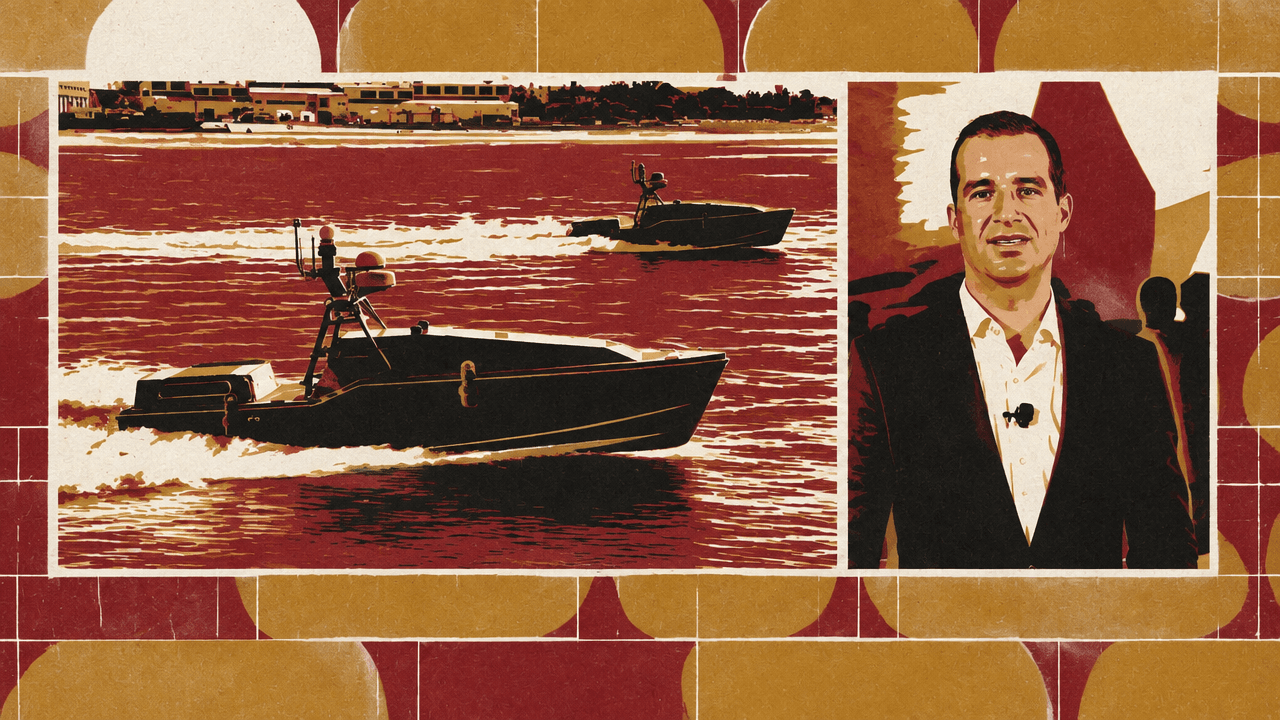
Asked how the United States was using Saronic’s platforms in the context of the war involving Iran, Mavrookas declined to discuss operational specifics. He identified the deployed platform as Corsair, a 24-foot, fully autonomous speedboat. Saronic has delivered hundreds to the Navy, he said, and can build thousands of the vessels every year.
That stated annual capacity is a claim about what the company can produce, not a report of current output. Mavrookas did not provide a production rate or explain how quickly deliveries might approach that level. He did offer one example of use: he said a Corsair helped rescue two downed Apache helicopter pilots in the Strait of Hormuz. He described the episode as evidence of military trust in autonomous systems in high-stakes settings, and said their use can keep additional people out of harm’s way.
The larger vessel in Saronic’s production plans is Marauder, a 180-foot autonomous ship. Mavrookas said the Navy had awarded Saronic a production contract for it. The company designed, built, launched and tested the ship, he said, and invested $300 million in its Franklin, Louisiana, shipyard to produce it.
Franklin and Brownsville serve different roles in the account Mavrookas gave: Saronic invested in Franklin to produce Marauder, while Port Alpha is the new shipyard intended to add capacity at scale. He said Saronic is preparing to produce Marauder at Franklin; Port Alpha’s planned opening and first-ship dates remain the end of 2027 and the end of 2028, respectively.
Marauder’s cost case turns on the mission, not just the ship price
Mavrookas said the Navy announced an average price of $40 million per Marauder. He compared that with a destroyer, which he said costs about $3 billion and takes six to eight years to build. But his argument was not simply that one ship costs less than another. It was that the cost and time to field a vessel should be considered alongside what it can carry.
For a mission involving vertical launch system tubes or other large missiles, Mavrookas said a destroyer can carry about 96 missiles, while Marauder can carry about 16. Based on those figures, he argued that Marauder offers a tenfold decrease in cost per missile tube and a hundredfold increase in speed to field. The comparison is his framing of the economics; it depends on the stated vessel prices, construction times and missile capacity, and on the mission being one where that payload is relevant.
That comparison also clarifies how Saronic links the two shipyard efforts to its urgency argument. Franklin is the production base Mavrookas cited for Marauder; Port Alpha is the larger investment intended to add capacity for future defense and commercial demand. The company’s stated ambition is to move ahead of that demand, while its Brownsville schedule sets a more specific test: whether the facility can become operational by the end of 2027 and begin sending ships out a year later.