Samsung’s Record Profit Trails Estimates as Memory Demand Outpaces Supply

Samsung reported record operating profit of 107.4 trillion won for the three months through September, as rising memory-chip prices and AI infrastructure spending lifted earnings. CLSA Korea Research Head Sanjeev Rana said the result was broadly in line with his expectations, despite falling short of the analyst estimate shown with the figures. He remains bullish on the memory cycle, citing demand that exceeds supply and expecting a sharp rise in high-bandwidth memory pricing in 2025.
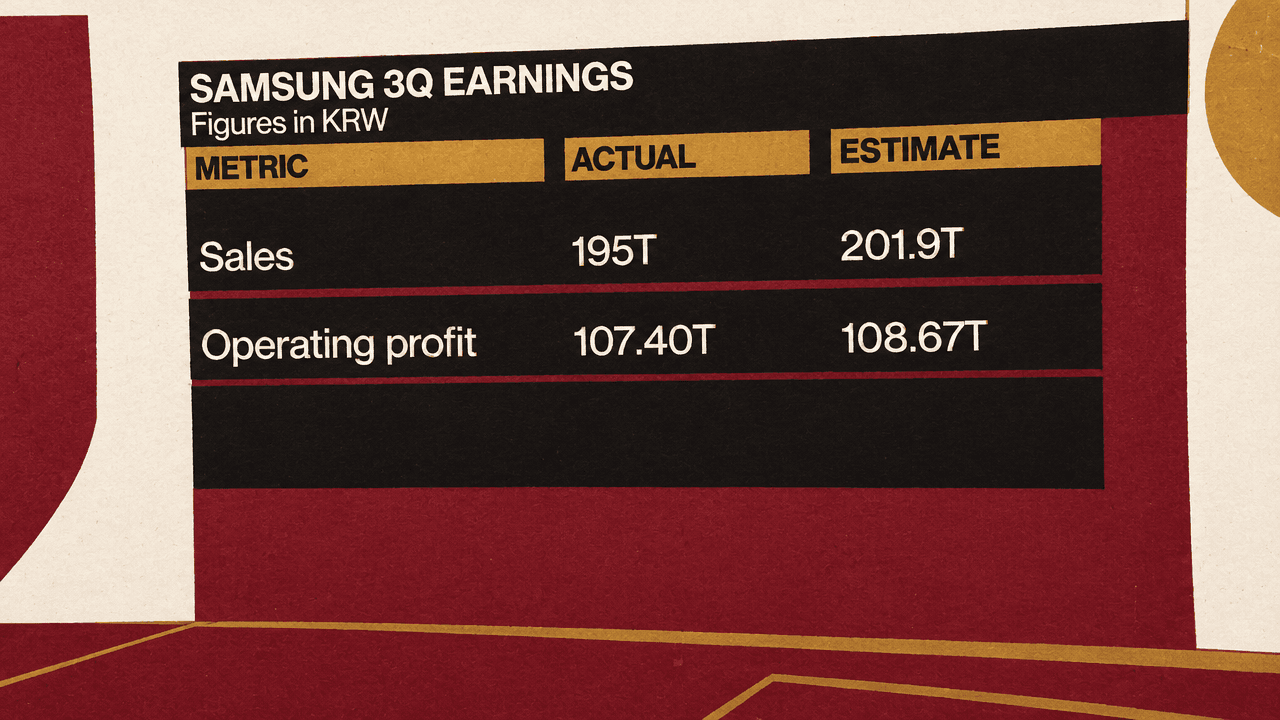
The record beat Rana’s expectation, not the market’s
Samsung reported operating profit of 107.4 trillion won for the three months through September, a record. Haidi Stroud-Watts attributed the result to surging memory-chip prices and continued spending on AI infrastructure, and put the profit at about $80.1 billion—more than eight times the level a year earlier.
The earnings figures shown on screen put the record beside estimates that Samsung did not reach. Sales were 195 trillion won against an estimate of 201.9 trillion; operating profit was 107.40 trillion won against 108.67 trillion. Stroud-Watts identified the operating-profit estimate as the analyst average. The comparison matters: a record in absolute terms can still come in below the benchmark investors were watching.
| Metric | Actual | Estimate |
|---|---|---|
| Sales | 195T won | 201.9T won |
| Operating profit | 107.40T won | 108.67T won |
Stroud-Watts framed the question around what investors wanted from the quarter: evidence that the memory cycle had further to run and that the profit boom had staying power. Sanjeev Rana answered by separating the market comparison from his own forecast. He said the result was in line with his expectations and with some recent expectations in the market. He had expected about 107 trillion won in operating profit, close to the reported figure.
We had expected around 107 trillion won in operating profit. The company delivered on that.
Rana called the result “definitely not a negative one.” His assessment did not erase the shortfall against the displayed analyst estimate; it explained why that shortfall did not make the result a surprise to him. The distinction is useful for reading the quarter: the record describes Samsung’s performance, while the estimates show the higher bar against which the figures were being judged.
Rana’s bullish case is a supply-demand argument
Rana said he remained bullish on both the memory cycle and Samsung Electronics. His case rested on demand that, in his words, continued to exceed supply, alongside what he called “very strong demand visibility.” He also forecast a big step up in high-bandwidth memory (HBM) pricing in 2025.
Those remarks extend the explanation for the record beyond the quarter’s result. Stroud-Watts had linked the profit surge to rising memory-chip prices and spending on AI infrastructure; Rana’s outlook focused on the persistence of demand relative to supply and on expected HBM pricing. He presented those conditions as reasons to remain positive about the memory cycle, rather than treating the record itself as proof that the boom would last.
The figures show both the scale of the result and the expectations surrounding it: operating profit reached a new high, yet came in below the estimate on screen. Rana’s response was that Samsung had delivered what he expected, while his broader view remained bullish because demand was strong and still exceeded supply. He also saw potential for substantial shareholder returns, adding that possibility to his positive view of the company.