Huang’s Return Lifts Nvidia, but Leaves Governance Questions Unanswered
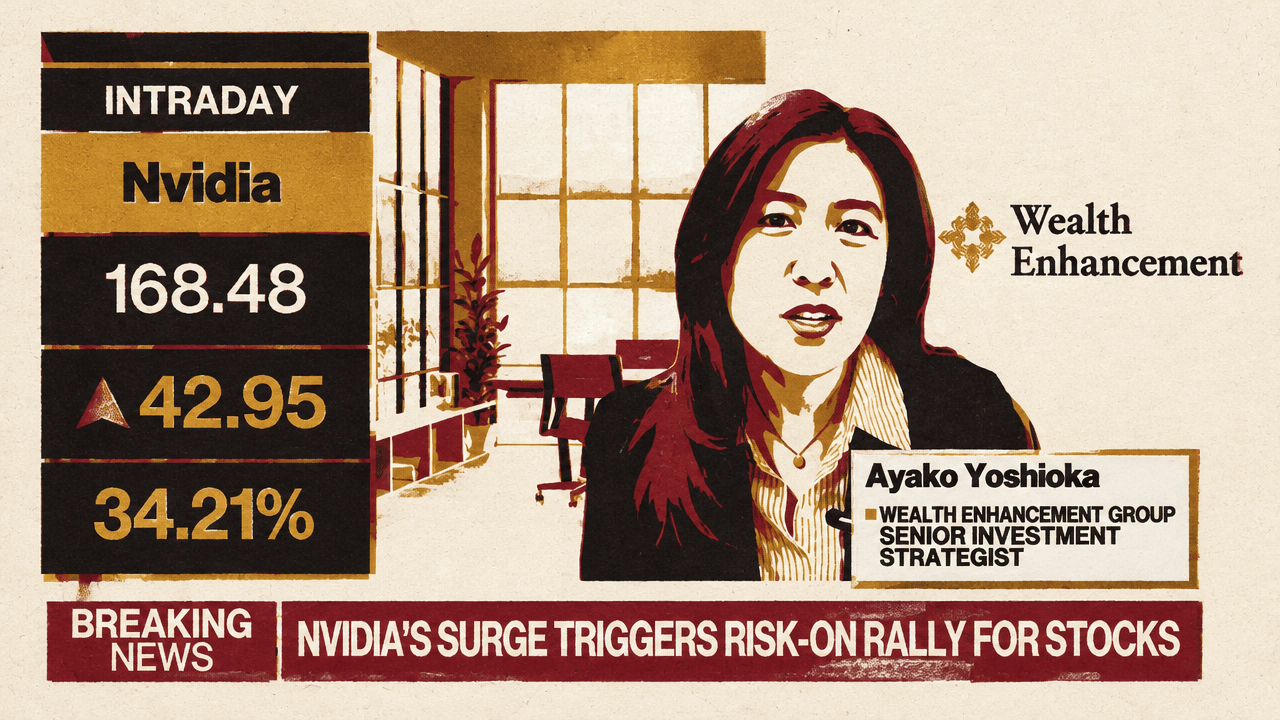
Jensen Huang’s return to Nvidia’s chief executive role eased one source of uncertainty for the company and the broader AI trade, but it left governance and succession questions unresolved, investment strategist Ayako Yoshioka said. Yoshioka, of Wealth Investment Group, called the episode unprecedented and said her firm would not make rash portfolio changes in response. The longer-term investment case, she said, still turns on how much the industry spends on AI and what returns that spending produces.
Huang’s return removes uncertainty, not the governance questions
? ayako-yoshioka said Jensen Huang’s return as Nvidia’s CEO lifted a major uncertainty hanging over the company and the broader AI ecosystem. It did not answer questions about succession or governance. Those remain open, she said, and investors will have to watch what happens next.
The scale of the market reaction made that distinction consequential. Bloomberg’s on-screen market data showed Nvidia up 33.75%, the Nasdaq 100 up 7.19% and the S&P 500 up 5.07% during the session. Host Ed Ludlow described the move as removing a major overhang on the AI trade and compared it with the market’s response to the April 2025 tariff announcement. He asked whether Yoshioka had seen anything similar in her career.
“I have not,” said Yoshioka, who has worked in markets since 1997. She called the sequence unprecedented: a CEO’s departure over relations with a potential Chinese spy, a reversal within days, and US government involvement. To her, it also underscored Nvidia’s importance to the rapid development of AI—and the need to ensure that development proceeds in a way society can live with.
The timeline shown on screen places the board’s announcement that Huang would resign on November 12 and his reinstatement on November 23, 11 days later. Ludlow emphasized that the board’s national-security conclusion was the conclusion reached at that stage, and that investigations could continue.
The board’s reversal leaves compliance and oversight in question
The board said it voted unanimously to reinstate Huang after discussions that satisfied it about his candor and ability to lead. In a separate statement shown on screen, it said it had received input from senior US government officials and was confident that his reinstatement posed no national security risk.
Ludlow noted that Nvidia would keep in place a board-level permanent compliance committee established the previous week and hire a chief compliance officer. He asked whether a company of Nvidia’s maturity should already have had such measures in place. Yoshioka agreed that governance and compliance issues had not been resolved.
In her view, the speed of events and the board’s sharp reversal created more questions, rather than closing them. She said the reversal made the governance and compliance concerns more pressing, and that there might be questions for which investors would never get the true answers. “We’ll have to wait and see,” she said.
Near-term orders look steadier than the long-term AI outlook
Yoshioka said her firm was not changing its positioning in response to the headlines alone. “Not today,” she told Ludlow. The firm would not make rash decisions based on short-term moves; instead, it would assess current fundamentals and future expectations within a balanced portfolio. Huang’s return did not by itself create a compelling buying or selling opportunity. The aim, she said, was to ensure that the portfolio was doing what the firm wanted it to do.
The firm had modeled different scenarios during the 11 days between Huang’s departure and return. Yoshioka said the fundamentals behind orders already placed were unchanged and unlikely to shift over the next three to six months. The harder question was what the market might look like in three to five years if new chips did not arrive at the same cadence. Her firm also considered what that could mean for frontier labs and the wider AI ecosystem. Those longer-term scenarios were harder to assess, she said, because they depended on many variables that still needed answers.
Huang’s return did not settle the underlying investment questions, Yoshioka said: how much capital the industry will spend on AI, what returns that spending will generate, and which companies will capture the highest returns. The market rally removed one source of uncertainty, but her firm’s longer-term scenarios still depended on variables that had not been answered.