OpenAI Explores $1.2 Trillion Funding Round Ahead of IPO


Bloomberg’s Ed Ludlow reports that OpenAI is in preliminary, investor-led discussions about a funding round that could value the company above $1.2 trillion, up from its most recent private valuation of more than $750 billion. Shirin Ghaffary says the financing could give OpenAI more flexibility to postpone an IPO, even as Anthropic appears to be moving ahead with plans for a public filing despite growing scrutiny of AI.
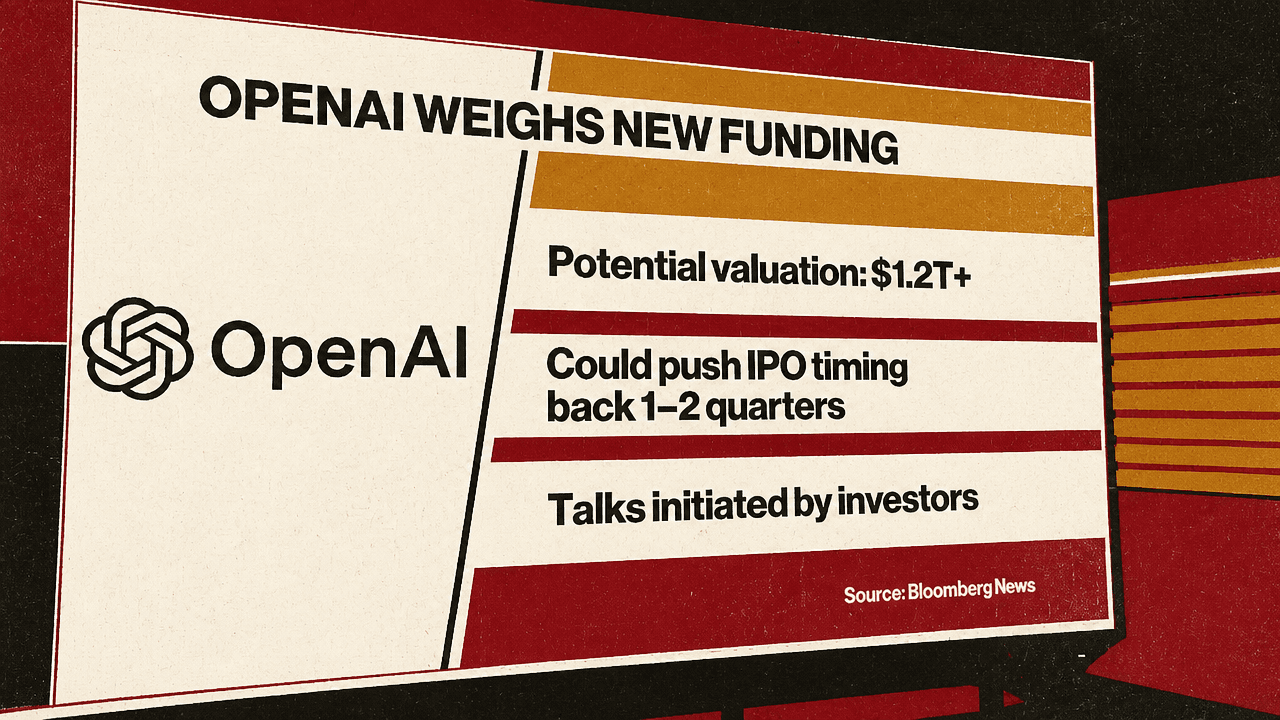
A new private round could reset OpenAI’s valuation—and its IPO timetable
Ed Ludlow reported that OpenAI is in early discussions with investors about a fresh financing that could value the company at more than $1.2 trillion. The discussions were described as preliminary, and Ludlow emphasized that the apparent direction of interest matters: an investor pool approached OpenAI about the possibility of doing a deal, rather than OpenAI publicly launching a raise.


The prospective valuation would represent a substantial step up from OpenAI’s most recent private-market value, which Shirin Ghaffary recalled as above $750 billion, though she did not give an exact figure. Whether the round happens—and, if it does, where it ultimately prices—remains open. Ludlow noted that other reports have floated an even higher number.


The significance is not only the headline valuation. Bloomberg News’ on-screen summary said the financing could push OpenAI’s initial public offering back by one or two quarters. A large private round would give the company more capital and potentially more latitude over when to enter public markets, rather than requiring an IPO on an earlier timetable.
The prospective pricing also places OpenAI in a comparison that is increasingly hard to avoid: the expected market debut of Anthropic. Ghaffary said a $1.2 trillion private valuation would be a major jump for OpenAI, but not necessarily as large as some of the figures circulating around Anthropic’s anticipated listing. The market’s response to an OpenAI round, if it materializes, would therefore offer a concrete signal about how investors are valuing the leading AI companies before they become publicly traded.
AI anxiety has not visibly stopped the rush toward public markets
The possibility of another private financing arrives amid widespread talk of an AI slowdown and heightened concern about the risks of the technology. Yet Ghaffary said there is no visible indication that those concerns have slowed Anthropic’s expected IPO process. From the outside, she said, the company still appears to be moving “full speed ahead.”
Anthropic was expected to move forward with an S-1 filing as soon as the coming days or weeks, according to Ghaffary. At the same time, the company has been having conversations about potentially bringing in external auditors—a point Ed Ludlow had raised earlier in the program. The juxtaposition is central to the moment: scrutiny and anxiety may be increasing, but the expected public-market process has not, on this account, paused.
OpenAI’s posture appears more cautious. Ludlow cited a recent Fortune interview in which CEO Sam Altman indicated that an IPO could occur next year, while characterizing the current moment as an unusual one in which to take the company public. Shirin Ghaffary said that statement differs somewhat from the posture suggested by other companies preparing to list.
But she also cautioned against treating current AI anxiety as the sole explanation for any delay. Bloomberg’s reporting had already indicated that OpenAI was considering skipping a public listing this year and moving it to 2027, before the latest wave of concern. That chronology suggests the market environment may be a factor in the company’s deliberations without necessarily being the decisive one.
The result, Ghaffary said, is a kind of cognitive dissonance. The industry is debating whether AI development has slowed and confronting substantial risks associated with the technology, even as some of the highest-valued private companies ever are preparing to test public markets. Anthropic’s expected S-1 and OpenAI’s potential new round point in different tactical directions, but both reflect the same underlying reality: investor appetite for frontier AI companies remains consequential enough that their financing and listing choices can be measured in valuations near or above a trillion dollars.