OpenAI Takes GPT-5.6 Global After U.S.-Reviewed Limited Preview


Bloomberg’s Seth Fiegerman reports that OpenAI is moving GPT-5.6 from a limited, government-shaped preview to global availability after pressure from the Trump administration to stagger the release. The model family is aimed at coding, cybersecurity and enterprise use, but Fiegerman says it remains unclear what changed between the restricted rollout and the wider launch. OpenAI argues the review process should not become the default for frontier-model releases, even as Washington scrutinizes systems with stronger cyber capabilities.
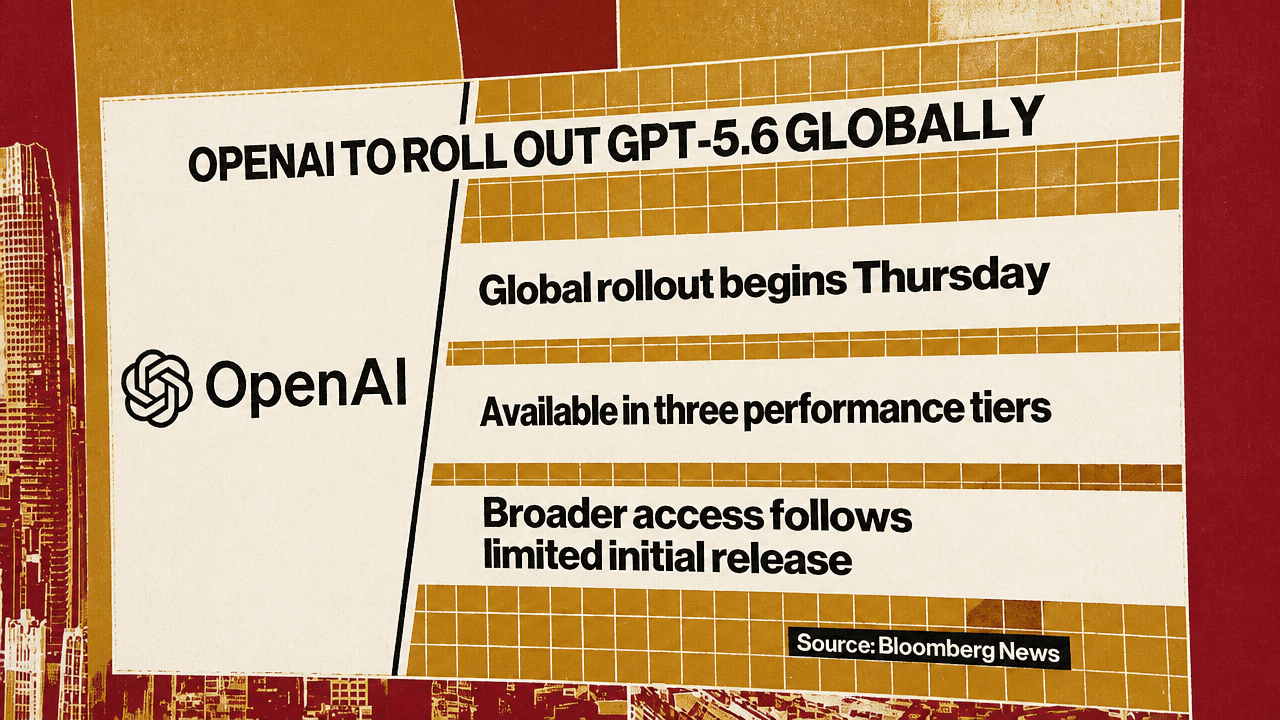
OpenAI is moving GPT-5.6 from a government-reviewed preview to global release
OpenAI is expanding GPT-5.6 from a limited preview to broad global availability after a staggered rollout requested by the U.S. government. Seth Fiegerman said the model had not been subject to a formal export-control ban, distinguishing OpenAI’s situation from Anthropic’s earlier experience. Still, the release was shaped by government pressure: OpenAI first gave access to an approved list of partners, and the model is now set to become publicly available “to everyone starting tomorrow.”


Bloomberg’s on-screen rollout graphic said the global release begins Thursday, spans three performance tiers, and follows a limited initial release. OpenAI materials shown on screen named those tiers Sol, the flagship model; Terra, a balanced model for everyday work; and Luna, a faster, lower-cost model.
The unresolved issue is what, if anything, changed between the constrained preview and the global release. Fiegerman said Bloomberg did not yet have clarity on whether OpenAI made meaningful changes to the model or its safeguards before widening access. Anthropic’s case, by contrast, involved additional cybersecurity safeguards that Fiegerman said were agreed to and implemented as part of bringing back its Fable and Mythos models.
We don't really know what meaningfully has shifted.
That uncertainty matters because the rollout reflects a process Fiegerman described as difficult to sustain. If AI developers must negotiate releases through case-by-case pressure, review, and partner lists, he said, it “does not feel like a workable long-term strategy.”
The model family is aimed at coding, cyber defense, and business adoption
GPT-5.6 is being positioned around the same market priorities now visible across frontier-model releases: coding, cybersecurity, and enterprise use. Seth Fiegerman said the new model family should be more capable at cybersecurity tasks, including both defending against cyber threats and supporting AI-and-coding workflows.
| Tier | Positioning | Noted claim |
|---|---|---|
| Sol | Flagship model | OpenAI materials shown on screen called it GPT-5.6’s strongest model and its most capable model yet for cybersecurity. |
| Terra | Balanced model for everyday work | OpenAI materials shown on screen said Terra is competitive with GPT-5.5 while being 2x cheaper. |
| Luna | Fast and affordable model | OpenAI materials shown on screen described Luna as bringing strong capability at its lowest cost. |
OpenAI materials shown on screen framed the release around deeper reasoning, coding workflows, biology analysis, and cybersecurity. They said GPT-5.6 introduced an “async reasoning effort” to give Sol more time to reason deeply, along with a “strike mode” that uses subagents to accelerate complex work. For coding, the materials said Sol set a new state of the art on Terminal-Bench 2.1, a benchmark for command-line workflows requiring planning, iteration, and tool coordination.
The same on-screen materials also claimed broad improvements in biology workflows, saying Sol outperformed GPT-5.5 on GeneBench v1 while using fewer tokens. The cyber claims were the most sensitive: the materials said Sol shifted the performance-efficiency frontier for long-horizon security tasks, including vulnerability research and exploitation. On ExploitBench, the materials said Sol was competitive with Mythos Preview while using roughly one-third of the output tokens; on ExploitGym, they said Sol, Terra, and Luna all showed strong improvements in cyber capabilities as reasoning increased.
Fiegerman tied those capabilities directly to commercial pressure. OpenAI and Anthropic, he said, are competing to serve the market for coding and cybersecurity tools and to win as many business customers as possible. In that context, getting new models into customers’ hands quickly is “paramount,” even as government opposition or scrutiny increases.
OpenAI is accepting a short-term review process while rejecting it as the default
OpenAI materials shown on screen framed the limited release as part of “ongoing engagement with the U.S. government.” The company said it previewed its plans and model capabilities ahead of launch and, at the government’s request, began with a limited preview for a small group of trusted partners whose participation had been shared with the government.
The company was explicit that this should not become the standing process for frontier-model releases. The on-screen materials said OpenAI did not believe “this kind of government access process should become the long-term default,” because it keeps the best tools away from users, developers, enterprises, cyber defenders, and global partners who need them. OpenAI described the limited preview as a short-term step toward broader availability while it worked with the administration to develop a cyber executive-order framework and a repeatable process for future releases.
That position aligns with Fiegerman’s assessment that the current arrangement looks informal and improvised. Ed Ludlow described the case as OpenAI more widely releasing a model that the U.S. government had time to review under the president’s executive order from the prior month. Fiegerman said the government had pressed OpenAI to stagger the release, but that the mechanism appeared less formal than in Anthropic’s case.


The distinction is important but not clean. Fiegerman said that, as far as Bloomberg knew, the Commerce Department had not issued a formal export-control ban on OpenAI’s models. He also said the relationship between OpenAI and the government had seemed less adversarial than the relationship between Anthropic and the government in recent months. But he stopped short of describing OpenAI’s cooperation as purely voluntary.
I think we've seen this happen seemingly in a more voluntary way, though under some duress.
In practice, Fiegerman said, if the government is pressing a company to move more slowly, formally or informally, it is difficult for the company to ignore that pressure.
The safety claim is that stronger cyber models need stronger safeguards
OpenAI materials shown on screen paired the capability claims with a safety claim: GPT-5.6 Sol launches with what the company called its “most robust safety stack to date.” The company said it strengthened protections for higher-risk activity, sensitive cyber requests, and repeated misuse, and spent multiple weeks finding weaknesses, pressure-testing the system, and hardening it against real-world attacks.
The safeguard framing was not simply that the model is restricted. OpenAI said it designed safeguards to prevent high-risk actions that could aid cyberattacks while preserving access to legitimate work such as code review, vulnerability research, and incident response. The materials said configurations were matched to each model’s capabilities, implying that Sol, Terra, and Luna carry different safety requirements according to their respective risk profiles.
A central line in OpenAI’s framing was that GPT-5.6 Sol is “better at helping people find and fix vulnerabilities than reliably carrying out end-to-end attacks.” The company said its priority, as these capabilities advance, is to ensure defensive tooling keeps pace. It also said it would share internal tools for finding weaknesses, developing patches, and strengthening systems more broadly.
The policy conflict is direct: OpenAI is arguing for broad access because cyber defenders, developers, enterprises, and global partners need the tools, while the government is applying pressure because the same capability class can support higher-risk cyber activity. Fiegerman’s account leaves unresolved what materially changed between the restricted preview and full release.