Nvidia’s AI Growth Case Extends Beyond Hyperscale Data Centers



T. Rowe Price portfolio manager Tony Wang told Bloomberg Tech that Nvidia’s selloff after earnings reflects investors applying an old semiconductor-cycle framework to a company whose AI demand may be more durable. Wang argued that agentic AI, inference, enterprise and sovereign customers, and Nvidia’s ecosystem investments widen the company’s market beyond hyperscale data-center spending. He said that makes Nvidia’s strategy “smart” and its valuation attractive if growth proves less cyclical than the market assumes.
Wang’s Nvidia thesis is that the market is using the wrong semiconductor playbook
Anthony Wang framed Nvidia’s post-earnings reaction as a category error. The second-quarter guide — about $91 billion, plus or minus 2% — was close to what Ed Ludlow described as the whisper number for both sell-side and buy-side investors. The problem was that “close” still was not enough for the stock.




Wang’s investable claim was not simply that Nvidia demand is strong. It was that traditional semiconductor investors may be applying the wrong playbook. They tend to sell growth at this scale because the usual assumption is that it cannot last and that margins have already peaked. Nvidia’s growth, he argued, is being driven by demand patterns that do not fit that pattern.
The growth at this scale is just unprecedented. I don’t think the market’s ever seen anything like it.
The first demand pattern is agentic AI. Wang’s key point was that the relevant unit of demand is shifting from a prompt or a short session to the duration of a task. Instead of one-shot responses or agents working for a few minutes, he expects work to move toward persistent tasks that can run for months. That requires far more compute because an agent has to “complete a task and think and be persistent.”
The second is the continued usefulness of scaling laws. Wang said frontier models are still improving as more compute is applied. He also argued that using the frontier model can save money because a better model “doesn’t go through so many rabbit holes” while trying to complete a task. Higher model capability, in that reading, is not merely a premium feature; it can change the economics of completing AI-driven work.
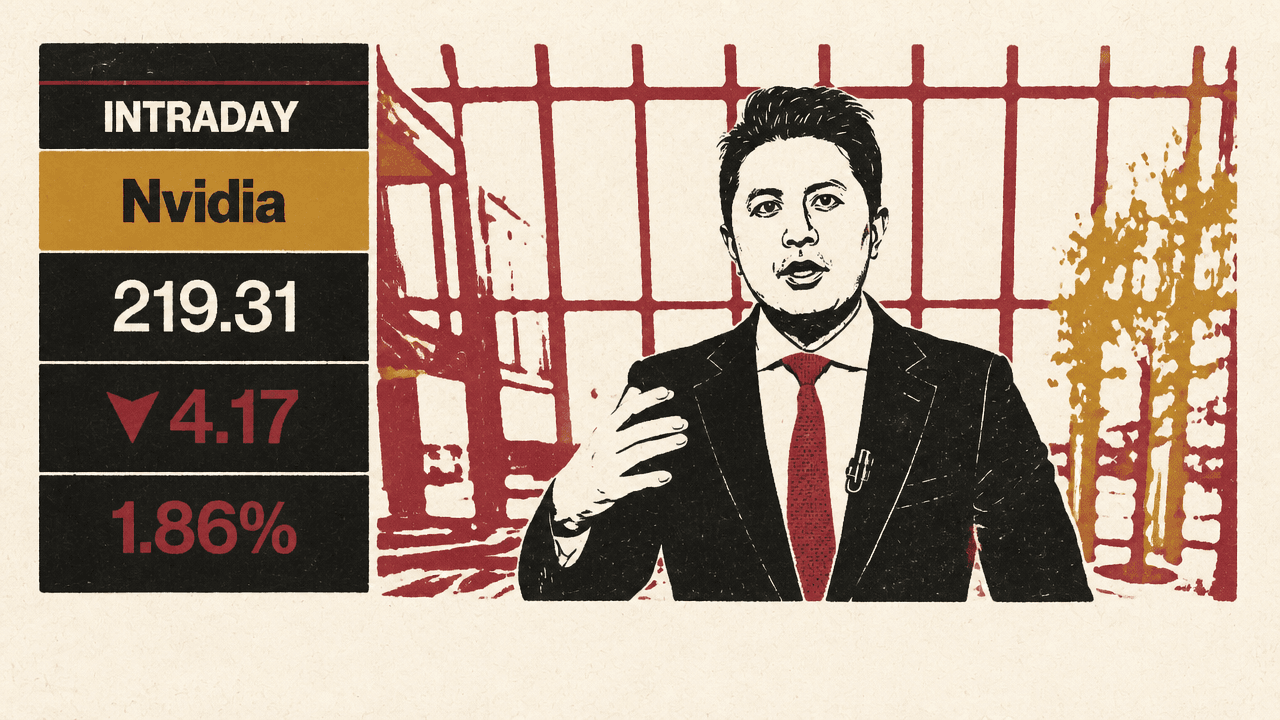
A Bloomberg intraday graphic put Nvidia at 219.27, down 4.20 points, or 1.87%. That was the central tension: Wang described end demand as “phenomenal,” while the stock reaction reflected investor discomfort with whether even unprecedented growth can keep surprising.
The demand story depends on markets beyond hyperscale capex
The bear case Wang identified is straightforward: Nvidia cannot outgrow hyperscale capital expenditure forever. If Nvidia is only a supplier into the largest cloud operators’ capital budgets, then investors can bracket its growth against those spending plans.
His counterargument is that Nvidia is no longer only a hyperscale capex story. One of the most encouraging parts of the quarter, he said, was Nvidia’s decision to break out hyperscale demand versus enterprise and sovereign demand. That disclosure matters because it makes visible the new total addressable market he sees forming outside the biggest data-center operators.
Enterprise adoption of agentic AI is the most immediate example. Wang pointed specifically to financial-services firms adopting demand that Nvidia’s products serve. He also named robotics as a future source of demand. Those categories, in his view, prevent Nvidia from being trapped in a “hyperscale compute paradigm.”
The context for that claim was Nvidia’s own argument that its growth is trending ahead of hyperscale capex growth. Ludlow referenced Nvidia’s use of scaling-law and dollar-per-token data points, along with a $1 trillion figure that he said had been clarified as Blackwell and Rubin demand for calendar years 2025 through 2027 — “basically a backlog,” in his words.
A Bloomberg revenue table put Nvidia’s fiscal first-quarter 2027 total revenue at $81.6 billion, 11.4% above estimate. Compute revenue was $60.4 billion, 1.1% below estimate, while networking revenue was $14.8 billion, 16.1% above estimate, and edge computing was $6.4 billion, 13.1% above estimate.
| Segment | Fiscal 1Q 2027 revenue | Versus estimate |
|---|---|---|
| Compute | $60.4B | -1.1% |
| Networking | $14.8B | +16.1% |
| Edge computing | $6.4B | +13.1% |
| Total | $81.6B | +11.4% |
The table and Wang’s comments addressed related but distinct points. The table showed where the reported quarter beat or missed estimates by segment. Wang’s investment argument was about customer mix: hyperscale remains central, but enterprise, sovereign demand, and eventually robotics are the categories he sees widening Nvidia’s addressable market.
Supply is constrained, but valuation support depends on durable growth
Jensen Huang described Nvidia as operating through “the largest supply chain in the world,” with partners securing supply and components such as silicon photonics “all lined up.” The limiting factor, he said, was not coordination across the supply chain but global capacity itself.


The demand is much greater than the overall capacity of the world.
For Anthony Wang, that supply-demand imbalance does not automatically settle the investment case. The market is watching relative earnings growth and trying to identify where bottlenecks create the best returns. Capital is flowing toward those bottlenecks. Nvidia’s setup becomes more compelling if the company’s growth proves durable enough to support a higher multiple.
Ludlow put Nvidia’s valuation at about 22 times forward 12-month earnings and contrasted that with a historical level nearer 34 times. Wang said Nvidia’s multiple looked “really attractive” if the growth is durable, referenced the PEG ratio, and said multiple expansion from current levels was possible.
Inference is central to that durability claim. Wang said Nvidia is the platform on which much AI inferencing will be built, and he expects inferencing to become much bigger than training. Training, he added, is also still growing because scaling laws continue to support more compute. The investment case therefore does not require training to remain the only durable workload.
Capital return is the other support. Wang said he covered Apple and Nvidia for T. Rowe Price and drew an analogy to Apple’s capital-return programme. Apple’s return programme did not re-rate the stock immediately, he said, but consistent capital return at the right valuation expanded the multiple over time. Nvidia could follow a similar path if it becomes perceived as less cyclical and more durable.
Nvidia’s ecosystem investments are part of the platform thesis
Nvidia’s use of capital is not a distraction from shareholder returns in Wang’s reading. It is part of how the company strengthens the market around its own architecture.
Ed Ludlow described Nvidia as investing in its ecosystem in relatively small increments — “two billion here, two billion dollars there” — and contrasted that posture with investor frustration around Apple, where the demand has often been to “do something.” Anthony Wang called Nvidia’s strategy “really smart.”
When you’re at the frontier of technology, you have to build the ecosystem and bring up the supply chain, bring up the partners.
His argument was that a company operating at the frontier of technology has to build the ecosystem around it: supply chain, partners, and adjacent companies that help extend the market. Nvidia, he said, is using free cash flow to strengthen those dependencies and to push the technology frontier forward.
That matters because Wang sees Nvidia not merely as a chip supplier but as a single-architecture platform company. The leverage comes from the platform: as the ecosystem grows around it, the architecture becomes more useful, and the margins reflect that leverage. He said this has been Nvidia’s bet “from day one” — to be an ecosystem company — and that the current investment strategy is a continuation of that approach.
The T. Rowe Price Science & Technology Fund holdings graphic put Nvidia as the third-largest position at 8.49%, behind Broadcom at 9.86% and Alphabet at 9.16%.
| Holding | Portfolio weight |
|---|---|
| Broadcom | 9.86% |
| Alphabet | 9.16% |
| NVIDIA | 8.49% |
| Apple | 6.73% |
| Microsoft | 5.45% |
| AMD | 3.85% |
| Intel | 3.42% |
| Micron | 3.29% |
| Meta | 3.06% |
| Cisco | 2.49% |
Wang also said Nvidia still has excess cash after making these investments. For shareholders, his view is that the private-market deals have been “pretty good,” while also helping build the supply chain and ecosystem on which Nvidia’s platform depends.
Older GPUs are still challenging the obsolescence bear case
The durability question also extends to prior generations of Nvidia hardware. Wang said revenues are coming through for Nvidia’s customers, pointing to cloud demand, GPU pricing, and enterprise adoption. Even older GPUs, he said, are holding pricing “phenomenally well.”
That point responds to a bear case Wang said was common roughly 24 months earlier: that Nvidia GPUs would become obsolete within three or four years. He countered that the warranty periods themselves are three or four years, depreciation can be adjusted through pricing, and demand has been strong enough that older GPUs continue to produce value.
H100 pricing, Ludlow noted, is a social-media fixation. Wang said he tracks it. But the more important point was not only H100 pricing; it was that even A100s are still being used. If older generations keep earning their place in workloads, then Nvidia’s demand story is not only about the next chip cycle. It is also about how long each installed generation remains economically useful.
Wang connected that to enterprise demand from his own vantage point. T. Rowe Price, he said, is developing AI solutions internally, and those efforts are consuming “a bunch of tokens.” There is still experimentation, but he said the promise is visible.