Scarce Infrastructure Is Driving Valuations for Nvidia, SpaceX, and AI Labs



DA Davidson’s Gil Luria and Switchyard Partners’ Joe Kaiser argue that Nvidia’s latest earnings reinforce a broader market bet on companies controlling scarce AI and space infrastructure. Luria says Jensen Huang used the quarter to show Nvidia’s competitors still lack meaningful traction, while Kaiser says the company’s moat lies as much in TSMC advanced packaging capacity and networking scale as in chips. They extend the same framework to SpaceX, OpenAI and Anthropic: valuations depend on whether these companies can secure the physical capacity needed to turn demand into revenue.
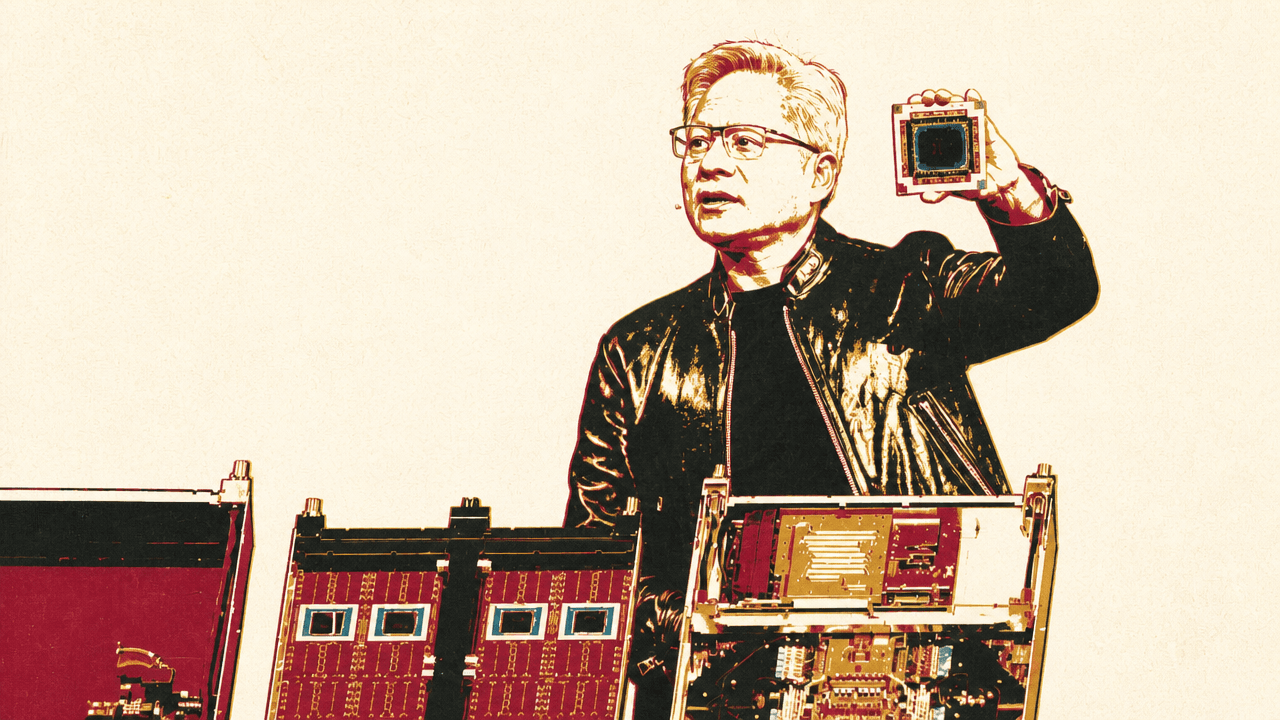
The market is pricing control of hard-to-get infrastructure
Nvidia’s earnings were treated less as a single-company result than as evidence of a broader market logic: investors are assigning extraordinary value to companies that control the infrastructure needed for AI and space. For Nvidia, the strongest version of that claim is not simply that it sells chips. It is that Nvidia has dominant competitive positioning, networking scale, and access to constrained advanced packaging capacity. For SpaceX, the analogous assets are launch capacity, orbital infrastructure, and the promise of data centers in space. For OpenAI and Anthropic, it is compute.
Gil Luria said Nvidia did more than clear a high bar. In his reading, Jensen Huang used the quarter to define where Nvidia believes competition does not yet matter.
Luria described Huang as “dunking” on AMD and Broadcom by identifying a segment of Nvidia’s business where, outside of companies developing chips for their own internal use, “the entire rest of the market is 100% Nvidia.” Huang then turned, in Luria’s account, to CPU incumbents Intel and AMD, saying Nvidia’s standalone CPU business is on track to grow “from nothing to 20 billion” within a year. He also dismissed the market for “hyper-speed inference” as tiny, even though Nvidia participates in it — a remark Luria framed as a jab at Cerebras.
The stock reaction was more restrained than the operating story. A Bloomberg market panel showed Nvidia trading intraday at 218.84, up 4.63 points, or 2.08%, after the company had beaten already elevated expectations. The tension is that Nvidia keeps outperforming, but its scale forces investors to judge each quarter against a rising bar.
Joe Kaiser argued that some of Nvidia’s less-discussed businesses already have strategic scale. He pointed to networking equipment revenue of about $15 billion, saying that puts the unit on a run rate comparable to Qualcomm. His point was not that networking is Nvidia’s center of gravity, but that a business of that size can still look like an “also-ran” inside Nvidia.


Kaiser connected that to Huang’s “AI factory” framing from GTC: the idea, he said, is “coming to life.” He also corrected the valuation comparison being discussed, saying Nvidia was expected to have $370 billion in annual sales and, at a $5.4 trillion valuation, was trading at about 14.5 times sales and roughly 20 times forward earnings on a 12-month basis.
The moat, in Kaiser’s view, is not just silicon design. It is packaging capacity at TSMC. He said Nvidia is consuming almost two-thirds of packaged chips coming out of TSMC, creating a constraint for would-be rivals including Google and Amazon if they need the same manufacturing and packaging infrastructure for their own training chips.
The moat is not silicon. The moat is the packaging.
That claim reframes Nvidia’s advantage as a supply-chain lock as much as a product lead. If the critical bottleneck is advanced packaging capacity, then competing accelerator designs are not enough; competitors also need access to the same scarce production flow.
SpaceX’s valuation case depends on both mythology and operating proof
The prospective SpaceX valuation was measured against Nvidia’s. SpaceX was described as potentially valued at $2 trillion, or about 80 times sales, while growing around 20%. Nvidia, by contrast, was framed as trading at a far lower sales multiple with much faster growth.
Gil Luria said SpaceX’s valuation logic is tied to the company’s stated ambition. He cited language about humanity becoming multiplanetary and “extending the light of consciousness into the stars,” saying that kind of mission naturally sounds “multi-trillion” in market terms. He also recalled asking Elon Musk about taking SpaceX public 13 years earlier, when Tesla was already public at about a $5 billion market capitalization and creating headaches for Musk. According to Luria, Musk said then that he expected to keep SpaceX private for a while. Thirteen years later, Luria said, both Tesla and SpaceX appear headed toward trillion-dollar status.
Joe Kaiser pushed against treating SpaceX as a pure narrative asset. He said the “dream is grounded in reality” because SpaceX is already launching infrastructure into space to support a future “data center in space” model.
Matt Miller challenged the operational premise. Starship, he said, is not yet launching commercial payloads; the vehicle is supposed to carry 100 to 150 tons of payload, and if customers were using it now, he said the practical payload would be closer to 35 to 50 tons. Kaiser’s answer was less technical than historical: “don’t bet against Elon.” He said the tactical technology problems would be solved.
SpaceX’s valuation case, as described here, rests on both current operating proof and investor confidence that the harder launch and payload problems will be solved.
Musk’s valuation playbook stacks today’s cash, tomorrow’s platform, and the distant prize
Gil Luria offered the clearest framework for how Elon Musk companies sustain valuations beyond current earnings power. He said Musk divides the business into three parts: a money-making business today, a business “on the come,” and a larger dream.
For Tesla, Luria identified cars as the current money-making business, robotaxi as the business on the come, and Optimus robots as the dream. For SpaceX, he mapped those categories to Starlink, data centers in space, and life on Mars.
His answer on AI infrastructure was less cleanly bounded by company. The question referred to xAI, SpaceX’s GPU clusters, and capacity rented to Anthropic. Luria answered by moving among the S-1, Tesla, Grok, “Colossus” data centers, and Anthropic’s expected use of capacity. In his account, the S-1 shows the AI buildout had been a “huge money drain on Tesla,” but that could turn around because Anthropic is expected to pay $15 billion a year for capacity.
Luria said Musk is good at building Colossus data centers, while Grok has not yet been popular enough to fill them with inference demand. The excess capacity, as he described it, can be sold to Anthropic to help pay for the investment while Grok improves. He added that Musk could give Anthropic 90 days’ notice and reclaim the capacity for Grok if demand materializes.
A company with perhaps $20 billion in revenue and $20 billion in losses could still attract a $2 trillion valuation, Luria said, if investors believe the growth trajectory and total opportunity are large enough. He put SpaceX, OpenAI, and Anthropic in the same category: companies expected to go public this year, losing tremendous amounts of money, but claiming total addressable markets in the multiple trillions. Investors, he said, are hungry for this type of growth.
The 2026 IPO pipeline shown on screen put SpaceX, Anthropic, and OpenAI in the same frame, with reported estimates sourced to Bloomberg, SpaceX, and The Information:
| Company | Reported figure shown | Expected timing |
|---|---|---|
| SpaceX | $75B | June |
| Anthropic | $60B | 4Q 2026 |
| OpenAI | TBA | 4Q 2026 |
Luria said these offerings could “take the oxygen out of the room,” making other companies look worse by comparison because of their growth rates and the perceived size of their opportunities.
The OpenAI-Anthropic race is now a compute race as much as a model race
OpenAI’s position was tested against a practical shift in usage: some sophisticated AI users have moved toward Anthropic, especially for coding. Joe Kaiser said the data is mostly private and must be pieced together, but he still described OpenAI’s revenue growth from 2023 to 2025 as extraordinary, from $2 billion to $20 billion. Matt Miller’s objection was that OpenAI had been “the only game in town” for much of that period.
Kaiser said the “flip” came with Anthropic’s newer tools, particularly coding. He said Anthropic’s Code now has double the users of Codex, making software engineering a two-horse race in which Anthropic is currently ahead. He also said Anthropic’s growth rate is now much faster than OpenAI’s, and suggested that may be part of Sam Altman’s motivation to move toward the public markets sooner.
For Kaiser, OpenAI’s IPO urgency is primarily about capital. He said OpenAI is discussing $600 billion of infrastructure deployment through the rest of the decade and “just needs the capital.” He added that OpenAI “must get out before Anthropic,” implying that sequencing matters if investor attention and appetite are finite.
Gil Luria was more cautious about declaring a winner. If Anthropic “runs away with it,” he said, that would be a problem for the broader multi-trillion-dollar economy built around OpenAI’s assumed leadership. But he argued the race remains too fluid. In the past six months, he said, OpenAI appeared to have an insurmountable lead, then Google Gemini appeared to have one, and then Anthropic took the lead.
Enterprise usage, in Luria’s account, is not winner-take-all yet. He said OpenAI usage in the enterprise is “almost as big as Anthropic,” and that many companies want to use both. He also emphasized compute availability: Anthropic grew demand quickly but lacked enough compute to serve it, while OpenAI had been ahead in securing compute. If OpenAI has a slightly better model and more compute to deliver it, he said, it can come back into the lead. Google also remains in the enterprise mix after making what Luria described as a compelling case for Gemini.
The hierarchy is not settled. Models matter, usage matters, and capital matters because compute determines whether demand can actually be served. On that point, the Nvidia, SpaceX, OpenAI, and Anthropic stories converge: the market is paying for control of scarce infrastructure as much as for software, chips, rockets, or brand.