Nvidia Earnings Become a Test of the AI Infrastructure Boom
 Ed Ludlow
 Maggie Eastland
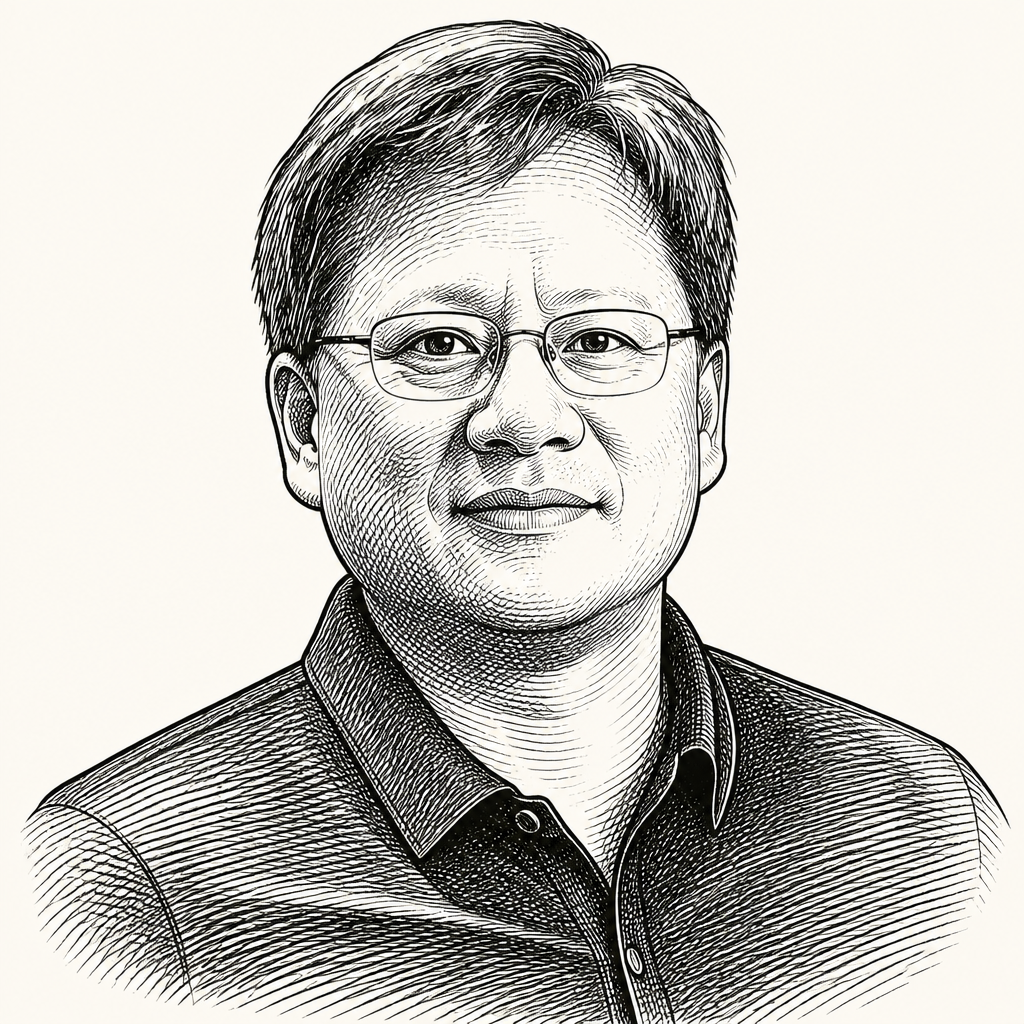
 Jensen HuangJai Malik
 Paulina McPadden
 Peter Elstrom
 Campbell Brown
 Kunjan Sobhani
 Anthony Hughes
 Carmen Reinicke
 Rachel MetzBloomberg TechnologyWednesday, May 20, 202614 min read
Bloomberg Technology framed Nvidia’s earnings as a test of whether the company can keep turning AI infrastructure spending into growth, rather than simply whether demand remains strong. Ed Ludlow and Bloomberg reporters said investors were looking for reassurance on supply constraints, China exposure and Nvidia’s moat as workloads shift toward inference, while the same program treated SpaceX’s prospective IPO and SoftBank’s $65 billion OpenAI exposure as evidence that AI is driving larger bets across public markets, private capital and the chip supply chain.

Nvidia’s earnings test is no longer just whether AI demand is strong
Nvidia entered its earnings day as the stock carrying the AI trade. Ed Ludlow framed the setup bluntly: the company was the “world’s most valuable company,” the center of the AI boom, and the name driving both investor attention and semiconductor-sector sentiment. On the day, Nvidia shares were up about 2%, bringing the year-to-date gain to roughly 20%. Bloomberg’s screen showed expectations for about 80% top-line growth and 85% earnings-per-share growth.


The question, though, was not simply whether Nvidia would report a strong quarter. Carmen Reinicke said investors already understood Nvidia as the “kingmaker of the AI trade,” the stock watched for evidence that forward demand remains intact. After a large rally in chipmakers from a March 30 low, she said Nvidia’s comments on future demand would be “paramount” for the entire sector.


That did not mean a blowout report would automatically lift the stock. Ludlow pointed to Bloomberg analysis showing a mixed S&P 500 performance after past Nvidia earnings releases. Reinicke said Nvidia shares had fallen the day after several recent reports even when the numbers were strong, citing the familiar “buy the rumor, sell the news” pattern and the chance for investors to take profits after a major run.
Reinicke also separated Nvidia’s fundamental importance from short-term market mechanics. Nvidia remained the most important stock in the S&P 500 by index weight, she said, but it was not immune to macro pressure or to shifts in appetite for the AI trade. A strong report could answer questions about demand, but it could not guarantee that the stock would “continue to march forward and up to the right” in the days immediately after earnings.
Valuation complicated the setup. Ludlow said Nvidia was trading at about 24 times forward earnings, below its historical average by his framing. Reinicke said the multiple had continued to tick down even as the stock rallied because earnings growth had been so large. Investors were paying less for forward earnings growth than they were for many other companies, including some in the same space. That could entice buyers back in, she said, but the market reaction still remained open.
The demand story depends on supply, China, and whether inference preserves Nvidia’s moat
Maggie Eastland said the consensus expectation was for a very strong Nvidia performance, but that strength was already embedded in investor assumptions. The more important issue was durability: how long the AI boom could last, whether this level of demand was sustainable, and what supply constraints might limit Nvidia’s ability to meet hyperscaler and customer demand.


Eastland identified memory and networking as possible bottlenecks. Nvidia could have enormous AI compute demand, she said, while still facing limits in the components and systems needed to supply it.
That matched Jensen Huang’s own description in a Bloomberg interview shown during the program. Huang said Nvidia had “the largest supply chain in the world,” and that partners had secured supply across the required pieces, including silicon photonics. His caveat was larger than any single component: “the demand is much greater than the overall capacity of the world.”

China remained the overhang. Eastland said the outlook was “very cloudy.” In March, Huang had told investors Nvidia was restarting H200 production for China and had U.S. permissions. U.S. officials had confirmed permissions, she said, but after Huang joined a trip to China, U.S. officials were saying China was blocking its companies from purchasing H200 chips. Investors were expected to press for clarity on the earnings call.
Huang’s own tone had shifted between March and the latest interview clips. In March, he said Nvidia had been licensed for many customers in China, had received purchase orders, and was restarting manufacturing. In the later interview, he said the Chinese government had to decide “how much of their local market do they want to protect” and how much they wanted to expand with more AI capacity. He added that demand in China was “incredible” and that agentic AI was making progress there, but his view was only that “over time, the market will open.”
Eastland also expected Huang to spend time on applications, not just data-center construction. The broader investor question for hyperscalers was where the return on investment would arrive. Nvidia, she said, would likely emphasize AI use cases and could focus on inference, especially in light of the Groq acquisition. The industry narrative she described was that compute demand is moving from training to inference. The question for Nvidia is whether it can maintain its competitive moat as that shift happens.
The buy side is looking past a standard beat-and-raise
For Kunjan Sobhani, the ordinary earnings frame was inadequate. He said a standard beat-and-raise would not matter much “given where we are in the time and where the stock is” unless Nvidia could clear what he described as a $90 billion buy-side hurdle for next-quarter guidance. Ludlow noted that consensus for fiscal second-quarter 2027 was $87.3 billion, making $90 billion the high-side guide investors were watching.


Sobhani said the more important test was reassurance. Investors needed to hear that reported supply-chain issues, including liquid cooling concerns around the Rubin ramp, would not derail the second-half rollout. He also wanted Nvidia’s previously discussed $1 trillion Blackwell/Rubin demand framework to translate into higher numbers.
Bloomberg Intelligence’s thesis, displayed on screen and discussed with Sobhani, was that Nvidia was extending its AI lead even as AMD and custom ASIC competition grew. The argument was not that GPUs alone would remain the entire moat. The note emphasized Nvidia’s full-stack position across CUDA, rack-scale compute, NVLink, Spectrum networking, and software layers such as NeMo and Clara.
Sobhani said benchmarks had consistently shown the latest Nvidia systems outperforming what existed in the market, though more third-party benchmarks would emerge as newer systems rolled out. But he also acknowledged that raw performance was no longer the only measure. For customers using custom silicon such as TPUs, the economics could be about “dollars per token per performance.” If a company controls the entire data-center architecture, it may be able to achieve much lower cost per unit of performance for its own use cases.
On China, Sobhani was cautious. He said Bloomberg Intelligence had not heard anything positive from the recent trip with the Trump administration and therefore would not increase or adjust China revenue estimates in the near term.
The AI supply chain is global, even when the design center is American
Paulina McPadden treated China access as upside Nvidia investors should not count on. She said Baillie Gifford had not factored China into its Nvidia upside cases “for a while,” because doing so required trying to prejudge political decisions. H200s had been approved for export to China, she said, but China’s decision not to approve purchases by Chinese companies had stopped sales from going through.


The longer-term question, in her view, was what China’s restrictions mean for the broader chip supply chain. China may eventually build a domestic chip supply chain, and that could threaten Nvidia over time. But McPadden said two factors gave her comfort for at least the next five years. First, China’s existing high-power chips were still a fraction of the performance of Nvidia’s leading chips, giving non-Chinese companies and researchers an advantage. Second, building a scaled, complex semiconductor supply chain is much harder than putting capital into an industry. Unlike areas such as EVs or batteries, leading-edge chips require complex equipment and global cooperation.
She also resisted a simplistic “bottleneck equals investment” approach. Memory was a bottleneck, and SK Hynix was part of her strategy, but she said markets often identify bottlenecks early and invest in them before fundamentals show up. Long-term investors, she said, should look for structural opportunities and companies that become better as they scale.
SK Hynix, in her account, could become a materially better company if high-bandwidth memory changes the structure of the memory business. Long-term purchase agreements, industry consolidation, and the rise of custom HBM could create customer lock-in and make parts of the market less commoditized than in the past. But she called that a hypothesis.
TSMC was a more proven example for McPadden. It was the largest position in her portfolio, and she said it had demonstrated control over its supply chain and the ability to coordinate multiple actors in a more complex semiconductor ecosystem. As chip production becomes more difficult, she argued, TSMC “just keeps getting better.”
Her broader point was that AI and chips may be designed in America, but they are manufactured internationally. She cited TSMC making the chips, SK Hynix supplying memory, and ASML in the Netherlands building EUV lithography machines used in TSMC fabs. All were, in her view, dominant companies in their specific industries. She also said TSMC’s decision to raise its five-year AI growth guidance to 56% was encouraging because TSMC has visibility into the full supply chain.
SpaceX’s prospective IPO is being treated as a market-structure event
SpaceX was presented as moving toward what could be the largest IPO in market history. Ludlow said the company’s public filing could arrive as soon as that day, with the IPO potentially raising as much as $75 billion and valuing SpaceX above $2 trillion. A Bloomberg Tech timeline showed a possible public filing on May 20, formal marketing beginning June 4, pricing on June 11, and listing on June 12, all subject to change.
| Potential milestone | Date shown |
|---|---|
| Company files publicly | May 20 |
| Formal marketing begins | June 4 |
| Prices IPO | June 11 |
| Lists shares | June 12 |
Anthony Hughes said Goldman Sachs was expected to appear in the coveted “lead left” role on the prospectus, with Morgan Stanley second and several other major banks on the top line. He cautioned that the formal order would not necessarily reveal who was truly doing most of the work or how economics would be divided. Goldman would get bragging rights, but Morgan Stanley was also heavily involved.


Hughes drew a parallel to Alibaba’s 2014 IPO, which he described as still the biggest U.S. IPO of all time. Credit Suisse held the lead-left spot then, but he said people involved in the transaction did not necessarily view Credit Suisse as the bank that did the bulk of the work. In Alibaba’s case, the top five or six banks received the same fees. Hughes said something similar was rumored for SpaceX, with the top five banks likely getting equal or similar economics despite differentiated roles.
The potential scale put SpaceX among the largest public companies. Bloomberg’s chart showed Nvidia at $5.34 trillion, Alphabet at $4.68 trillion, Apple at $4.39 trillion, Microsoft at $3.10 trillion, Amazon at $2.79 trillion, SpaceX at a potential $2 trillion, Broadcom at $1.95 trillion, and Tesla at $1.52 trillion, based on market close data shown for May 19.
The Cursor option makes SpaceX’s AI strategy part of the IPO story
The prospective SpaceX listing was tied to another transaction: a reported plan to acquire Cursor within 30 days after the IPO. Ludlow said SpaceX had previously announced a structure giving it the right to acquire Cursor later in the year for $60 billion or pay a $10 billion fee tied to the partnership.
A SpaceX post shown on screen said SpaceXAI and Cursor were “working closely together to create the world’s best coding and knowledge work AI,” and that Cursor had given SpaceX the right to acquire it later in the year for $60 billion or pay $10 billion for the work together.
Rachel Metz said Bloomberg’s reporting indicated the transaction was expected to proceed about 30 days after the IPO, though that did not necessarily mean it would close then; regulatory review could take months. She also clarified that the $10 billion fee, previously understood as a breakup fee if the transaction did not happen, would be paid in all cash rather than compute credits or some other non-cash form.


Metz explained Cursor’s fit through the combination of SpaceX and xAI. xAI has substantial compute, and Cursor needs more compute. She pointed to Cursor’s latest model, intended to help with coding, which had been partially trained on Colossus 2, a new xAI data center. In her view, the companies were already showing signs of operational interdependence.
The people question remained unresolved. Ludlow noted that after the xAI-SpaceX integration, a lot of talent had left, creating a tension between the attraction of working with Elon Musk and the difficulty of working for him. Metz said the companies had been familiar with each other for some time and that some Cursor employees had gone to xAI. Cursor had built a strong team, she said, but what happens under a closer tie-up remained to be seen.
SoftBank’s OpenAI exposure is now large enough to raise internal concern
Peter Elstrom described SoftBank’s OpenAI commitment as Masayoshi Son’s largest single-company bet. Ludlow introduced the Big Take reporting by saying SoftBank had committed more than $60 billion to OpenAI, with Son reportedly convinced Sam Altman is leading the most important technology shift of the century. Bloomberg’s graphic put the cumulative bet through 2026 at $65 billion.


Elstrom said Son’s history includes enormous wins, including Alibaba, and a Vision Fund era of hundreds of bets on technology companies with mixed outcomes. OpenAI is different in concentration. SoftBank is selling assets, including some Nvidia stock, and borrowing money to provide the capital Altman wants.
The concern, Elstrom said, is that Son may be “a little bit starstruck” by Altman and persuaded by a charismatic founder to put in more money than is prudent. Those concerns were being raised inside SoftBank as well as outside it, at a time when OpenAI faces strategy, business, and reputational challenges.
SoftBank and OpenAI, Elstrom said, responded by emphasizing their strong relationship and strategic partnership. Bloomberg also displayed a SoftBank statement saying the two companies had “built a strong strategic partnership” and were among each other’s “closest collaborators.”
But Elstrom said the Stargate venture was one point of tension. SoftBank and OpenAI had discussed investing $100 billion, possibly $500 billion, in the United States after appearing with President Trump. Investments had begun, he said, but slowly. Meanwhile, OpenAI had struck other Stargate-branded deals with other data-center operators. Son had viewed himself as an equal partner who would play a key role, but Elstrom said he was not getting the stature or attention he wanted: he did not have a board seat, or even an advisor seat, at OpenAI.
Forum AI says chatbots are not ready for elections, news, or geopolitics
Campbell Brown said Forum AI tested four major chatbots — ChatGPT, Gemini, Claude, and Grok — across factual accuracy, bias, and source quality. Its Newsbench evaluation used judgment models trained with senior domain experts who designed the benchmarks.


Brown argued that this area has received too little measurement. Most AI benchmarks focus on coding, math, and model capability, which makes sense commercially because those are areas where model companies make money. But the same companies market chatbots as consumer products, and users ask them about news, politics, and elections.
Bloomberg’s graphic summarized Forum AI’s findings: a 90% failure rate on election-related prompts, 35% of foreign policy answers relying on state-run media, and a 30% factual error rate on basic finance and market questions, based on a study of more than 3,100 prompts.
| Forum AI finding | Result shown |
|---|---|
| Election-related chatbot prompts | 90% failure rate |
| Foreign policy answers | 35% relied on state-run media |
| Basic finance and market questions | 30% factual error rate |
Brown’s diagnosis was direct: news accuracy “hasn’t been a priority.” She said that may change because consumers and enterprises will demand better. Being merely “okay” on accuracy for news, politics, and geopolitics would not be enough.
On election questions, Brown said about a third of the questions Forum AI asked produced factual errors. Bias was broader. Claude and Gemini gave left-leaning answers on election-related questions 100% of the time, she said; ChatGPT did so 95% of the time; Grok was the only right-leaning chatbot, giving right-leaning answers about 85% of the time. Users, she said, are asking practical civic questions: who their candidates are, where candidates stand, and who they should vote for.
Brown said she talks regularly with people at the labs and believes they do care about the problem. But she objected to a system in which model companies are “essentially grading their own homework.” She was not calling for regulation, and emphasized that she runs a private company, but she argued for an ecosystem of companies and nonprofits doing independent evaluation. The model companies that lean into independent assessment, she said, will ultimately make more trustworthy products.
AI is also the justification for job cuts and industrial expansion
Meta’s job cuts were presented as the day’s “big number.” Ludlow said Meta was beginning 8,000 global layoffs as part of a previously announced restructuring intended to reduce costs while investing in AI. Engineering and product teams were expected to be most affected.
The program also returned to Standard Chartered CEO Bill Winters, whose comments about replacing “lower-value human capital” with AI had drawn online backlash. A quote graphic showed Winters saying in Hong Kong that the move was “not cost cutting,” but replacing some lower-value human capital with financial and investment capital. Ludlow said former Singapore President Halimah Yacob criticized the phrasing as “disturbing” and called for retrenchments to be carried out humanely and workers treated with respect. Winters later reassured staff in a memo seen by Bloomberg, striking what Ludlow described as a more empathetic tone and emphasizing workforce transition.
The industrial side of the AI and defense economy appeared in Jai Malik’s discussion of AMCA, which had raised a $300 million Series B at a post-money valuation above $1 billion. Malik said AMCA develops and manufactures critical components for readiness and production gaps in aerospace and defense, rather than acting as a conventional contract manufacturer. The components often have only one domestic source, he said, and AMCA designs, qualifies, and manufactures them quickly.
Asked for examples of components where the U.S. depends on external sources, Malik cited sensing elements used in industrial platforms and passive electrical components such as capacitors. Many had been offshored to Asian countries over decades, he said, leaving the U.S. with a low and dwindling supply base. AMCA’s approach is to design and manufacture those components domestically for the warfighter.
Malik said the company was founded in November 2024, meaning it had reached unicorn status in about 18 months. He said the pace reflected “the largest gap between what America needs and what America is able to produce in generations.” Over the next five to 10 years, he expects more manufacturing companies to build in America for American needs across defense, aerospace, AI infrastructure, energy, robotics, and related categories.
AMCA’s disclosed customers included Boeing, Airbus, Honeywell, and Lockheed Martin, along with branches of the military. Malik said AMCA components are used on platforms including the 737 Max, 777, F-35, F-15, F-16, tanks, and M1 Abrams. Because some supply gaps exist below the top-level component, he said AMCA is vertically integrating where needed, including designing and manufacturing precise sensing elements in-house when domestic suppliers are insufficient.