Microsoft’s $25 Billion Bond Offering Signals More AI Spending Ahead


Microsoft is seeking to raise at least $25 billion in its first broad U.S. bond offering since 2017, a move Bloomberg Intelligence senior credit analyst Robert Schiffman says reinforces his view that AI spending will continue to grow. He argues Microsoft’s strong credit standing gives it room to borrow while continuing to invest and return cash to shareholders. The deal, in his assessment, is another sign that the broader hyperscaler spending cycle has not yet peaked.
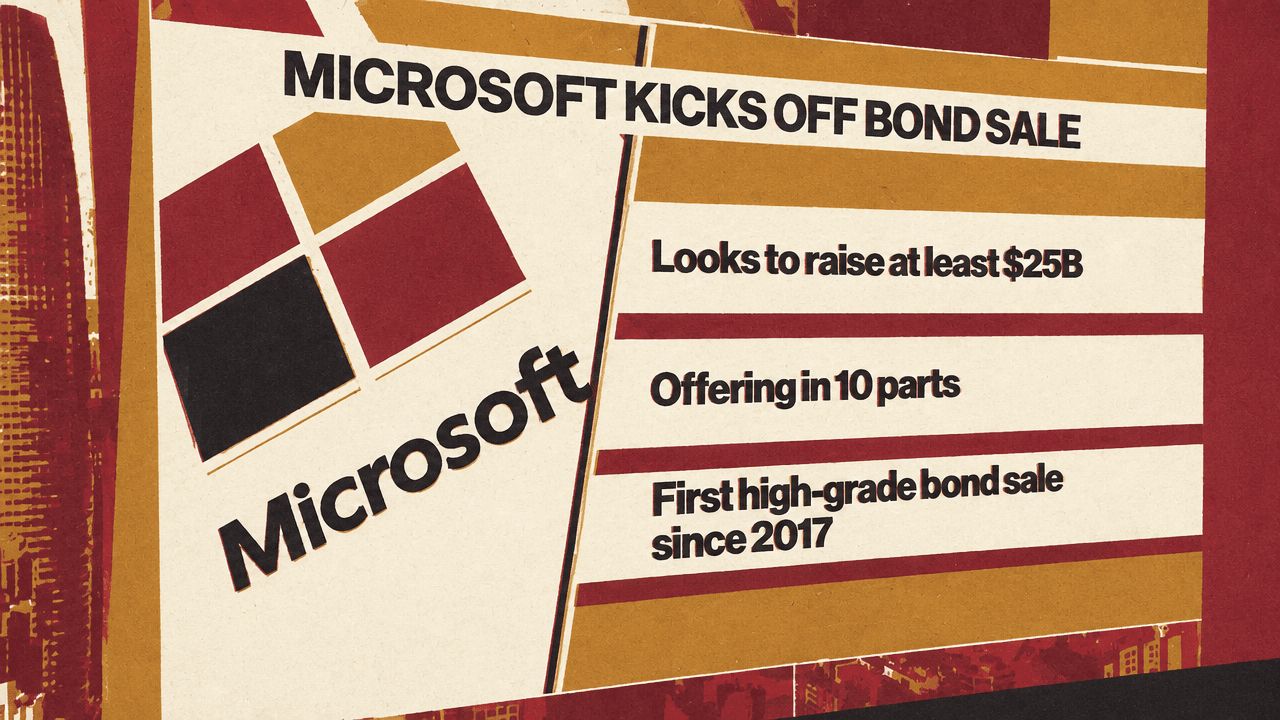
The bond sale signals capacity for more AI investment
Microsoft is looking to raise at least $25 billion in its first broad U.S. bond deal since 2017. The on-screen bond-sale graphic says the offering is divided into 10 parts. Bloomberg Intelligence senior credit analyst Robert Schiffman reads the move as another sign that Microsoft’s AI capital spending is still climbing—and that the broader hyperscaler spending cycle has yet to peak.


Schiffman’s reasoning starts with Microsoft’s borrowing capacity. He described the company as having a AAA balance sheet and said its rating is higher than the U.S. government’s. He said Microsoft has less debt than its peers, leaving room to borrow while continuing to fund capital spending and return cash to shareholders. The bond sale, in this view, is not evidence that Microsoft has run out of ways to fund investment; it shows the company can use its credit standing as spending continues.
He contrasted Microsoft with Meta, Alphabet, SpaceX and Oracle, which he said are issuing equity. Microsoft, by comparison, is still buying back stock. Schiffman said that combination of lower debt, stronger-looking free cash flow relative to peers, and continued capacity to spend helps explain why Microsoft’s stock and credit are performing better. He added that demand for the bonds could be so strong the company could issue $100 billion if it wanted to. That was his assessment of potential investor demand, not the size of the announced offering.
Why have a AAA balance sheet if you're not going to use it?
The point is that Microsoft can add debt without, in Schiffman’s account, giving up its ability to invest or return money to shareholders. He tied that financial room directly to the prospect of continued capital spending, while the on-screen Bloomberg Intelligence note described the bond deal as reinforcing the view that AI capex is still climbing.
Cash on hand does not settle the financing choice
When Ed Ludlow asked why Microsoft would borrow while keeping cash on its balance sheet, Schiffman did not frame the deal as a response to an immediate cash shortage. He said Microsoft has roughly $60 billion in cash, compared with about $240 billion for Alphabet at the end of the quarter, and noted that Microsoft had not been borrowing. His stated rationale was financial flexibility: “You borrow cash when you can, not when you have to.”


Schiffman also pointed to the relative cost of financing. He said Microsoft’s weighted average cost of debt was still close to zero, while its cost of equity was around 14%. On that basis, he said the company could borrow and return money to shareholders, making use of the difference between those costs. This is distinct from saying the company needs the proceeds to fund a particular investment: Schiffman described borrowing as an available option that can support capital spending and shareholder returns, not as evidence that Microsoft lacks cash.
Ludlow highlighted Microsoft’s unusually strong credit standing, noting its AAA ratings from Moody’s and S&P and comparing them with the U.S. government’s lower ratings. Schiffman’s broader argument was that Microsoft’s balance sheet gives it room to choose among financing and capital-allocation options. The debt sale could increase that flexibility while the company continues buying back stock, rather than requiring it to choose between borrowing and shareholder returns.
A large corporate deal can redirect demand from Treasuries
Ludlow connected the bond announcement to movements in U.S. Treasuries and asked whether a large supply of corporate debt would force investors to choose between corporate bonds and government debt. Schiffman described two related mechanisms. Investors may choose Microsoft debt over Treasuries, particularly farther along the maturity curve, if the corporate bond offers a yield pickup of about 120 basis points. And when investors buy corporate credit, he said, they sell Treasuries to hedge those positions, which can put pressure on Treasuries.
The on-screen chart displayed the intraday U.S. 10-year yield, including a reading of 4.9844 and a change of -0.0331. Those figures alone do not establish that Microsoft’s bond sale caused a particular Treasury move; Schiffman’s explanation was about how demand for corporate credit and hedging can affect Treasury trading.
He called highly rated hyperscalers the “Mount Rushmore of credit,” describing them as alternatives to traditional government debt, particularly in a rising-rate environment. His point was not simply that a bond sale adds supply. A highly rated company can draw investors who might otherwise buy Treasuries, and hedging those corporate positions can prompt Treasury sales as well. Together, those channels help explain why a single large corporate offering can matter to the government-bond market.