Marvell Weighs an $83 Billion Lumentum Deal as Optics Supply Tightens


Bloomberg’s Ryan Gould reported that Marvell Technology is in advanced talks to acquire Lumentum Holdings, a maker of optical components for data centers, in a deal that could make Lumentum a substantial part of Marvell. Gould’s case for the fit is that optics are becoming essential to moving signals between servers as data-center demand grows, and Marvell has said it wants to expand in the field. But with Lumentum valued at about $83 billion and Marvell holding less than $4 billion in cash, how the companies could finance a deal remains unresolved.
Optics are becoming part of the data-center capacity constraint
Ryan Gould reported that Marvell Technology was in advanced, still-ongoing talks to acquire Lumentum Holdings, a maker of optical technology for data centers. Lumentum had been valued at about $83 billion until recently, Gould said. The report described a proposed purchase large enough to make the supplier a major part of Marvell, rather than a small addition to its existing business.


The strategic fit is in the work optics do inside a data center. Ed Ludlow described Lumentum’s lasers, optical components and transceivers as equipment that takes an electronic signal from a GPU, converts it into light and moves it between servers. Gould said those components are becoming more important as Nvidia expands its chip business and Marvell develops custom chips of its own. In his account, they are not peripheral accessories: a data center cannot run without them.
That makes the acquisition a move beyond adding another chip business. Marvell would be seeking a larger position in the optical equipment needed to connect computing capacity inside data centers. Gould said the company had made clear under CEO Matt Murphy that it wanted to expand further into optical technology. Buying Lumentum would substantially increase its presence in that area.
Demand strengthens the case, but also sharpens the question of supply. Gould cited Lumentum’s CEO as saying the company was sold out through 2029 and probably would not be able to meet roughly 70% of its order backlog.
Gould described the proposed acquisition as a referendum on the AI trade: demand for the infrastructure supporting data centers is extending beyond processors to the components that move signals among servers. The reported supply limits help explain why Marvell might seek to buy a supplier outright. They do not, by themselves, resolve whether it can afford a transaction of this size.
A company this large would force a financing question
Lumentum could represent something like 20% or 30% of Marvell’s market capitalization, Gould said. That scale was prompting questions from sell-side analysts about how Marvell could do the deal; he said Bloomberg was asking the same questions.
Gould said that without a massive financing package, Marvell would probably need to use quite a bit of its stock. Both companies’ shares had risen during the year, he noted. That leaves a substantial stock component as a possibility, not a confirmed financing plan. The source did not specify the structure of any package or the terms under discussion.
Ed Ludlow noted that Marvell had less than $4 billion in cash on its balance sheet. That figure puts the financing question in sharper relief beside Lumentum’s roughly $83 billion market value, but the report did not establish how much cash Marvell would use or how it would combine cash, stock or other financing. The scale of the target makes those unanswered details central to assessing the proposal.


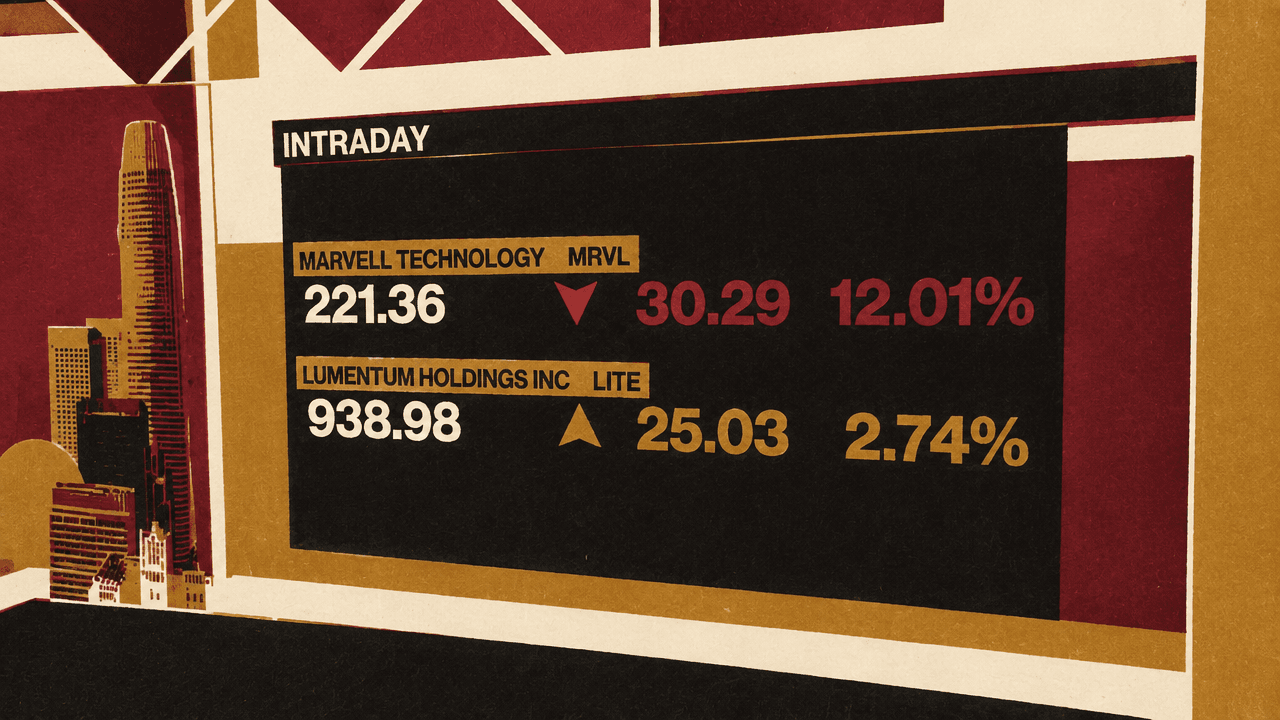
The market moved in opposite directions after the report: Bloomberg’s intraday graphic showed Marvell down 11.98% and Lumentum up 2.68% at the time displayed. Ludlow described Marvell as down about 12% and Lumentum up roughly 2% to 3%, while noting that the reaction may have been sharper when the story first broke.
Gould cautioned against reading Marvell’s decline as a direct verdict on the deal. He pointed to a broader Nasdaq sell-off and disappointing Google figures discussed earlier in the broadcast as other possible influences. In his view, those factors made it difficult to attribute the share move solely to investors disliking the acquisition, particularly given the fit between Marvell’s optical ambitions and Lumentum’s products.
Strategic fit does not settle whether the talks can produce a deal
The case for the purchase is specific: Marvell wants to expand in optical technology, and Lumentum makes components Gould described as crucial to data centers, in a market where its CEO says demand already exceeds what the company can supply. The obstacle is equally concrete. Lumentum is large relative to Marvell, and the available information leaves the financing approach unresolved.
Gould called the proposed transaction an audacious attempt at technology M&A in the current environment. He also wondered whether a deal like it might be possible under another administration, without presenting political timing as a settled barrier. The talks were still ongoing. Ludlow’s closing point returned to the practical question behind the market reaction: Marvell had less than $4 billion in cash, and many details about how it could complete a purchase of this scale remained unanswered.