AI Stock Leadership Shifts From Magnificent Seven to Memory and Chips


Bloomberg’s Ryan Vlastelica argues that the Magnificent Seven are no longer the market’s default AI trade after years of setting the direction for the S&P 500. Investor attention, he says, has shifted toward the current bottlenecks in AI infrastructure — especially memory, storage and semiconductors — while the largest platform companies face more scrutiny over heavy AI spending and uncertain returns.
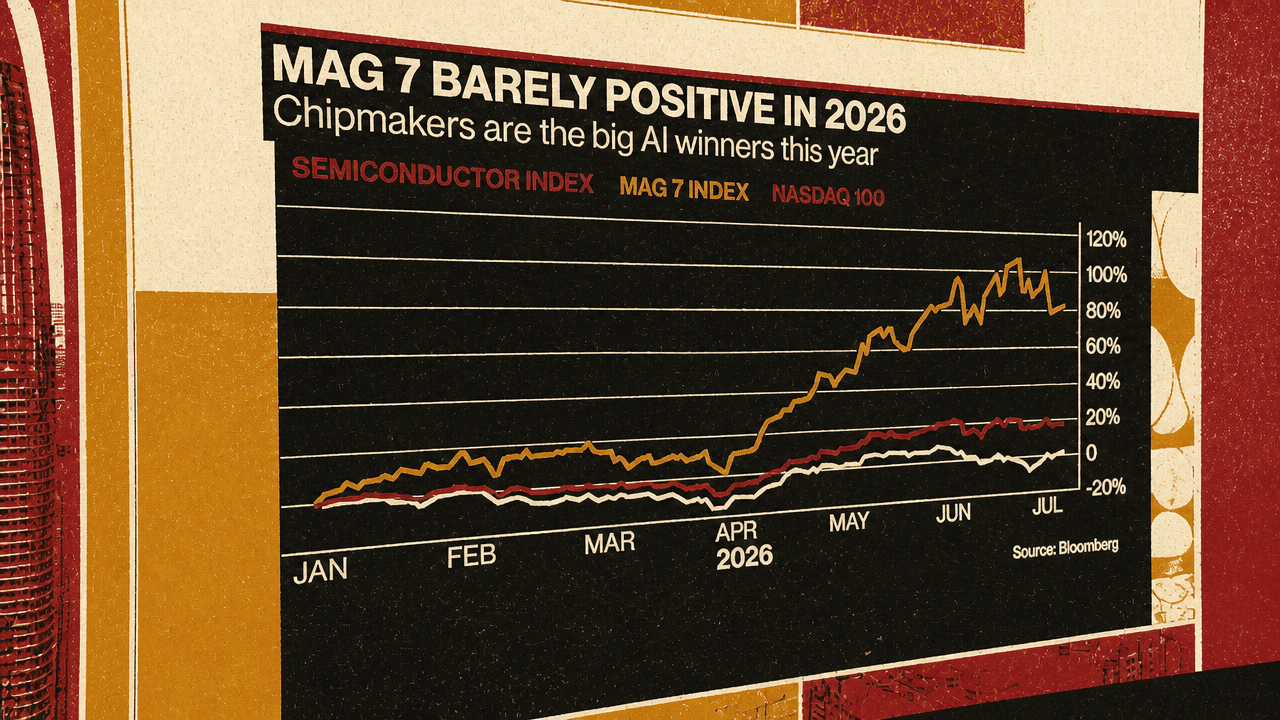
The AI trade has moved toward the bottleneck
Ryan Vlastelica described the Magnificent Seven as “something of an afterthought” in a market they used to lead. For years, the largest technology stocks in the group commanded investor attention and helped determine the direction of the broader market. The point now is not that AI has stopped mattering. It is that the market is no longer concentrating its attention on the same AI-linked platform companies.


The Mag 7 have become something of an afterthought within the market, following years where they were really the primary leaders.
The focus has moved to “where the current bottleneck is within AI infrastructure,” Vlastelica said. At the moment, he identified that bottleneck as memory and storage. Micron, SanDisk, and Western Digital were his examples of stocks that have seen “absolutely enormous gains” this year, while some of the former leadership names have struggled.
Bloomberg’s year-to-date chart framed the rotation directly. The chart, titled “MAG 7 BARELY POSITIVE IN 2026,” compared the Semiconductor Index, the Mag 7 Index, and the Nasdaq 100 through July. Its subtitle was blunt: “Chipmakers are the big AI winners this year.” The Semiconductor Index was shown far above both the Mag 7 Index and the Nasdaq 100, while the Mag 7 Index was only slightly positive.
That comparison narrows the current meaning of the AI trade in Vlastelica’s account. Investor attention has shifted from the largest platform names associated with AI — including Microsoft, Alphabet, Amazon, and Meta — toward the more constrained parts of the infrastructure buildout. For now, he placed memory and storage at the center of that shift.
Alphabet is holding up better, but the group is still lagging
Ed Ludlow asked whether there is differentiation inside the Magnificent Seven. Vlastelica said there is: Alphabet has “done pretty well this year” relative to the group, even though all of the Magnificent Seven stocks are underperforming the Nasdaq 100.


The case for Alphabet, as he described it, is broader than any single AI product. Optimism remains around Gemini, its AI model, but he also pointed to Alphabet’s chips business, YouTube, and Waymo as assets that appear to be “working in concert with each other.”
Microsoft is the contrast. Vlastelica said the stock is down more than 20% and had just posted what he believed was its worst monthly performance since December 2000, placing the move in the context of the dot-com era. He described greater skepticism around Microsoft than around Alphabet.
That skepticism sits inside a broader question about AI spending. The large technology companies are spending “very aggressively” on AI, and so far the return looks like “a mixed bag.” The questions he identified were direct: what kind of return are companies getting from the spending, what is the timeline for that return, and what is the effect on cash flow and cash balances while the spending continues?
Those questions matter more because some companies are raising equity or tapping debt markets. That has produced more skittishness, Vlastelica said, even as long-term optimism remains that AI infrastructure and capital expenditure will eventually pay off.
Chip stocks can be under pressure and still lead the year
Chip stocks can face short-term pressure while still leading year-to-date. Vlastelica said semiconductors are coming off their best quarterly gain ever and remain “extremely strong” for the year, even though the trade has become highly volatile.
The volatility is especially visible relative to software stocks. He described a recent push-pull dynamic in loose terms: “Basically if one of them is rising, the other one is falling and vice versa.” The point was the elevated volatility around chips and their contrast with software during this stretch.
The intraday examples underscored the magnitude of moves in the memory and storage names he had identified. Bloomberg showed SanDisk up 10.17% intraday and Micron up 7.65% intraday, illustrating the sharp price action accompanying the shift in attention.
| Stock | Intraday move shown |
|---|---|
| SanDisk | +10.17% |
| Micron | +7.65% |
The result is a more selective version of the AI trade. The Magnificent Seven still matter, but they are not being treated as the only or primary way to express AI exposure in the market. Investors are distinguishing between companies spending heavily to build AI capacity and companies currently supplying the constrained pieces of that buildout.