Nvidia’s Board Weighs Huang’s Return Against Search for Outside CEO


Jensen Huang said he would return as Nvidia’s CEO if the board decided it was in the company’s and stakeholders’ interests, making his offer conditional on directors’ judgment. In a statement, he cited calls from employees, investors, business partners and customers for his return. Bloomberg’s Mike Shepard reported that Nvidia was proceeding with a search for an outside candidate and was not then considering bringing Huang back, leaving the board’s reported succession plans at odds with the public appeals.
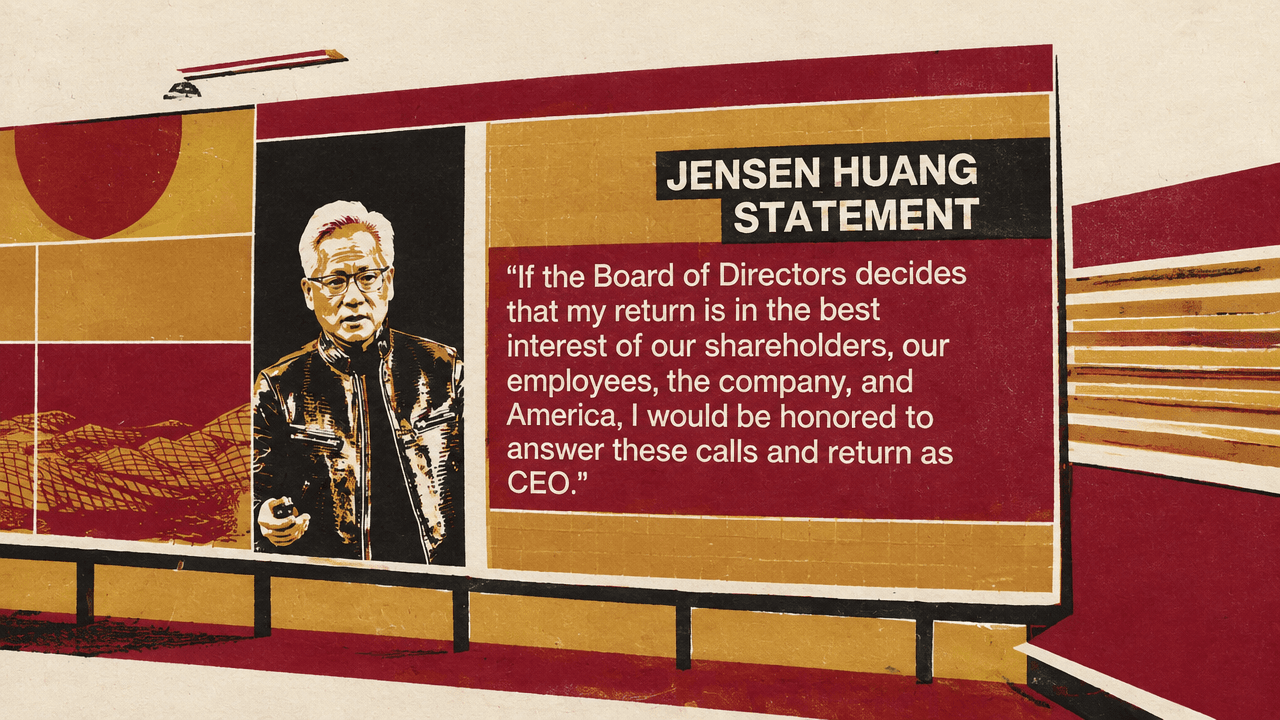
Huang’s offer puts the decision back on Nvidia’s board
Jensen Huang said he would return as Nvidia’s chief executive if the board decided his return was in the interests of the company and its stakeholders. His statement made the offer conditional, not a declaration that he was seeking the job regardless of the board’s view.
“If the Board of Directors decides that my return is in the best interest of our shareholders, our employees, the company, and America, I would be honored to answer these calls and return as CEO,” Huang said. The statement also acknowledged calls from employees, investors, business partners and customers for him to return. Bloomberg’s Michael Shepard reported that Huang regretted his actions and said he would cooperate with the board’s inquiry and take whatever steps might come next.
Shepard said this was the first time Huang had spoken directly about the push for reinstatement. He described the statement as putting pressure on directors while they search for a replacement CEO. Huang was also, in Shepard’s reading, directing an appeal toward shareholders: if they want him back, they could make that view known to the board.
The timing brought the question into sharper focus. Huang’s statement followed President Donald Trump’s endorsement of the idea that he should return. But support from the president did not resolve what the board would do, or what other senior officials thought Nvidia needed.
The public endorsements run against the reported search for an outsider
Ed Ludlow said the board’s position, based on Bloomberg’s reporting and other reports, appeared firm: Nvidia was proceeding to look for external candidates and was not then considering Huang’s return. Shepard said Bloomberg had checked with the company the previous day, after Trump’s endorsement, and was told Nvidia was not looking to bring Huang back.
Treasury Secretary Scott Bessent had taken a different position from Trump. Shepard said Bessent called for a culture change and a “dramatic shakeup,” and argued that Nvidia should look outside its ranks for leadership. In Shepard’s account, an outside hire would bring a culture change whichever candidate the board chose.
That creates a conflict between the public calls for Huang’s reinstatement and the reported direction of the succession search. Huang’s statement leaves the decision with the board, while also making the calls for his return more visible. Shepard said the board would have to contend not only with the CEO search but also with governance issues and its own inquiry.
There was also an internal constituency for Huang, Shepard said. Many Nvidia employees, he reported, would welcome his return because they had looked to him as a leader and because the chipmaker’s advance in AI had made them rich. That support sits alongside the case Bessent made for change, rather than settling the question of which kind of leadership the board should choose.
The inquiry and the succession calendar converge in December
The board’s decision is unfolding alongside scrutiny of the circumstances around Huang’s departure. Shepard said Huang was scheduled to appear before Congress on December 1. He would face questions about his affair with Alice Wang, a Megaspeed executive, which Shepard said led to his downfall as Nvidia CEO, as well as questions about security protocols. Shepard said the board was investigating security protocols itself and was trying to digest those issues.
Ludlow said Huang officially parted ways with the company on November 12. Nvidia was also due to hold its Washington, D.C., edition of the GTC conference from November 30 to December 3. The conference dates put the event across the same period as Huang’s scheduled congressional appearance, with the board’s search and inquiry still in view.
Nvidia’s earnings report was due after the market close on the day of the broadcast. Ludlow identified Colette Kress, Nvidia’s CFO for the previous 13 years and interim CEO, as the executive presiding over the report. The earnings timing made the market move part of the immediate backdrop to Huang’s statement, but it did not answer the board’s longer-running question about who would lead the company.
The statement coincided with a relief in losses, not a gain
The market response was a change in the scale of Nvidia’s decline, not a move into positive territory. Ludlow said Nvidia had been one of the biggest point drags on the Nasdaq 100. After Huang’s statement appeared, the index pared some of its losses; Bloomberg’s graphics also showed Nvidia shares paring losses. The displayed readings changed during the broadcast: one intraday graphic showed the Nasdaq 100 at 26,871.76 and Nvidia at $154.64, while a later sidebar showed the Nasdaq at 26,819 and Nvidia at $154.00 as both were reported higher relative to earlier declines.
By the close of the discussion, Ludlow said Nvidia shares were still down about 1.7%, after having pared their decline. The market reaction therefore showed a partial recovery in the stock and some relief for the index, not evidence that the succession question had been resolved. The board’s reported search for an outside candidate remained in tension with Huang’s conditional offer, the calls for his return and the governance questions still under examination.