HPE Forecasts 31% Revenue Growth as Supply Limits Order Conversion
Hewlett Packard Enterprise forecast 31% revenue growth at the midpoint for 2027, but supply constraints are limiting how quickly it can convert customer orders into sales. Chief Executive Antonio Neri said demand remains strong, free cash flow should grow 20% and customers did not change their behavior during the leadership upheaval at Nvidia.
Growth guidance is strong; supply limits what HPE can deliver
Hewlett Packard Enterprise forecast substantial growth for 2027, even as the company’s near-term revenue conversion remains constrained by supply. That gap is central to the investor question: HPE is describing strong demand and a larger year ahead, but it cannot yet turn all of its orders into revenue.
CEO Antonio Neri Antonio Neri said the 2027 outlook calls for revenue growth of 31% at the midpoint, operating-profit growth of 26%, and non-GAAP earnings-per-share growth of 31%. He expects free cash flow to grow 20% from what he described as a large 2026 base. HPE has committed to return 75% of free cash flow to shareholders through dividends and share buybacks; Neri said the company is increasing its dividend by 90%.
The networking figures make the supply gap concrete. Neri said networking orders grew 56%, while HPE plans networking revenue growth of 20% in 2027. He attributed the difference to limited supply: supplier long-term agreements should help HPE convert more revenue next year, but he said conversion would remain well below order bookings.
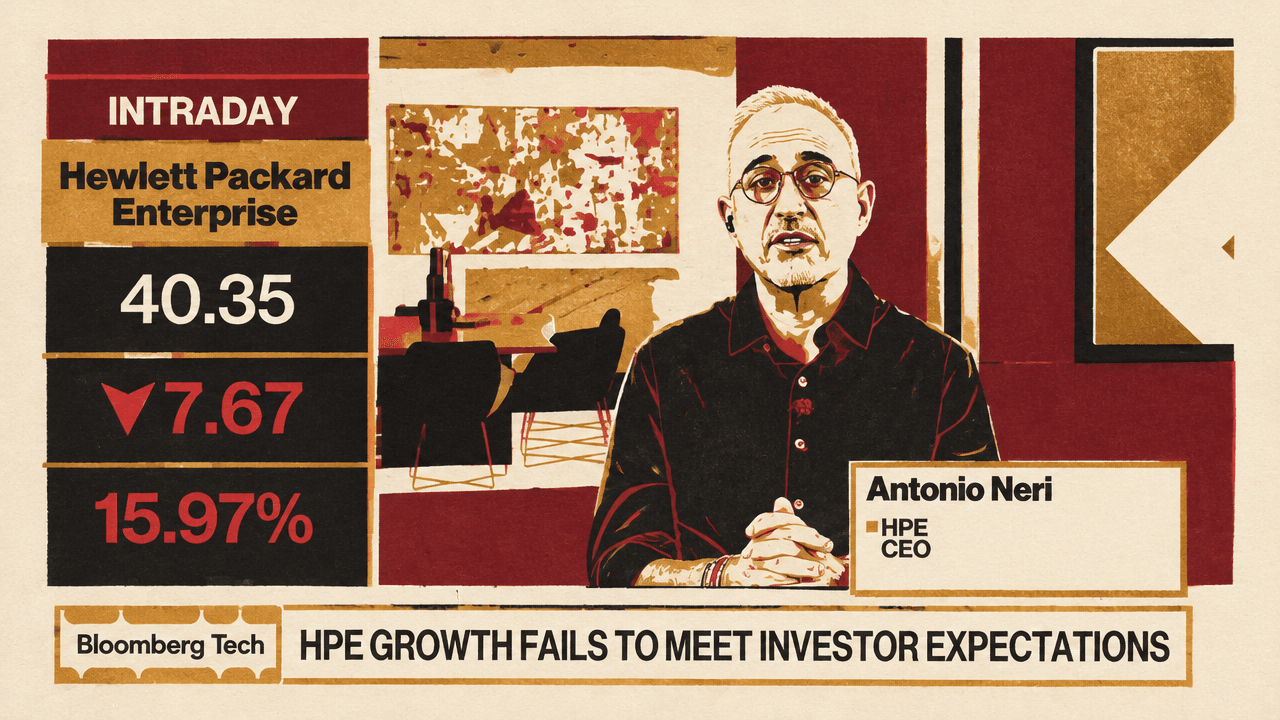
Margins are a separate concern. In the Bloomberg chart, HPE shares were shown down about 15.6% intraday, alongside the headline “HPE SLIDES ON AI SERVER MARGIN CONCERNS.” Neri said the margin outlook depends on business mix. In cloud AI, he described a balance between AI growth and moderating costs. In networking, after completing the Juniper integration, he expects margins to rise from the low 20s to the mid-to-high 20s.
Neri says demand held through the Nvidia leadership episode
Asked whether customers changed their behavior during the 11-day period when Jensen Huang left Nvidia and returned, Neri said they did not. He said demand had not changed for Nvidia-based systems, AMD Helios, or inference using CPUs. He also said customers were seeking flexibility and choice across solutions.
As evidence of continuing work with Nvidia, Neri pointed to an AI factory the companies had recently opened in Europe. European customers can use it to test sovereign models and run proofs of concept as they scale deployments, he said. HPE’s private-cloud AI offering combines Nvidia software and GPUs with HPE servers, storage and GreenLake.
Neri said he did not speak with Nvidia during the leadership episode, explaining that HPE did not want to be part of the process. He described the companies’ relationship as decades long, including their work on large supercomputers that are still operating, and said their focus is on solving customer problems together.
A broader compute ecosystem gives customers more options
Neri expects the AI infrastructure market to become more diverse over time. He compared the cycle, initially driven by Nvidia GPUs, with earlier periods in which Intel and AMD both served the CPU market. He expects AMD, other third-party accelerators and chips developed by hyperscalers to contribute to that broader ecosystem.
AMD Helios illustrates how HPE is approaching that mix. Neri described it as a system with 72 AMD GPUs connected by six trays of HPE Juniper networking products. He said the design is intended to deliver higher performance and lower cost per token. HPE and AMD have announced a first customer win with neocloud provider Vultr.
Neri also addressed investor concerns about HPE’s exposure to neoclouds and China. He said HPE had not used its financing-services business to finance any neocloud, and therefore had no exposure of that kind. He said the company had divested and closed its H3C business in China a few months earlier. He framed HPE’s broader position as offering customers choice across different technologies.
Modernization and inference underpin Neri’s demand outlook
Neri cited enterprise infrastructure modernization as one source of demand, including efforts to address cybersecurity challenges and the work involved in applying patches. He also expects growth in agentic AI and inference across distributed environments, including on-premises systems. Some customers are building their own AI factories for compliance, data and security reasons.
He said HPE expects inference to account for 80% of AI demand by the end of the decade. Neri argued that HPE can serve that demand through its portfolio, GreenLake cloud offering and networking products following the Juniper integration. That outlook sits alongside the nearer-term constraint: in his account, customer demand and order bookings are ahead of the supply HPE can currently convert into revenue.