HPE Says Contracted Supply Capacity Supports Raised AI Outlook

HPE Chief Executive Antonio Neri says the company’s raised outlook is based on demand that continues to exceed available supply, backed by multiyear supplier agreements intended to support planned deliveries. He points to an expanded Oracle arrangement for gigawatt-scale AI infrastructure, including HPE Juniper networking gear, and a separate multibillion-dollar hyperscaler contract for servers used in internal AI inference. Neri argues that these deals, alongside growing enterprise AI adoption, support HPE’s forecast despite an initial negative market reaction to its results.
HPE says demand exceeds supply, but contracted capacity supports its forecast
HPE’s outlook rests on a straightforward commercial claim: orders are arriving faster than the company can turn them into revenue, but it has secured enough supplier capacity to deliver against the targets it has set. Antonio Neri said HPE raised its 2026 outlook again and lifted its 2027 guidance because of demand across networking, traditional servers, and AI infrastructure, along with execution and expanded profitability.
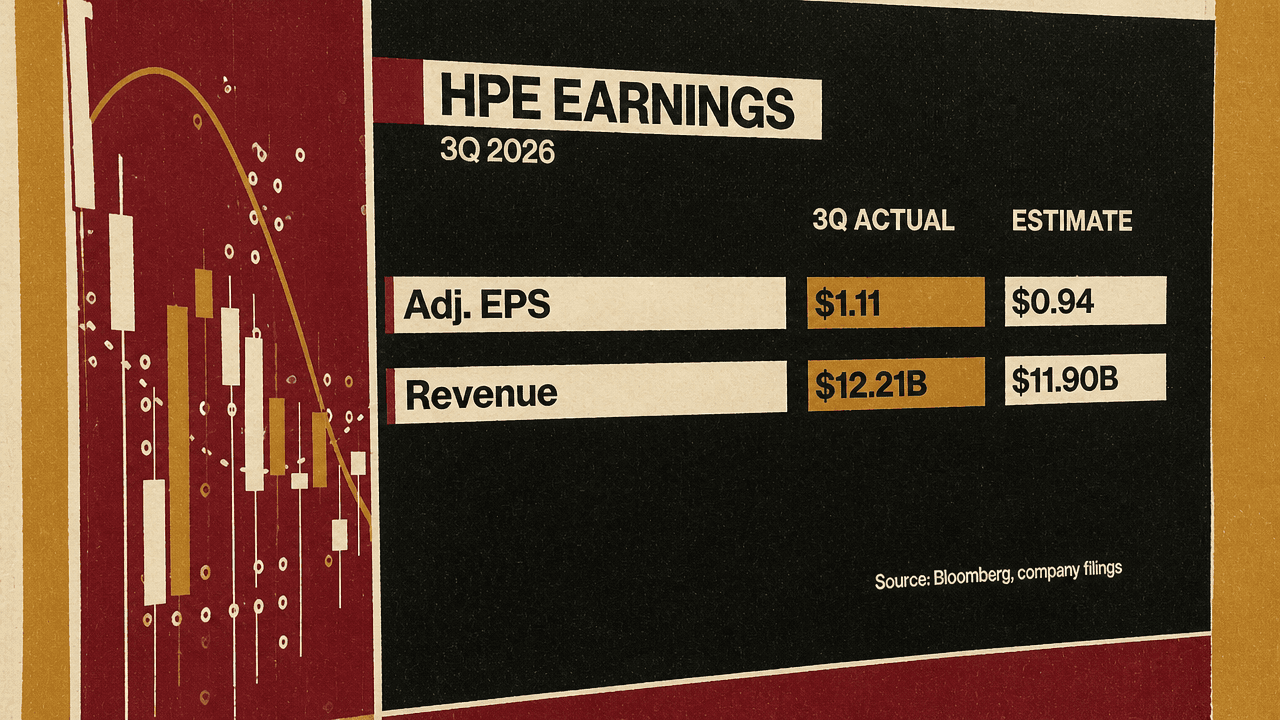
Bloomberg’s on-screen earnings table, citing Bloomberg and company filings, showed adjusted earnings per share of $1.11 against a $0.94 estimate, and revenue of $12.21 billion against an $11.90 billion estimate.
| Measure | Third-quarter actual | Estimate |
|---|---|---|
| Adjusted EPS | $1.11 | $0.94 |
| Revenue | $12.21B | $11.90B |
The market nevertheless reacted negatively at first. HPE shares were down roughly 6% during the discussion, after at one point falling as much as 12%; on-screen market data also showed the stock up about 102% year to date and 113% over one year. Neri characterized the decline as an initial investor reaction to results and guidance that may take time to absorb.
The gap between demand and recognized revenue is particularly clear in networking, he said. HPE’s networking revenue grew 10% in the third quarter, while order demand grew 36%—about three and a half times as fast. Neri said demand “significantly outpaced” revenue.
But the reality is that demand will continue to outpace supply.
That constraint does not, in Neri’s account, undermine the forecast. He said HPE builds guidance around numbers it expects to achieve and beat, factoring in its supply-chain ability to deliver. For the fourth quarter, HPE expects revenue to rise by nearly $2 billion quarter over quarter; from that larger base, Neri said, it expects 14% to 17% growth. Multiyear agreements with suppliers are intended to provide the capacity required for that plan, while HPE works with customers to coordinate when supply becomes available and when equipment can be delivered.
Oracle warrants tie their value to infrastructure deployment
Neri described an expanded strategic arrangement with Oracle as one of two announcements that should matter to HPE’s future demand. The partnership is intended to let HPE build gigawatt-scale infrastructure as Oracle expands its AI footprint.
The buildout will include HPE Juniper products, Neri said, citing QFX scale-out switches and PTX scale-across routers. He presented the deployment as evidence of HPE’s ability to bring current networking technology to market quickly. It does not yet account for HPE’s unreleased Helios stack, which he said is expected to include scale-up switches.
The arrangement gives Oracle warrants, leading Ludlow to ask whether it amounted to circular financing. Neri rejected that characterization. The warrants scale with the amount of infrastructure HPE deploys: as the deployment grows, so do the warrants. He described the structure as a mechanism that gives both companies an incentive to grow the infrastructure footprint together.
It’s not this circular financing you’re referring to, but it’s about incentives on both sides to grow together.
An unnamed hyperscaler is buying servers for its own inference
The second announcement is a multibillion-dollar contract with an unnamed hyperscaler. Neri would not identify the customer, but clarified that it is a traditional-server contract.
The hyperscaler will use the servers internally for its own AI inference needs, he said. Neri asked viewers to think of the customer, in this transaction, as an enterprise using HPE servers for its own requirements. He presented the deal as a proof point that HPE can serve different kinds of customers and use cases.
The two deals point to distinct sources of AI-related demand in HPE’s account. Oracle is expanding an AI footprint through a planned gigawatt-scale infrastructure deployment that includes HPE Juniper networking products. The unnamed hyperscaler is purchasing traditional servers for internal inference. Neri also cited what he called “huge growth” in enterprise adoption of AI, arguing that the breadth of demand supports the durability behind HPE’s raised outlook.