Tech’s 30% Valuation Reset Has Historically Favored Further Gains


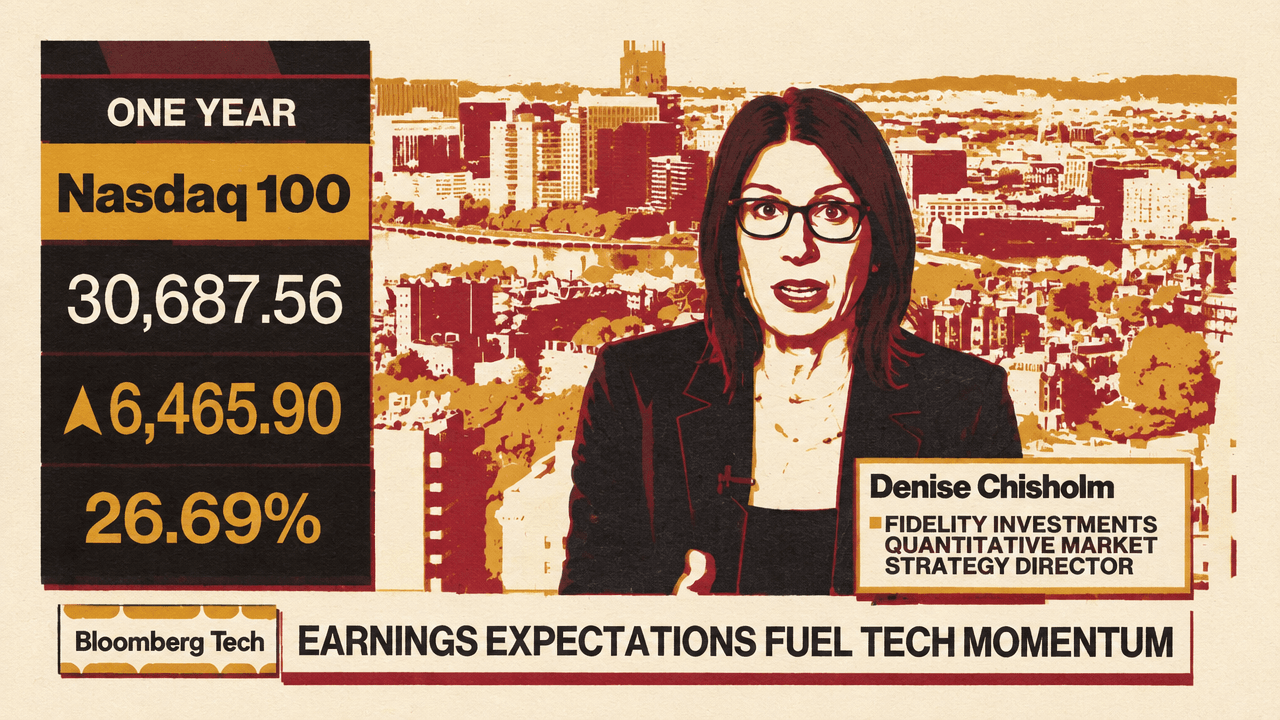
Fidelity’s Denise Chisholm argues that a rare valuation reset has improved the outlook for technology stocks, even as investors worry that AI and other tech spending may slow. The sector’s multiple has contracted about 30% while earnings expectations continue to rise; Chisholm says history suggests such a correction often leaves room for further gains, and that slower technology investment has not usually meant contraction.
A sharp rerating may have priced in the main fear
Denise Chisholm says technology stocks have undergone a valuation reset rare enough to change the sector’s risk-reward profile. Since 1990, a 30% contraction in the sector’s valuation multiple has occurred less than 5% of the time. Tech now trades at a 10% premium to the S&P 500, near the bottom quartile of its historical range since the 1960s.


Chisholm’s case is not that the sector is cheap in an absolute sense, or that earnings cannot fall. It is that a deep multiple correction has historically tended to improve the odds of subsequent outperformance. The pattern has held even when earnings declined, she says, though the odds are stronger when earnings keep growing.
The central question is whether today’s reset reflects peak earnings. Historically, Chisholm says, earnings continued to grow after a multiple correction 77% of the time.
When earnings kept growing, she says, the odds of outperformance were strong. Even when earnings fell, she puts those odds in the 70th-percentile range. That history bears on concerns about excessive capital investment, whether the returns will justify the spending, and whether weaker free cash flow will persist. Chisholm’s interpretation is that a substantial amount of that bad news may already be reflected in prices.
Tech is unusually discounted against its recent norm
Ed Ludlow pointed to a Bloomberg chart comparing forward price-to-earnings ratios across S&P 500 sectors with their five-year norms. The weekly-data Z-score puts information technology at -1.49, the lowest reading in the table. Health care is at 1.07, the highest; the S&P 500 overall is at -0.42.


The comparison is relative, not a claim that tech has the lowest valuation in absolute terms. Ludlow framed the question around whether this unusual derating, alongside strong fundamentals and forward earnings expectations, supports further outperformance.
Chisholm said the risk-reward is skewed in tech’s favor. In her view, the valuation correction is a more meaningful signal than short-term noise: earnings have often continued to grow after such corrections, while lower valuations have tended to reflect a fair amount of bad news. She says the broader US market can also climb “the wall of worry,” but sees technology as more likely to lead, given its valuation data and the consistency of earnings over time.
A slower pace of tech investment has not usually meant contraction
The slowdown in technology capital spending is already visible in government accounts, Chisholm says; the question is what that easing means for stocks and the economy. The June national income and product accounts showed a slowdown in the rate of change, she says, and she expects further deceleration. The government data also break out data-center investment back to 2020.
Investors may read that slower growth in spending as a warning. Chisholm argues that it has not historically been enough, by itself, to derail technology stocks. Because technology spending has followed a long-term upward trend, most slowdowns have not ended in contraction. She says stocks have been more likely to outperform when a slowdown begins from a stronger starting point.
Chisholm traces the longer-term rise in technology capex from about 3% of GDP in the 1960s to more than 7% today. She acknowledges that this leaves the US economy more dependent on technology investment. By contrast, she says residential investment “kind of got us into the crosshairs” in the financial crisis. She identifies four contractions in technology capex: the financial crisis, the dot-com bubble, and two recessions in the 1970s.
A slowdown therefore need not mean that the investment cycle has broken. Chisholm says that when technology capex slows, capex and GDP growth in other sectors have usually accelerated—not every time, but often enough that technology investment may signal future growth as well as create exposure to weaker spending.