A SpaceX–Tesla Tie-Up Would Unite Production From Chips to AI


Chad Anderson, an early SpaceX investor and CEO of Space Capital, says a potential merger with Tesla would bring together companies already converging operationally, creating a vertically integrated business that could span chip fabrication through AI services. He compares SpaceX’s role in building infrastructure for intelligence with the industrial giants of the early 20th century, but says the growth case depends on Starship becoming reusable: more launch capacity is needed to expand connectivity and AI computing in orbit.

The proposed tie-up is part of a larger production system
Chad Anderson said he would support a potential SpaceX–Tesla merger because, in his view, the companies are already converging operationally. His case for the tie-up rests on what the combined company could span: “from chip fabrication all the way through intelligence.” He said that would make it a company without a close comparison in today’s markets.

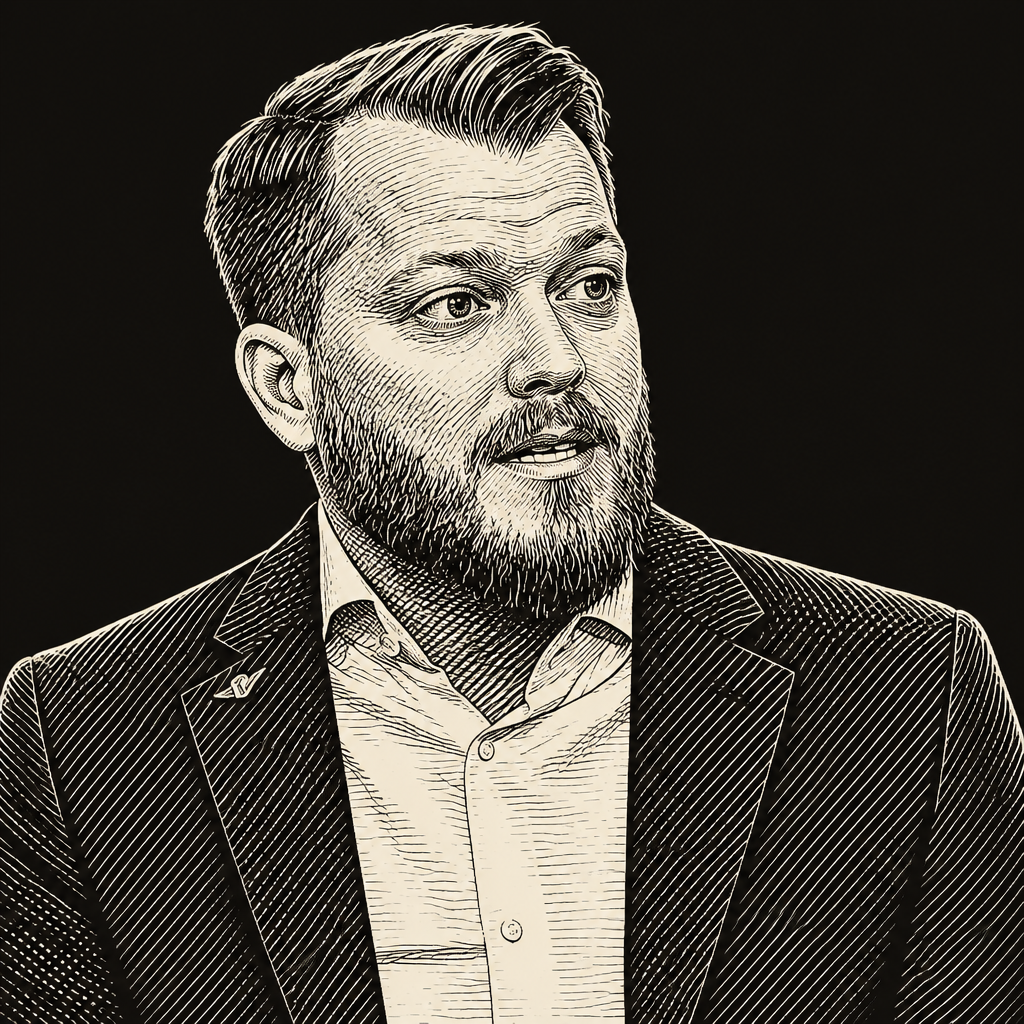
Anderson compared that breadth with the vertically integrated industrial giants of the early 20th century, naming Carnegie Steel and Ford. The comparison is about control of production: those companies owned the means to make industrial goods; SpaceX, he said, is building the means of production for intelligence. His point was not simply that the companies have businesses in different industries, but that bringing production and the systems that use it together could create a company with unusual control over how its services are built and delivered.
SpaceX is building the means of production for intelligence.
That case depends on a broad definition of the space business. Ed Ludlow pressed Anderson on whether renting cloud-computing capacity to third parties really counts as space. Anderson said it does, placing that activity within a larger infrastructure system whose development connects space and ground. In his account, launch is one access point in that system: it puts infrastructure in orbit, where it can support services on Earth and, potentially, new capabilities in orbit.


He pointed to GPS as a precedent. Space infrastructure had been operating for decades, he said, but commercial receivers built by Trimble using intellectual property from HP made the signal accessible to technology companies, which built location-based services on top of it. Anderson said the modern economy runs on GPS. He sees a similar pattern emerging in connectivity and other areas: legacy systems are being upgraded while new layers of infrastructure are built. He described this as an early stage in a multi-decade infrastructure cycle, with hundreds of billions of dollars of infrastructure tied to economic growth and national security. Launch, in this framing, matters because it enables the infrastructure layer; the cloud and connectivity businesses are ways that infrastructure can be used.
AI leads revenue, while Starlink and launch remain part of the growth case
Bloomberg’s earnings graphics showed third-quarter revenue of $1.77 billion for Space, $5.25 billion for Connectivity and $7.56 billion for AI. Each figure was displayed alongside a positive comparison with estimates: 23.7% for Space, 8.0% for Connectivity and 19.9% for AI. Ludlow said AI had become the largest revenue line, while connectivity, principally Starlink, remained the largest by operating income. The figures therefore show a change in which segment leads revenue, not that connectivity has ceased to matter to the business.
Ludlow also pointed to uneven results in the earnings metrics. The table showed adjusted diluted EPS of $0.35, 138% above estimate, and revenue of $14.6 billion, 13% above. Rocket launches totaled 35, 14% below estimate, while Starlink subscribers reached 13.6 million, 4% below. Capital expenditures appeared as “-$19.6B,” with the graphic displaying a comparison of “-0.05%.” The segment-revenue table and the broader metrics offered different views of the quarter: AI led segment revenue, while launch count and subscriber numbers missed estimates.
Anderson’s reading was that SpaceX remains a growth story despite valuation questions he recalled hearing. He described the AI business as inflecting toward profitability, cited strong forward guidance, and said that growth did not require an equity raise. Ludlow noted that SpaceX president Gwynne Shotwell had said the company would continue borrowing.
For Starlink, Anderson put more weight on revenue than on the consumer subscriber miss. He said revenue was up 70% year over year, which he interpreted as evidence that enterprise and government customers were adopting the service more, and that revenue per customer was increasing. That interpretation links the subscriber miss to a different measure of growth: the number of customers was below expectations, but Anderson said revenue growth indicated greater adoption among higher-value customers.
He also pointed to Starship as a potential driver of further growth. More launch capacity, he argued, could enable more connectivity and AI compute in orbit, as well as support longer-term ambitions that include going to the Moon for NASA and going to Mars. In that account, the current mix of revenue and the future infrastructure thesis are connected: the existing businesses generate revenue, while Starship could make it possible to put more of the infrastructure they depend on into orbit.
The growth forecasts depend on Starship becoming reusable
Ludlow cited a target of $500 billion to $1 trillion in ARR by the following December and first-quarter 2027 guidance of $33 billion to $37 billion. He asked whether Starship’s launch cadence and reusability were decisive for the company’s future business lines.
Chad Anderson agreed that Starship is central to those forecasts. He pointed to Shotwell’s stated target of achieving full reusability in the first part of the next year, with both the booster and the ship landing. He said the forecasts depend on Starship’s success: launching enough satellites, fulfilling billions of dollars in NASA contracts, and moving more infrastructure into orbit all rely on it.
That dependency brings Anderson’s broad infrastructure thesis back to a specific operational constraint. The potential expansion of connectivity and AI compute in orbit requires the ability to place more equipment there; the NASA contracts he cited also depend on Starship. Reusability and launch cadence are therefore not separate from the revenue outlook in his account. They are conditions for delivering the capacity the forecasts assume.
Anderson described the target as a major engineering undertaking and said other companies had tried, without replicating what SpaceX had done. He emphasized that the effort was being carried out in public, with launches live-streamed. The merger thesis and the revenue outlook both depend on infrastructure still to be built—and, in particular, on Starship delivering the capacity to put more of it into orbit.