Crypto Industry Pursues Agency Rules After Senate Blocks Clarity Act


Blockchain Association CEO Summer Mersinger says the Senate’s procedural block of the Digital Asset Market Clarity Act should not stop the crypto industry from seeking both immediate regulatory protections and legislation. She argues that the SEC and CFTC can begin building a framework to prevent failures such as FTX, but only a statute assigning authority and setting rules can give the sector durable certainty across administrations.
Build protections now, while pursuing a law that can last
Summer Mersinger’s response to the Senate’s procedural block is not to choose between regulation and legislation. The Blockchain Association wants the Digital Asset Market Clarity Act to pass, she said, but it cannot wait for Congress before addressing protections that digital-asset users lack today. Its approach is to work with the SEC and the CFTC on a regulatory framework while continuing to press Congress for statutory clarity.


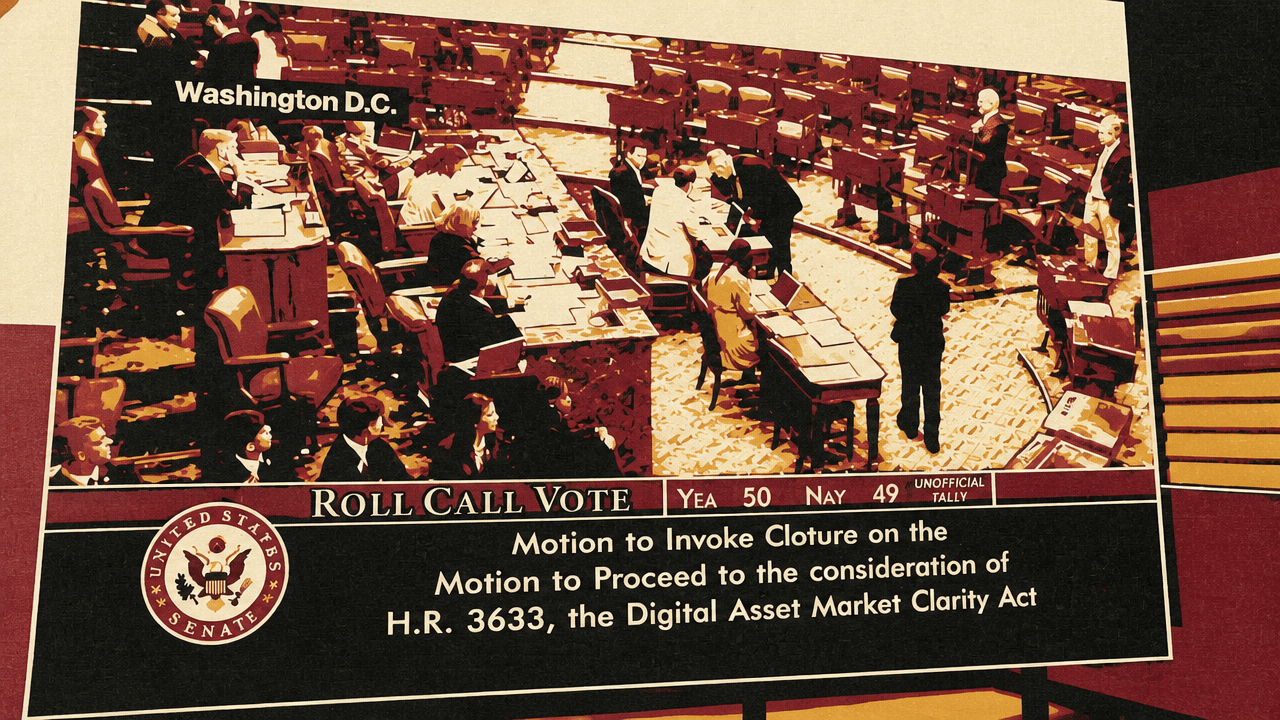
The Senate action halted an effort to proceed to consideration of H.R. 3633, the Digital Asset Market Clarity Act. Ed Ludlow said the measure would have given the CFTC primary authority over regulation of the digital-assets industry. Bloomberg’s Senate-floor display labeled the vote as a motion to invoke cloture on the motion to proceed, showing an unofficial tally of 50 yeas and 49 nays. Ludlow described the bill as failing to advance by 49 votes to 50.


Mersinger argued that the outcome leaves a legislative path open rather than closing it. Because this was a procedural step, she said, the bill could potentially return to the floor. Setbacks of that kind are routine in congressional work, particularly for legislation attempting to establish a broad framework for an industry.
Legislation is rarely a linear process. You’re always going to have two steps forward, you know, three steps back.
That does not make the bill optional for the industry. Mersinger said the industry wanted the Clarity Act enacted and still does. Bloomberg displayed Blockchain Association members including a16zcrypto, FalconX, Ava Labs, Kraken, Coinbase, Chainalysis, Grayscale, and Circle; asked whether those members wanted the bill passed, she answered yes.
Her urgency centered on protections that she said were intended to be included in the legislation but are not yet in place. The association will therefore work with regulators now, rather than allow the absence of a statute to become an excuse for inaction. Mersinger cited the need to avoid another FTX-type failure and argued that Congress should not be writing rules only after a crisis has forced its hand.
We need to make sure that we don’t have another FTX situation. You never want Congress to legislate in a crisis.
The position is not that agencies cannot construct a framework. Mersinger said the SEC and CFTC have already been working on ways to do so, and she expressed confidence that they are moving in the right direction. The remaining question is whether regulatory action can offer the lasting certainty that the industry seeks from Congress.
Markets reacted to the gap between rulemaking and statutory certainty
The distinction between an agency framework and a statutory one was central to the negative market reaction displayed alongside the Senate vote. Bloomberg’s intraday panel showed declines in Bitcoin, the Bloomberg Galaxy Crypto Index, Coinbase, and MicroStrategy under the headline “US Senate Blocks Landmark Crypto Bill.” A separate Bitcoin panel carried the headline “Clarity Act Fails Procedural Hurdle in Senate.”
Mersinger’s explanation was durability. Regulators can write rules without the bill, but a framework created solely through the regulatory process is less secure across changes in administration than one placed in law. That is why the possibility of SEC and CFTC action did not, in her view, eliminate the significance of the Senate setback.
I think anytime you are dealing with just using the regulatory process versus having something in law, it’s a little bit less durable.
Ludlow put the tension directly: if the SEC and CFTC would be responsible for making rules either way, why would markets treat the failed procedural vote as negative? The answer Mersinger offered was not that rulemaking is inadequate. It is that rulemaking and legislation provide different kinds of assurance. Agencies may develop the needed framework, she said, but it is harder to know how well that framework will endure through future administrations.
For the Blockchain Association, then, the immediate task is dual-track. Regulatory work can begin to fill protection gaps and establish operating rules. Legislation remains the preferred route to assigning authority and making that framework more durable. The market declines shown by Bloomberg reflected the value investors placed on that second element: not simply rules, but rules backed by statute.