Chip Stocks Fall as Data-Center Construction Threatens to Slow Growth


Bloomberg’s Ian King argues that the chip selloff reflects doubts not only about demand, but about whether the infrastructure to support it can be built fast enough. Power, land, construction and approvals could slow data-center expansion, while a shift in the political landscape may add further delays. King said the market is reassessing expectations for the pace of growth, rather than treating the declines as proof that demand has collapsed.
The bottleneck may be building data centers, not making chips
Chipmakers are selling off as investors reassess whether the infrastructure needed to use their products can be built quickly enough. Ian King told Ed Ludlow that the industry had already flagged a practical limit: it may not be able to build enough data centers fast enough to house the chips being produced. Power, construction, land and approvals are all constraints.


King said a change in the political landscape could make those hurdles more difficult and slow the buildout further. The market had been pricing in rapid growth at the pace of the chip industry; now investors are confronting the possibility that the physical process of turning demand into operating data centers cannot keep up.
The concern is about the speed of delivery, not simply the number of chips companies can make. Even if demand remains strong, facilities need power and land, must be built, and require approval. King said these obstacles were already on investors’ minds; the political change raises the prospect that the process could take longer. He described the market’s shift as a pause in expectations that the industry could move as fast as it wanted.
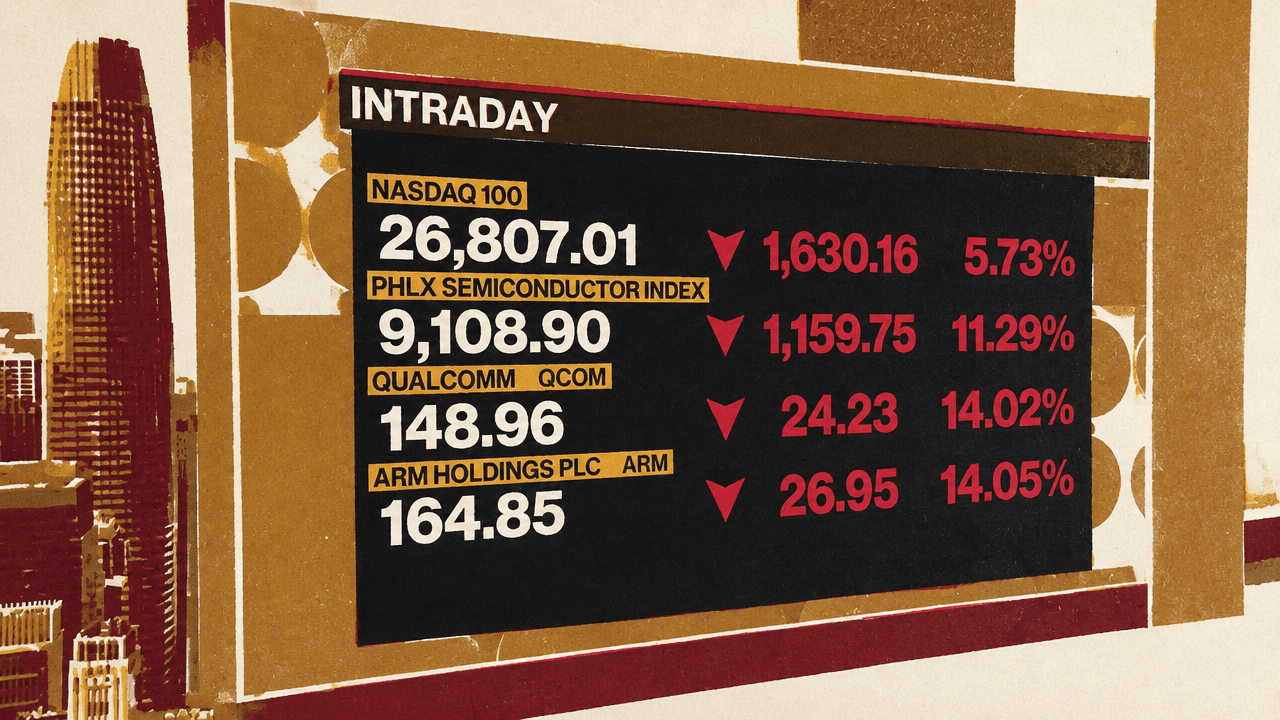
The declines shown on screen were broad. The PHLX Semiconductor Index was down about 11% intraday, while the Nasdaq 100 was down about 5.7%. Nvidia shares had fallen as much as 7% at one point, according to Bloomberg’s description. Qualcomm and Arm were each down around 14% on the screen after their earnings reports.
The cycle is familiar; the buildout constraint is less so
King did not claim to know where the industry is in its cycle. He pointed instead to a recurring feature of semiconductors: over decades, supply and demand have repeatedly fallen out of balance. Nvidia chief executive Jensen Huang and AMD chief executive Lisa Su have both acknowledged that demand and supply will eventually move in a different direction, King said.
What makes the current moment less familiar is the strength of demand and how long it might last. King’s concern was that the question is no longer only whether chip demand will eventually cool. Other constraints could make it harder to deliver the buildout that current demand depends on. A shift in the political landscape, alongside existing difficulties with power, land, construction and approvals, adds uncertainty about the speed of that process.
That distinction matters to the way King described the selloff. He did not frame it as proof that demand has already collapsed or that the cycle has turned. Rather, investors appear to be reconsidering whether the industry can move as quickly as they had expected. A cyclical mismatch between supply and demand is a longstanding feature of the business; the added doubt now is whether the infrastructure required to support demand can be brought online on the expected timetable.
Qualcomm’s transition is squeezing margins
Qualcomm’s weakness has a separate explanation within the broader sector move. King said the stock had struggled this year even during periods when chip stocks were up 60% or 70%. The company is in transition: its smartphone business, which supported it for years, is not currently a growth market, while supply-chain issues are also holding it back.
Qualcomm is trying to expand into automotive and networking chips, but King emphasized that those businesses take time to develop. In the meantime, the transition is squeezing margins—the issue he said investors were reacting to after the latest earnings report. The challenge, in King’s account, is therefore not just a weak day for the sector: Qualcomm is managing a shift away from dependence on a smartphone market that is not currently growing, while its prospective areas of expansion take time to build.
On screen, Qualcomm shares were down about 14% intraday. Arm was down by a similar amount after its earnings report, and AMD was down about 16%. Those moves came alongside the wider decline in semiconductor stocks, but King’s explanation for Qualcomm was specific to the company’s business mix and the costs of its transition.
The two pressures are distinct: uncertainty about how quickly data-center capacity can be built bears on the sector’s expected pace of growth, while Qualcomm faces a company-specific transition that is already squeezing margins.