Tech Selloff Exposes a Divide Between Apple and AI Infrastructure Borrowers


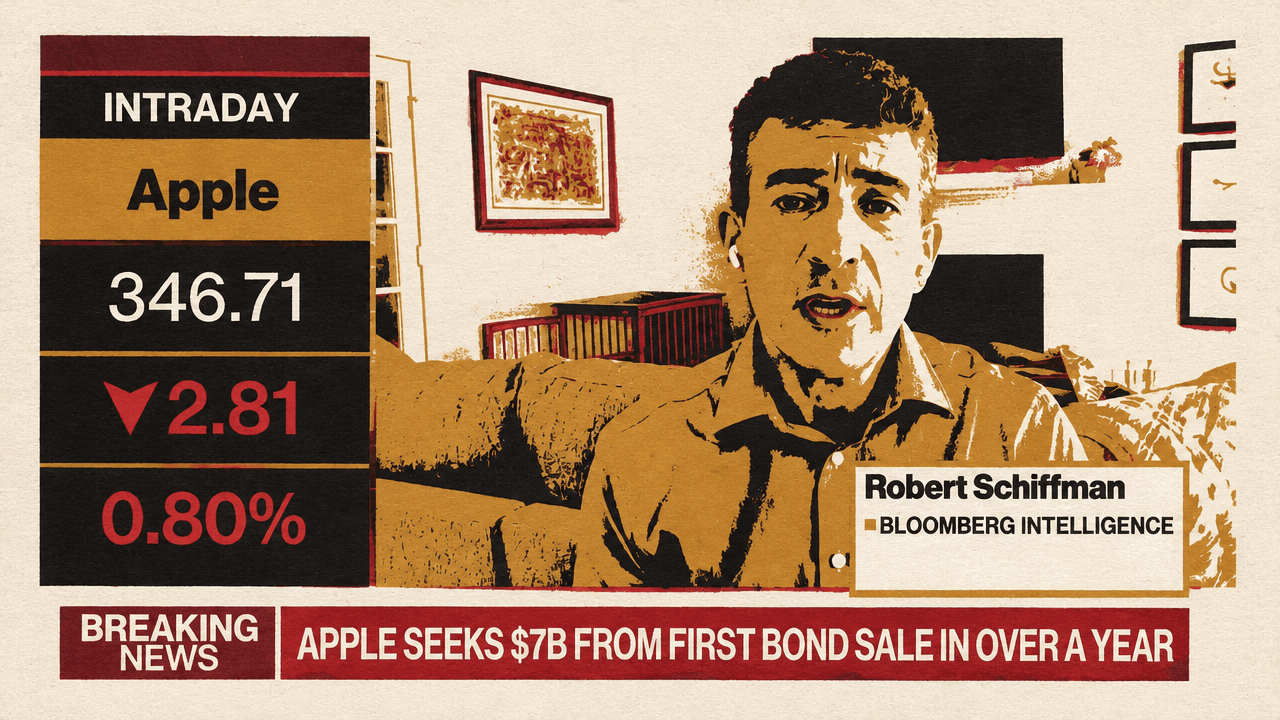
Apple’s planned $7 billion bond sale is less a response to a cash need than a way to borrow cheaply and fund share buybacks, Bloomberg Intelligence credit analyst Robert Schiffman argues. As technology shares fall amid investor concerns about the debt and spending behind the AI buildout, he says Apple’s strong credit standing sets it apart: credit markets are signaling concern about when cash flows arrive, not whether borrowers will ultimately receive them.
Apple can borrow to return cash, while peers fund a more capital-intensive race
Apple plans to raise about $7 billion in its first investment-grade bond sale in more than a year, with proceeds helping fund share buybacks. Bloomberg Intelligence senior credit analyst Robert Schiffman described the move as opportunistic rather than funding-driven: Apple can borrow on favorable terms and direct more capital to shareholders.


Schiffman pointed to Apple’s all-time-high stock price, roughly $5 trillion market capitalization, AAA rating and bond spreads tighter than those of its peers. The proposed borrowing, he said, is not like a neocloud seeking financing at a 17% yield. Apple could borrow for 10 years at around 5.5%, in the “belly” of the yield curve. With Treasuries rallying, he said, the timing gives Apple an opportunity to lower its weighted average cost of capital while funding buybacks and supporting shareholders, without damaging bondholders.
That rationale reflects a difference in capital priorities. A Bloomberg Intelligence note shown on screen described shareholder returns as a greater priority for Apple than the massive AI-infrastructure spending confronting hyperscaler peers. That is the note’s contrast between Apple’s capital priorities and the spending demands it attributes to hyperscalers—not a claim that Apple has no investment needs.
Apple’s capacity to return cash is central to the case. Schiffman said Bloomberg Intelligence expects the company to generate $150 billion in free cash flow in fiscal 2027. He saw little prospect of major merger-and-acquisition spending and said Apple had recently dropped its net-cash-neutral balance-sheet target under a new CFO. In his view, removing that target gives the company more latitude to repurchase stock and potentially raise its dividend. The bond sale would add to that flexibility while Apple’s borrowing costs remain comparatively low.
The selloff is separating stronger borrowers from more exposed names
The borrowing plan arrives amid a sharp technology selloff. Tim Stenovec noted that Apple had been the best-performing member of the Magnificent Seven so far that year and was down only about 0.8% on a day when the Nasdaq Composite had fallen more than 4% and the Nasdaq 100 more than 6%. He also cited a roughly 38% decline in the Philadelphia Semiconductor Index from its June high.


A market dashboard shown during the discussion recorded losses across major technology indexes and individual chip, memory and infrastructure names. Its readings show that the pressure extended beyond the headline indexes to companies exposed to the AI buildout and its financing:
| On-screen dashboard | Decline |
|---|---|
| Nasdaq 100 | 4.89% |
| S&P 500 Information Technology Index | 5.61% |
| PHLX Semiconductor Index | 9.21% |
| Qualcomm | 11.83% |
| Micron | 12.28% |
| Nvidia | 6.95% |
| Broadcom | 6.69% |
Schiffman rejected the idea that the market was signaling an imminent collapse. He attributed the selling to uncertainty, including questions about the effects of a change in Congress. In uncertain markets, he said, investors often sell first and ask questions later; he expected the effects to be less severe than the market appeared to anticipate.
He distinguished delayed cash flows from a failure of demand. Delays in cash coming in could also mean delays in cash going out, he said, potentially helping hyperscalers’ balance sheets in the near term. He considered technology companies rated BBB or higher to be in good shape. He also thought most neocloud companies would still be able to obtain funding, describing their problem as working capital rather than ultimate demand. In his account, some borrowers may face a timing squeeze without losing the underlying customer demand needed to generate cash.
Schiffman called the market one of “haves and have-nots.” Even if many companies can ultimately secure funding, investors may still reduce exposure when it is difficult to judge which names will face delays or tighter financing. He described the day’s broad selling as a moment when it was easier to get lighter and wait for clarity.
Credit markets are not confirming the equity market’s worst reading
For Schiffman, share prices and credit spreads were giving different signals. He said credit spreads, particularly for higher-quality technology companies, were generally flat to slightly tighter even as equity valuations fell. In his view, that contrast points to concern about the timing of cash flows rather than a broad expectation that borrowers will fail to receive them.
This is an equity valuation issue about timing of cash flows, not actually ultimately receiving those cash flows.
Apple’s comparatively strong credit standing and lower borrowing costs help explain why it can approach the bond market to fund shareholder returns while other technology companies are being judged on the cost and timing of their infrastructure spending.